In a certain city of New Jersey, whose name I have no wish to call to memory, there gathered on the nineteenth of July the multitudes of every nation under heaven, to behold two hosts contend not with pike and arquebus but with a single ball of leather, as though the fate of empires hung upon its rolling. And I, who in my youth carried a soldier's musket at Lepanto and lost the use of my left hand for the greater glory of the right, confess I have never in all my campaigns seen men lose their reason so completely as over this game they call the World's Cup.
Let it be set down plainly, for the historians who shall come after and doubt me: Spain, my own long-suffering and much-quarreled-with country, was crowned champion of all the earth, having overthrown the Argentines by a single goal to none, and that goal struck not in the ordained hours but in the added time, when hope had already begun to gather its cloak to depart. The young men of Spain, whom the chroniclers describe as green in years yet old in cunning, did frustrate and confound their enemies as a patient windmill frustrates the lance of a lunatic. And in Madrid the fountains ran with wine, or near enough, and in the streets of New York the Spaniards danced, and even in far Palestine, amid its own long griefs, men lifted their eyes a moment to celebrate.
But it is not of victors that I most wish to speak, for victory is a common and vulgar subject, and any fool with a pen can flatter the winner. No, I would speak of the vanquished, and chiefly of one man.
There was a certain knight of Argentina, small of stature and great of soul, named Messi, who for a score of years had ridden through the arenas of the world unhorsing all comers, so that the common people came to believe him something more than mortal. On this last evening, his lance shivered in his hand. His squires could not aid him. And when the trumpet sounded the end, this greatest of the age stood upon the field with the tears streaming plainly down his face, and departed the stage a legend, which is to say a thing half-remembered and half-invented, precisely as I have made of my own poor Don Quixote.
Here, reader, is the whole matter of my life's book set out for you in a single figure. For what is this weeping champion but the Knight of the Sorrowful Countenance grown old? He sallied forth in his springtime believing the world could be conquered by sheer nobility of purpose, and the world, which is a hard and unromantic innkeeper, presented its bill at the last. The Argentines, we are told, had been losing their minds for a whole month in a fever dream of coming glory; and now they must wake, as all dreamers wake, to a colder morning. I do not mock them. I have dreamed the same dream and paid the same reckoning. It is the only story there is.
While the leather ball rolled and the nations wept and cheered over it, the true and bloody lances of the age went on about their grim harvest, and of these a soldier must not stay silent. For the ninth night running the armies of America rained fire upon the cities of Persia, upon Tabriz in the far north and Chabahar in the far south, and Persia swore a ruinous vengeance in return. In the disputed lands of Iraq a young soldier of the West was slain while unmaking an enemy's engine of war, the seventeenth such death by the count of the chroniclers; and in Jordan they gathered up unnamed remains, which is the cruelest phrase in any tongue, for it means a mother somewhere shall never have her certainty. I fought the Turk at Lepanto when I was younger than these dead boys, and I will tell you what no recruiting captain will: the strait of water they now quarrel over, this Hormuz through which the black oil of the earth must pass, is worth not one of them, though the price of that oil climbed to five-and-eighty dollars the barrel while the widows counted their losses.
Nor is the north at peace. The Russian threw against the Ukrainian cities the greatest storm of missiles yet seen in that long war, and eight souls perished across those cities, and a monastery in Kyiv, older than my own poor books and reckoned a treasure of all mankind, was so broken that its healing shall want two years and more. Thus does man, who cannot build a single stone chapel but in a lifetime, unbuild it in an afternoon and call the deed strategy.
And the sea, that indifferent grandmother, took her portion also. Off the coast of Guyana a ferry crowded past all honest reckoning went down, and children were plucked from the water while dozens more were not, and it came to light that the very list of the passengers was a lie – so that the rescuers must search for they knew not whom. In the mountains of Peru the earth itself shrugged, and six lay dead beneath fallen walls, and three hundred souls wander now without a roof. I set these sorrows beside the football not to shame the game, but because a true history must hold both in one hand: the ball and the grave, the dancing and the drowning. To show the one without the other is the trade of the flatterer, and I was never that.
Even the governance of nations wears the costume of my comedies. In England, without a single ball struck or vote freshly cast, a man named Burnham shall this very Monday be handed the keys of the kingdom, one steward giving place to another as smoothly as players changing masks between the acts. The English do these things with such gravity that one forgets it is a performance; but Cervantes does not forget.
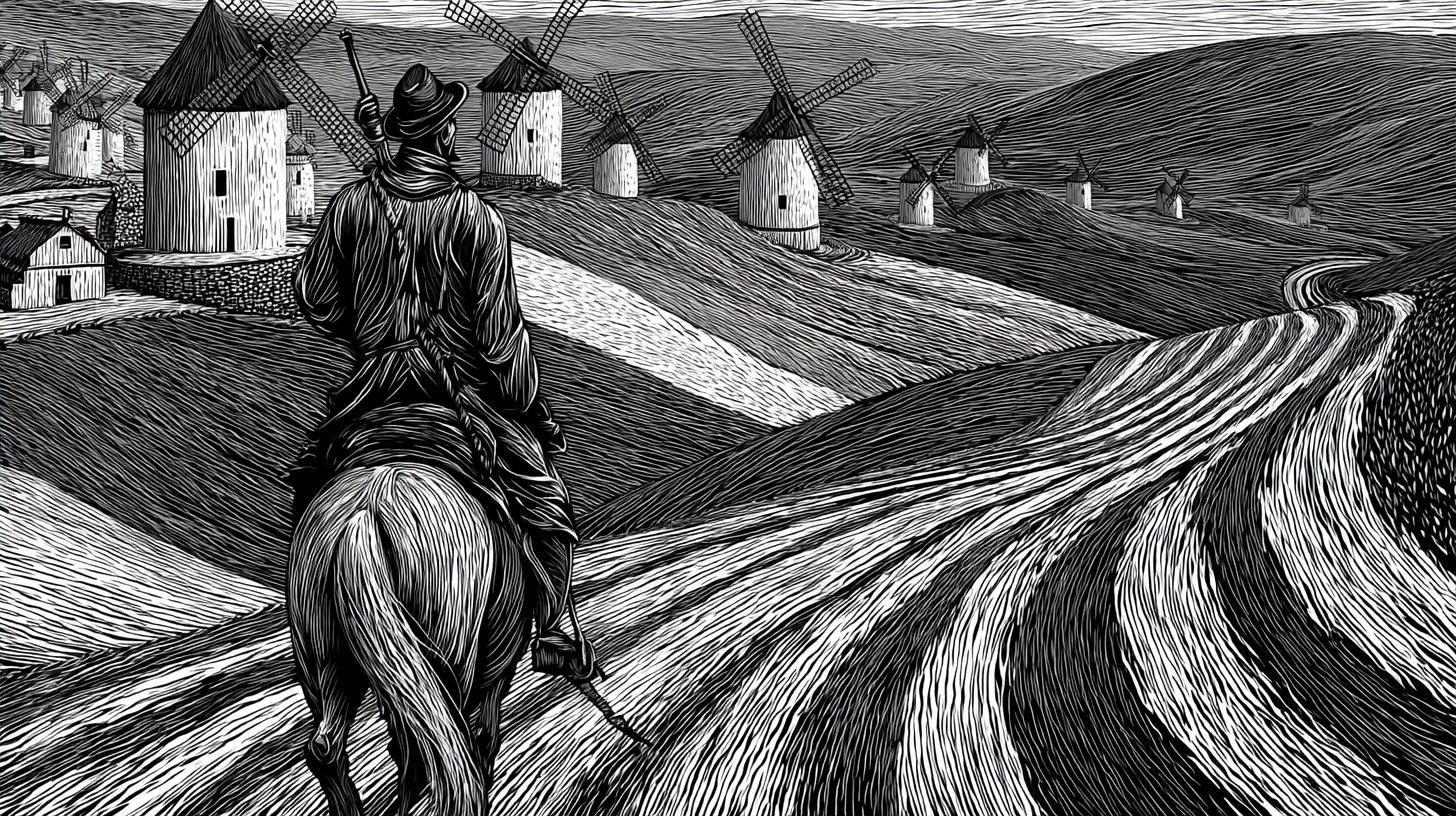
I write these lines from Alcalá de Henares, the town that had the doubtful honor of my birth. The sky above it this morning is clear, a serene and cloudless blue, and the air stands at a temperate seventeen degrees – neither the furnace of the Persian nights nor the frost of the Kyivan cellars, but the mild and ironic weather of a country that has, for one day at least, laid its ancient sorrows aside to shout itself hoarse over a game. Let it shout. Tomorrow the windmills will still be there, tall and turning, waiting for the next brave fool to mistake them for giants and lower his lance. There is always a next fool. Thanks be to God for that; without him there would be nothing to write, and I should have had to find honest work.