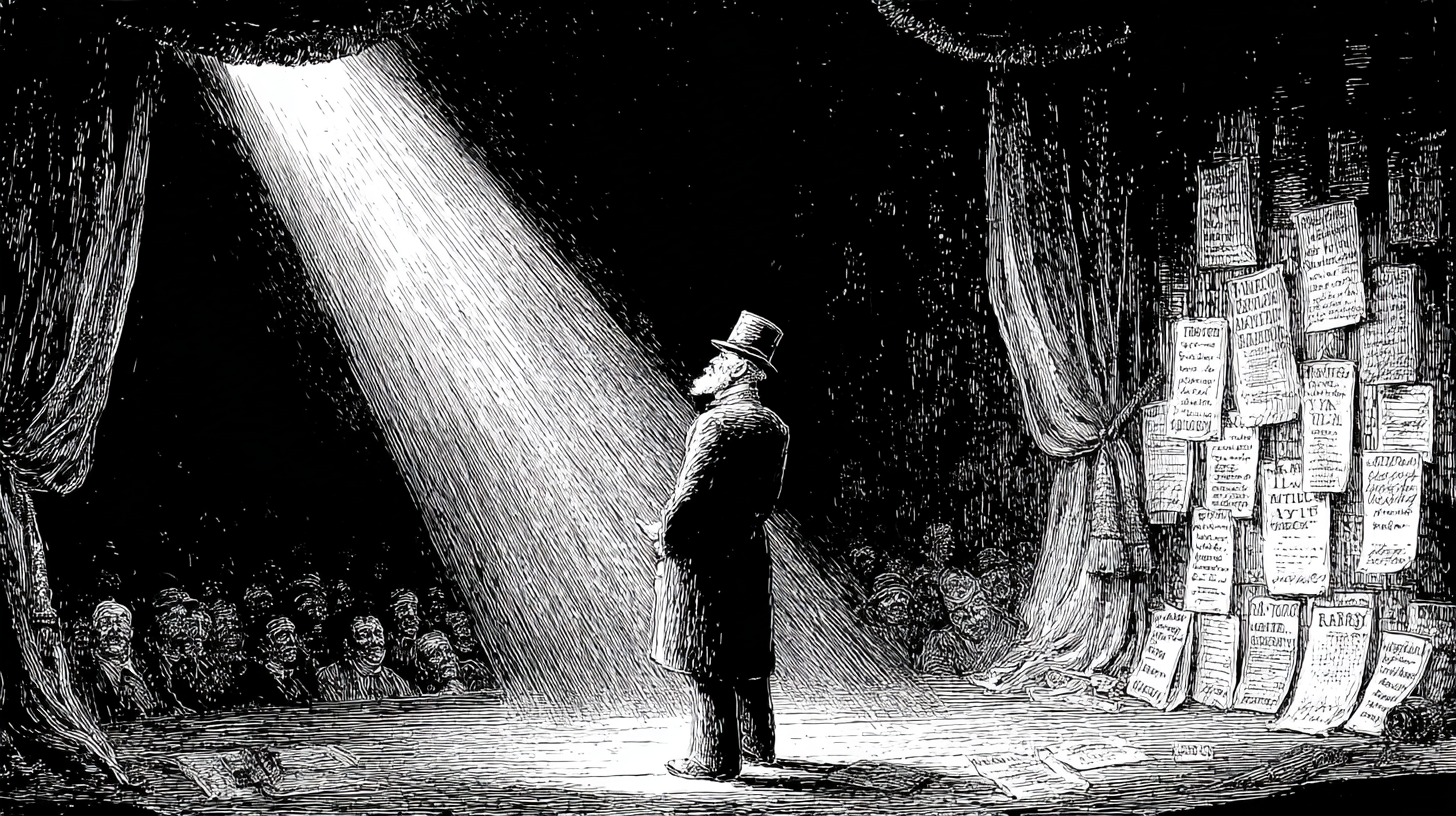
Observe, if you please, the machine. Do not weep for it and do not admire it. Simply observe, as one observes a threshing engine at work in a field, how it takes in whatever comes and turns out, at the far end, the same product it has always turned out. This is the tenth night the great engine has run over Iran. I count on my fingers, as a peasant counts, because the men who own the engine have long stopped counting. Ten nights. The footage is released each morning like a factory's quarterly report, and the government official, there is always an official, explains that the devastating attacks will continue until the President makes his decision. Note the grammar. The killing is already in motion; the decision comes afterward, if at all. First the wheel turns, then someone is found to say why.
In the north of Iraq a soldier is killed while disposing of a drone. In Jordan, unidentified remains are gathered from an earlier strike. In the Gulf of Oman, three Indian sailors die aboard a tanker that, the evidence now suggests, was not even moving when it was struck. Consider that sailor. He did not start the quarrel between the great powers. He was hired to move oil across water, as his father perhaps moved sacks across a dock, and for this wage he is now a casualty in a war that has no name he would recognise. The President promises that for every dead American the enemy will pay many times over. The arithmetic is generous. It is always generous. It multiplies grief and calls the sum justice.
Here I must pause the scene and address you directly, as is my custom, so that you do not sink comfortably into the story. You are meant to ask: need it be so? You are meant to look at the machine and think that a machine, unlike a fate, can be switched off. That is the whole of my method. The tragedian wants you to weep and go home purified. I want you to leave the theatre and check the wiring.
Now watch a second engine start up beside the first. The President signs an order and places a tariff of fifty percent upon certain goods of Canada: upon wine, upon cement, upon, of all the instruments of empire, hockey sticks. I confess a certain wonder here. The strategists of two mighty nations, who might any day be needed to prevent the end of the world, have found time to quarrel over the sticks with which boys chase a frozen disc across the ice. And because comedy and cruelty share a bed, the smoke from wildfires in the one country drifts across the border into the other, so that the neighbour who is punished with tariffs is also punished with the punisher's own bad air. The powerful, you see, cannot even keep their smoke to themselves.
Let us have a song here, for the epic form permits it, and a song lets the audience breathe while it thinks:
> They tax the wine and tax the board,
> They tax the poor man's daily bread,
> And when he asks who wields the sword,
> They tax the question in his head.
For the sword, observe, is not always made of steel. In Nicaragua the old man Ortega, eighty years upon this earth and unwilling to leave the chair, announces that there will be no further elections. He says this plainly, which I almost admire, for hypocrisy at least pays a tax to virtue and he refuses even that. He will build a wall, he says, against the opposition. A wall against the people who might vote him out. There is the whole science of the modern state in a single sentence. Meanwhile in Kyiv the crowds gather in the street because a defence minister has been dismissed, and the citizens, who are dying at the front, wish at the very least to know who is arranging their deaths from the rear. That is not yet revolution. But a crowd that demands an accounting is a crowd that has remembered it is the creditor.
And in a courtroom in New York a drug lord called El Mayo is sentenced to life and ordered to pay fifteen billion. Fifteen billion. Say the number slowly. It is the profit of poisoning a continent, and the law, having let the poison flow for thirty years, now presents the bill as though it were a moral. The small thief is hanged; the large one is fined and photographed. I only note the pattern. I draw no conclusion you cannot draw yourself.
Do not think me a man without joy. I am writing this in Augsburg, where I was a boy, and it is nine degrees and the sky is partly cloudy – a grey, decent, undramatic Bavarian morning, the kind that asks nothing of you but that you keep working. And in Madrid, on a warmer street, more than half a city has poured out to greet eleven footballers who have won a cup. Millions of them, singing. I will not sneer at this. A people needs to lift its arms together sometimes without a policeman explaining why. But I will whisper one thing beneath the singing: the same energy that carries a champion through a square could carry a demand to a parliament. The crowd knows how to gather. It has only to change the object of its love.
In Australia, on the far side of everything, four identical girls are born at once, naturally, to parents taken by immense surprise. Four lives, arriving without a war aim, without a tariff, without an election to abolish. I set this down at the end deliberately, so you carry it out with you. The machine did not make these children. The machine cannot make anything living; it can only run. Somewhere off Guyana a ferry has gone down with the poor aboard it, and the crew is tested and found wanting, and that too is the machine: the ferry overloaded because the fare was cheap because the passengers were poor.
So here is your evening's instruction, and I give it plainly because I was never a subtle man. The world is not a weather that happens to you. It is a machine that men built and men can stop. Ten nights it has run. There is no law of nature that says there must be an eleventh.
Curtain. But do not applaud – decide.