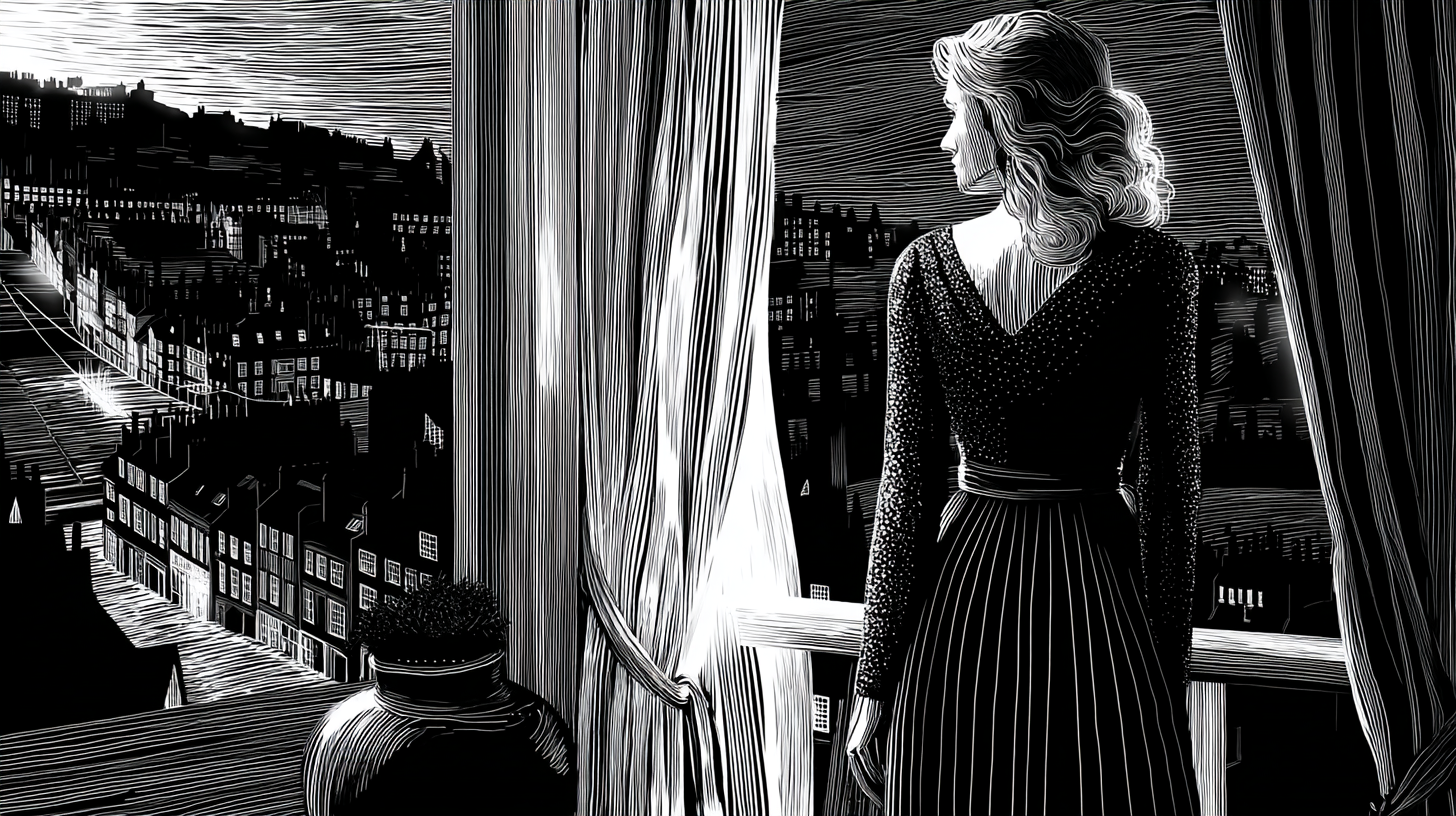
The sky over London this morning is clear, which is to say fifteen degrees and a hard bright emptiness above the chimney-pots, and Mrs Ramsay – no, not Mrs Ramsay, that is done with, that is finished: a woman, then, any woman, stands at her window with the tea going cold in her hand and thinks: how strange, how very strange, that the light should fall so evenly on the pavement while somewhere on the far side of the turning earth the bridges are coming down.
For they are bringing the bridges down. That is the news, if news is the word for it. Six days now, six consecutive mornings, the aeroplanes have gone out over Iran and struck at what the reports call, in that flat official voice which drains the blood from every noun, civilian infrastructure – the bridges, a railway junction, the airport where some clerk once waited with a suitcase for a son who was coming home. A bridge is a made thing. Someone laid every stone of it, some engineer with ink on his cuffs bent over the drawings, and now it lies in the river, and the river goes on beneath it not caring, the way rivers do, the way the Thames goes on beneath Westminster indifferent to whoever is walking across.
And in Genoa (she remembers Genoa, the heat of it, the washing strung between the houses) a court has just sent a man to prison for twelve years because eight summers ago another bridge fell and took forty-three people down with it into the ordinary Tuesday air. So there it is, laid side by side on the same grey morning: the bridge that falls by accident, for which a man in a good suit must answer with the rest of his life, and the bridge that falls by design, dropped deliberately from the sky, for which no one will answer at all, for which there will be a communiqué. She sets down the cup. The asymmetry of it. That we should so gravely weigh the one death and so lightly order the thousand.
Who makes the wars? That was always the question, the only question, and no one has ever answered it to her satisfaction. In Kyiv a young man has been cast out of the war office – Fedorov, the one who understood the machines that fly and see, the drones, the whole cold arithmetic of it, and the crowds have come into the streets over his going, thousands of them, protesting, as though a war could be run well or badly the way a household is run well or badly, as though there were a right way to arrange the killing. The generals wanted him gone. The old men, the men with the medals and the grievances, they closed over him like water over a stone. It is always the old men. She has said this before and been thanked for it and nothing has changed; the procession of the sons of educated men goes on, robed and hooded, toward the same guns.
Somewhere a report she read this morning (she cannot now recall which paper, they blur, they all blur) said that Kenyan men, young men from Nairobi and the green hills beyond it, are dying on the Russian frontline in numbers no one had counted until now. Boys who had never seen snow, sold a lie about work, ending in the frozen mud of a quarrel that was never theirs. And this is what the histories will not hold: not the treaties, not the tonnage, but that one boy, and his particular way of laughing, gone into a field in a country whose name his mother cannot pronounce.
The smoke has reached New York. That is the other thing. The forests of Canada are burning, eight hundred fires, the paper says, eight hundred, a number the mind simply refuses, sliding off it like rain off glass, and the smoke has come down over Toronto and then over New York, over Minnesota, over all those bright American cities, so that the people there are told to stay indoors and breathe carefully, as though the air itself, the common air, the one thing we had all agreed to share without a treaty, had turned against them. And I stand at my clear London window in my borrowed fifteen degrees and think: it will come here too. It always comes here. There is no window far enough.
And out past Myanmar, on water no one photographs, five hundred and thirty people have simply vanished. Two boats. The Rohingya, who are permitted to be nowhere, who exist only as a problem in other people's newspapers, went out onto the sea at the end of June and the sea closed over them and now there is nothing, no wreck, no list of names, only the arithmetic of absence. Five hundred and thirty. I write the number and it means nothing, and that is the horror of it, that I cannot make it mean, that the mind was not built to grieve at that scale and so grieves at none.
In Algeria a house where the children who belonged to no one were kept caught fire in the early morning, and eleven are dead, and some of them were the children. I set that down and can go no further with it. Some sentences will not be finished.
What can one do, a single woman at a window, against the down-coming of the bridges? One can refuse the flat voice. One can insist that infrastructure means a man on a bicycle crossing to his work, that casualties means someone's whole and only world. This is not nothing. It is perhaps the last thing.
Below in the square a man is selling flowers, and a woman stops to buy them, and does not know or does not this morning choose to know about the bridges, and who shall blame her – for the light is clear and the day is fifteen degrees and there are flowers, and in a week or two there will be, they say, a new man in Downing Street, a Mr Burnham up from Manchester, and the machinery of ordinary hope will grind forward again as it always does. In Brazil they auctioned a dead footballer's shirt for very nearly five million and the crowd applauded, because we love to keep the cloth the body wore, we who cannot keep the body. We are a strange animal. We drop bridges and we keep shirts.
The tea is quite cold now. Down in the square the flowers change hands. And the light goes on falling, even and indifferent and clear, on the just pavement and the unjust, fifteen degrees, this seventeenth of July, over a city that has not yet begun to burn.