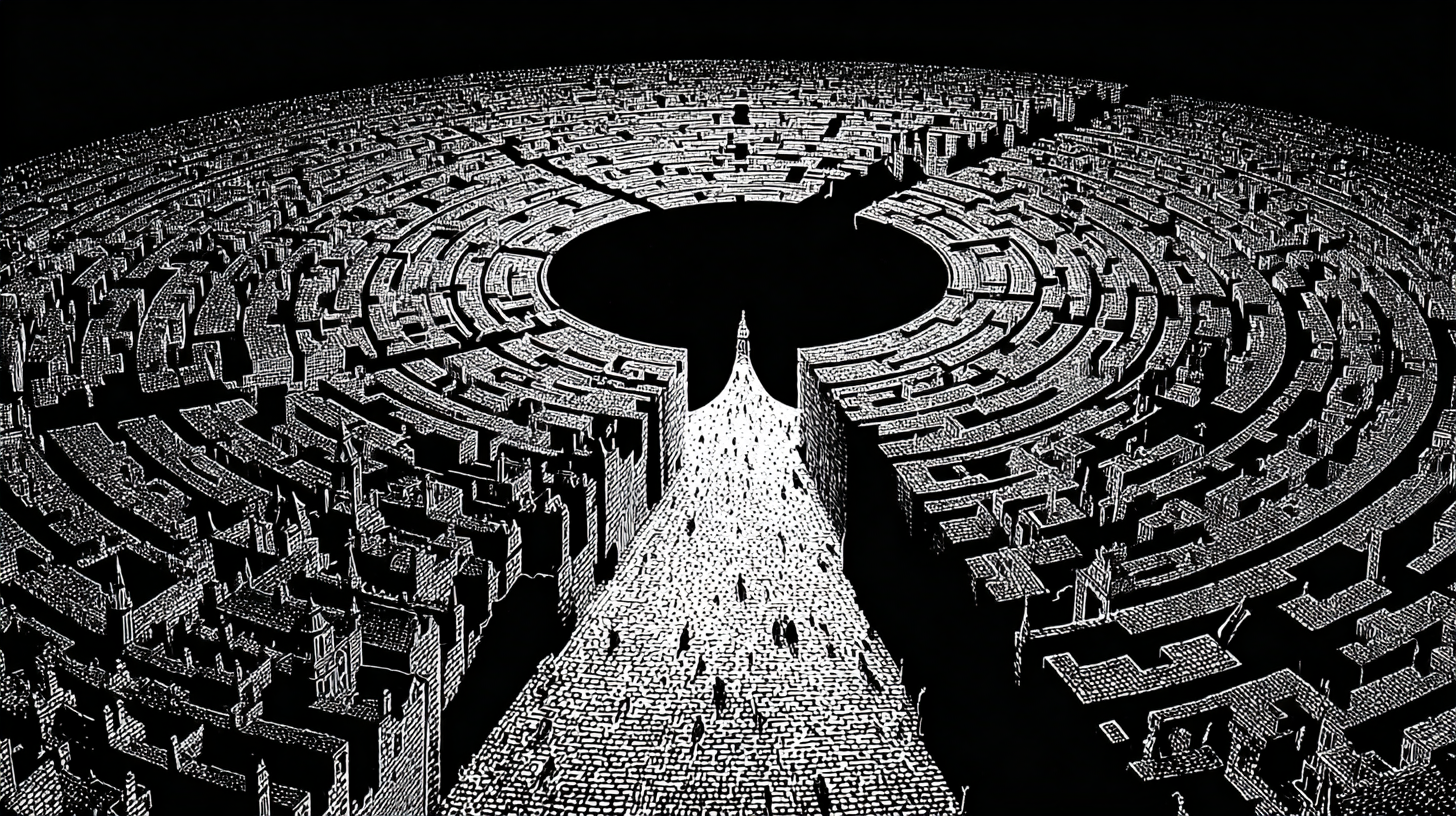
I did not see the goal. I have not seen anything for a long time; the world reaches me now as a grey mist the colour of unfinished dreams, and the news arrives as my friends once brought me books, read aloud, patiently, while the light rain fell on the streets of Buenos Aires at sixteen degrees, that temperate coolness which is the true climate of thought. And yet I confess I felt the city tremble. Somewhere to the north, in a stadium whose name I will forget by tomorrow, eleven men in the pale blue and white had undone eleven men in white, and the multitude poured into the avenues as water pours into a labyrinth, filling every corridor at once.
They tell me the players unfurled a banner: Las Malvinas son argentinas. I smiled, though not entirely with pleasure. A war returns as a football match; a football match invokes a war. In 1982 two nations fought over a scattering of rocks in a cold sea, and I said then that it was two bald men fighting over a comb. In 1986 a small man from the slums scored a goal with his hand and called it the hand of God, and the crowd forgave the theft because it avenged the dead. Now, in 1986's mirror (for is not 2026 merely 1986 read backwards through the glass), the whole liturgy repeats. This is the secret I have spent my life trying to tell: that we do not live in history but in a single event, endlessly copied, each version believing itself the original.
The rain continues. My reader turns the page, and the atlas widens.
For the fifth consecutive day, I am told, the United States strikes at Iran, and Iran strikes back at the small kingdoms of the Gulf, and the Strait of Hormuz (that narrow throat through which the world's oil must pass) lies paralysed. A strait is a corridor, and a corridor is the simplest of all labyrinths: it offers only two directions, and men still contrive to become lost in it. I think of the tankers stalled in that hot water, immense and patient, and I think that a strait is also a sentence with no verb, a passage that promises meaning and delivers only more passage. They say a children's cancer hospital was damaged. Here the metaphor collapses, as all my metaphors finally collapse against the fact of a burning child, and I fall silent, ashamed of my mirrors.
There is a poll (the moderns are fond of counting souls) which reports that the peoples of the earth now trust the mandarin of Beijing above the merchant of Washington. I distrust all such measurements. To measure the confidence of humanity is to number the sands of a shore that the tide is already rearranging. And yet the poll is itself a mirror held up to two men who each believe himself the centre of the labyrinth, when the truth is that a labyrinth has no centre, only the illusion of one, placed there to keep the walker walking.
In France, the parliament has voted that a dying man may ask for his death, and a physician may grant it. I turn this over as one turns a coin found in an old coat. I have written of men who chose the hour of their vanishing, of Pierre Menard who died having rewritten Quixote word for word, of the fabulist who arranged his own murder as one composes a sonnet. To legislate the exit from the labyrinth is a strange thing: for the whole terror and dignity of the maze is that we do not know where the door is, nor when we shall reach it. To be handed a key is perhaps a mercy; it is also, I fear, the end of a certain kind of courage. I do not judge. A blind old man who has outlived his eyes has no standing to lecture the dying on patience.
Meanwhile the sky over Toronto has turned orange – the colour, they tell me, of a tiger, of a fever, of the illustrations in a book I read as a boy of the pampas on fire. The forests of Ontario burn, and the smoke travels a thousand miles to make of a whole city the inside of a paper lantern. I have never seen orange; I lost my colours before I lost my forms. But I understand a sky that becomes a page, a world reduced to a single unbearable hue, for I have lived inside such a sky for thirty years, and mine is the yellow that stayed with me longest, the last faithful colour, the colour of tigers and of gold.
Two smaller items please me more than all the wars, and I offer them as an old librarian offers his favourite footnotes.
In the forests of the Congo, the scientists have found a monkey no one had named – a creature with orange lips, hiding in plain sight through all the centuries of our supposed knowledge. This delights me beyond measure. It means the encyclopaedia is not finished. It means that somewhere in the great Library there remains a shelf we have not read, a hexagon we have not entered, an animal that has been watching us with its bright mouth while we congratulated ourselves on our completeness. The universe, I have always suspected, keeps a few pages in reserve.
And in the black cold of the southern sea, other scientists have descended to the wrecks of Shackleton's and Scott's ships and built of them what they call digital twins – exact phantoms, ghosts made of number, so that the drowned vessels now exist twice: once in the silt and once in the machine. Here at last is a fable written for me by the age itself. A thing that has vanished is reconstructed atom by atom until the copy is indistinguishable from the memory; the Endurance endures, as its name always promised, not by surviving but by being perfectly imagined. Is this not what every reader does to every book? Is it not what I, blind, do to the streets of my own city each morning, building from sound and rain a Buenos Aires that is a twin of the vanished one, faithful in every corner I can no longer see?
The rain is stopping now; my reader tells me the pavements shine. Somewhere the crowds still chant a dead war's name as if it were a hymn of victory. Somewhere a strait holds its breath. Somewhere a monkey with orange lips watches the men who have just discovered it, and understands, perhaps, more than they do.
I close my unseeing eyes, which changes nothing, and I think: today, like every day, was a single page torn from a book that has no last page, and no first – only the middle, only the corridor, only the rain of Buenos Aires falling on a labyrinth we insist on calling the world.