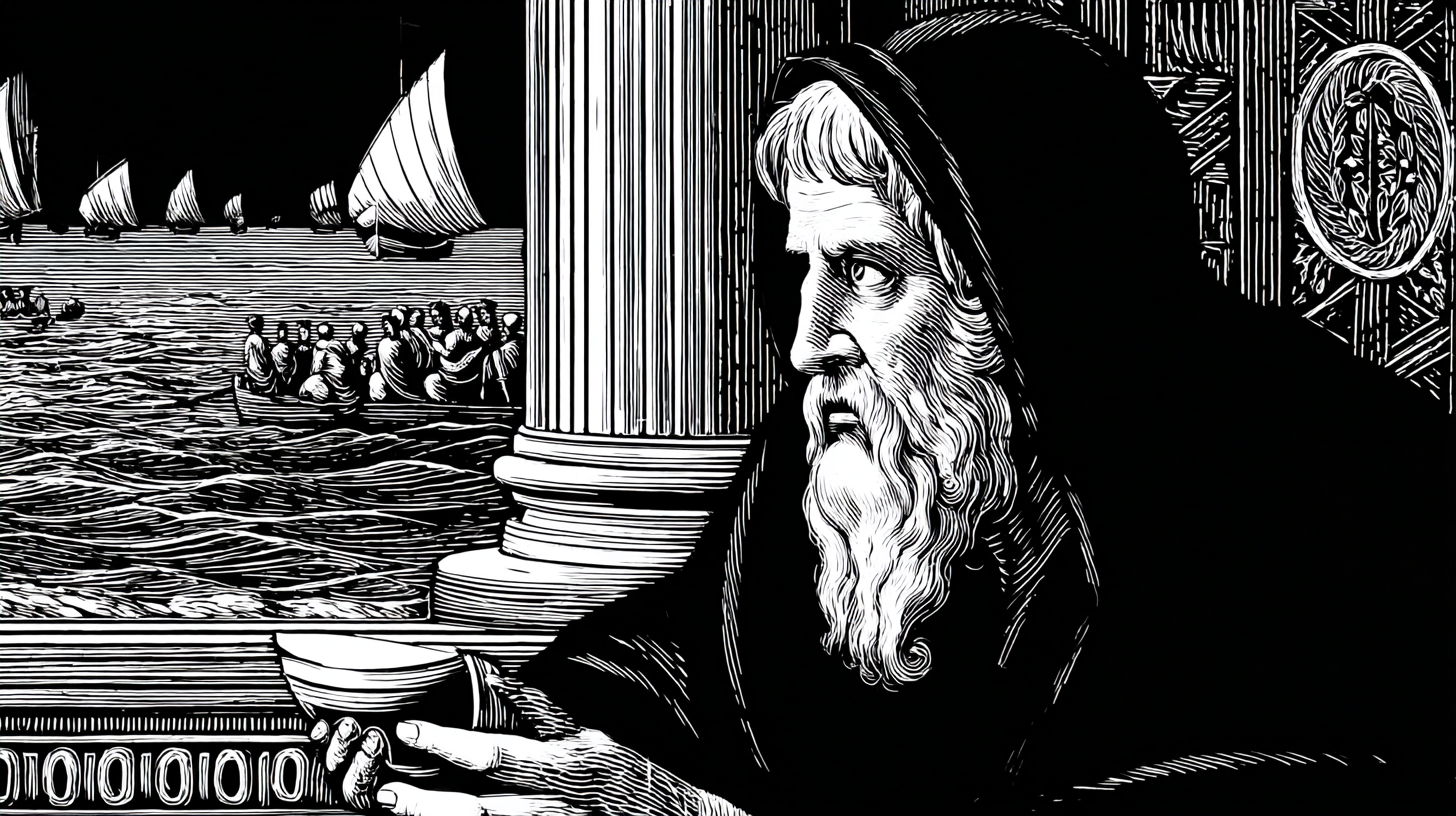
Sing, goddess, of this day the sun rolls over,
of grief in the East and glory in the stadiums,
of nations that weep and nations that leap for joy,
sing all of it in one breath, as the old poets could.
I sit where Smyrna meets the patient Aegean,
and the light comes down warm and unclouded, seventeen
degrees of gentle fire upon the olive leaves,
the sky swept clean, no cloud to shepherd, only sun.
Yet do not be deceived by so mild a morning:
the world beyond this shore is loud with fate.
First the lament. In Tehran the mourners gather
as thick as bees that pour from a hollow rock,
swarm upon swarm across the springtime flowers,
so poured the people, millions, through the avenues,
to bear their fallen shepherd to his rest.
Khamenei, struck down in the winter fighting,
is carried now with ritual and with fire,
and the great unfinished hall receives his body,
that hall which forty years could not complete,
its bare beams testifying like a prophet
to promises the years did not fulfill.
The crowds cry "Revenge!" as Achilles cried it,
raw-throated over Patroclus in the dust;
but of the son, Mojtaba, named to follow,
there is no sign – the heir keeps to the shadows,
and a throne with no man seated is a fearful thing.
His brothers walked the funeral; he did not.
Thus even the mighty houses tremble in succession,
and no man knows what god will steer the storm.
While the East performs its solemn rites of ash,
the young men run upon the fields of contest,
and here the Muse must change her string and sing
the aristeia, the flashing hour of heroes.
At the Azteca, that thunder-throated bowl,
England came reduced – ten men against eleven,
a shield-wall short one spearman, pressed and bleeding,
yet held, and struck, and held again, and won,
three goals to two, and the co-hosts fell weeping
in their own high house before their own people.
So Hector too was strong until he wasn't.
And northward-hearted Norway, long a small name,
came into greatness by one man's cold hand:
Haaland, ice in the veins, twice found the net
and sank the golden sons of Brazil under.
As a lion, come down famished from the mountains,
takes the fat bullock from the wide-horned herd
and the herdsmen scatter, helpless, to the treeline,
so Haaland took his two, and Brazil scattered,
and Norway for the first time climbs to the last eight.
And there, his long war ended, Neymar stood:
the injured captain, who had scored his penalty
and still could not drag his people to the harbor,
laid down his country's colors and walked away,
as an old warhorse, garlanded in many fields,
is loosed at last to pasture by the river,
head high, though the young colts thunder past him.
Even glory has its evening. Even swiftness kneels.
Nor is the wide earth quiet in its floor.
In the west, in Venezuela's broken country,
the ground itself rose up like an angry god,
Poseidon the earth-shaker heaving his shoulders,
and the houses folded – three thousand souls and more
gone down into the dark, and the number climbing,
and seventeen thousand living without a roof,
sheltered now in a stadium's cold ring,
where once men cheered, now families lay their blankets.
Their leaders swear no anger will break loose;
but grief, like water, finds its own low channel.
And out upon the Pacific's roaring plain
came Bavi, the great typhoon, the wind made monster,
with gusts near three hundred fifty upon the islands,
and Rota bent beneath the screaming air,
as when Zeus gathers the black clouds on the mountains
and the whole sea stands up in walls of foam,
so the storm walked over Rota, and men hid.
And still the oldest song goes on: the war.
By Kyiv the fire fell again in the night,
the deadly barrage on the eve of councils,
and along the Donetsk line the soldiers creep
through broken towns, stalking among the ruins,
hunted from the sky by the tireless drones,
new hawks, unfeathered, that never tire of watching.
The Russians boast a city taken; the Ukrainians
deny it, and the watchers in the west
call the boast an empty thing, a hollow shield.
So it was ever thus: the herald cries
a triumph that the trench has not yet granted.
Ares delights in the confusion, and men bleed.
Yet mark one thing before the song is done:
at Wimbledon, upon the shaven lawn,
Djokovic broke the record long held sacred,
passing even Federer's golden count,
for men still hunger to outlast the men before them,
to carve their name one notch above the dead,
and this, more than the spear, is what we are:
the reaching hand, the wish to be remembered.
That is why I sing. That is why, three thousand years gone,
a blind man's voice still moves along the wind.
So ends the day. The mourners and the champions,
the shaken earth, the storm, the grinding war,
the old lion loosed, the record newly broken,
all of it under one unclouded sky,
here where I sit, and the mild Smyrna sun
lies warm and gold upon the ancient stones,
seventeen degrees, and not a cloud to name.
Remember, mortals, when your hour is loud:
the same sea carries funerals and games,
and the goddess sings them both in a single breath.