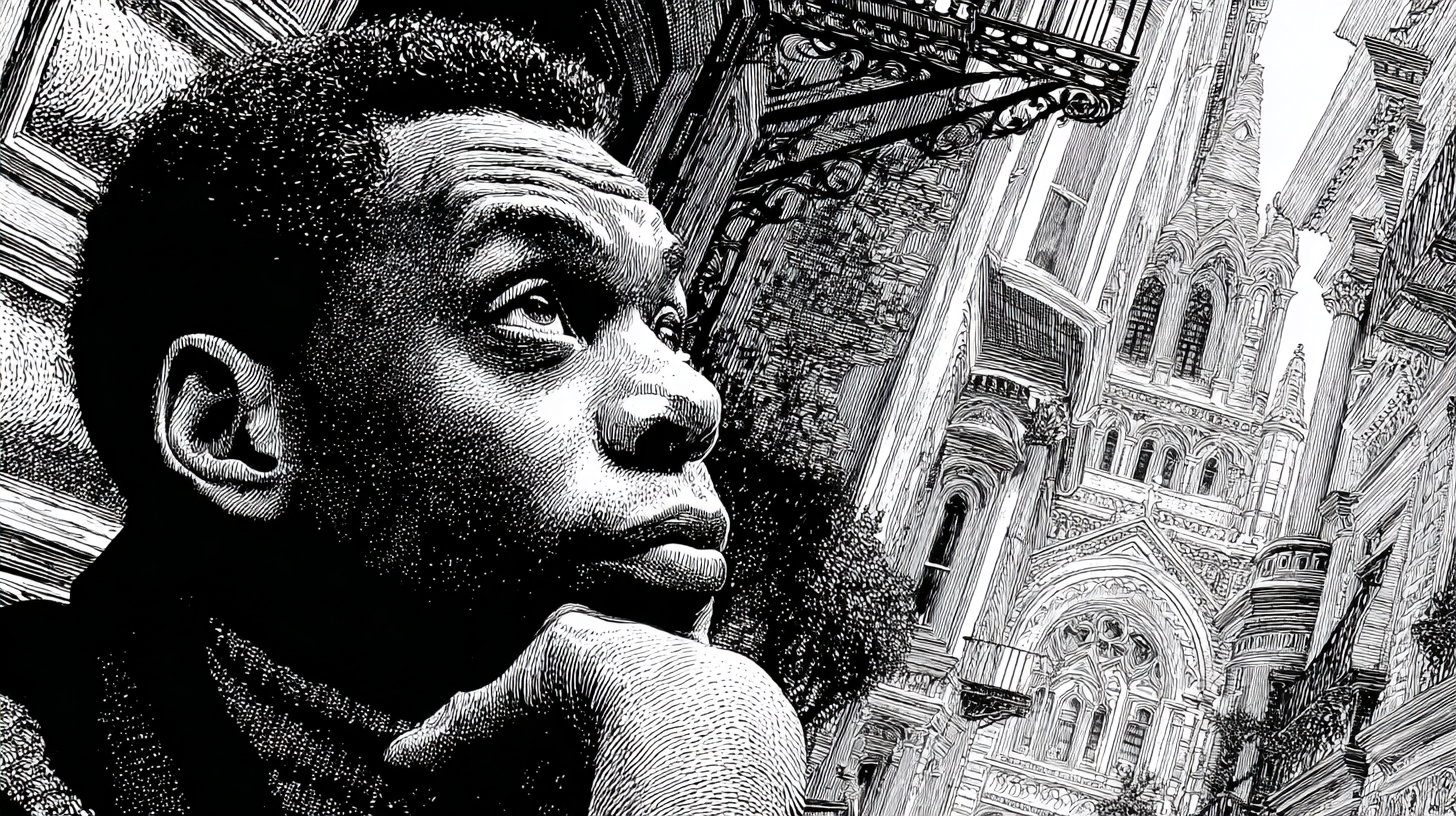
The rain came down over Harlem last night as though the sky itself had grown weary of pretending. It is still falling as I write this, heavy and unhurried, twenty-four degrees and gray, drumming on the fire escapes and pooling in the gutters of the only streets that ever taught me who I was. I have known this rain all my life. It does not discriminate. It falls on the just and the unjust, on the celebrant and the mourner, on the flags hung out for the anniversary and on the men who marched beneath other banners, and it asks none of them for their papers.
Two hundred and fifty years. The number has a weight to it, and last night, across the river, they tried to answer that weight with fire of their own – fireworks over the New York skyline, a quarter-millennium of independence written in gunpowder and light. I watched from my window as the sky bloomed red and gold and fell dark again, and I thought, as I have thought all my life, that there is no people on earth so gifted at the celebration of an idea they have not yet consented to live by.
For I love this country more than any other in the world, and exactly for this reason I insist on the right to criticize her perpetually. That is not a contradiction. That is the whole of it. A man who loves cannot look away. And so I will not look away from what this birthday has shown us, even as the trumpets sound in Washington and the President rises to speak of freedom.
He spoke of communists. He spoke, they tell me, of breaking his enemies, of the party across the aisle as a thing to be swiftly destroyed, and he called it a defense of liberty. I have heard this music before. I have heard it in the mouths of men who could not name the true source of their terror and so invented an enemy near at hand, someone to fear so that they need not look into the mirror. America has always preferred the comfort of an enemy to the labor of an honest reckoning. The storm delayed him: a real storm, thunder over the capital, the heavens declining to cooperate with the pageant. And still he insisted he would speak. Of course he would. The show must proceed. The republic has always been very good at proceeding.
And while he proceeded, they marched. Hundreds of men, masked, white, moving through the streets of the capital in the hours before the great celebration of freedom. I want you to hold those two pictures in your mind at once, because the country will do everything in its considerable power to keep you from holding them together: the fireworks and the marchers, the anthem and the masks. They are not two Americas. They have never been two Americas. They are one country, and it is the country that raised me, and it is dishonest to pretend that the beauty is real and the terror is an aberration. The terror is not an aberration. The terror is the oldest thing we have.
Consider the man they mean to deport. He served three tours in Iraq, three times he crossed the ocean to carry the flag into other people's countries, three times he was good enough to bleed for the idea of America, and now, his uniform folded away, they have decided he is not good enough to remain inside her borders. Benito is his name. I say his name because the machinery of a nation is designed precisely so that you will not have to. He was a citizen when they needed his body. He is a foreigner now that they are finished with it. This is the American arithmetic, and it has never once balanced, and we go on pretending we cannot read the sum.
I know what I will be told. I will be told that I am ungrateful, that I have chosen a day of joy to speak of wounds. But I did not choose the day. History chose it. You cannot summon a country to the mirror on its two hundred and fiftieth birthday and expect it to admire only the parts it has learned to love. The wound and the glory are the same body. To love the one, you are obligated to tend the other.
And the world is watching. It always is; we forget this, we who imagine ourselves the only story. In Tehran they are burying an Ayatollah killed in the winter's fire, and enormous crowds move through the heat behind his casket, and beneath the mourning the men who remain are already measuring one another for the empty throne. In Rome the Pope goes down to a small island where the sea gives up its drowned, and he asks Europe to remember that a migrant is a man. On the island of Lampedusa they bury people whose only crime was to believe, as my own ancestors were told to believe, that there was somewhere on this earth a shore that would receive them.
I raise these not because they are America's news but because they are the same news. The masked marcher in Washington and the closing gate at Lampedusa and the soldier awaiting his deportation are speaking a single sentence in three tongues, and the sentence is this: we have decided who is human and who is not, and we have decided it by the accident of skin and paper and birth. That decision is the great sickness of the age, and no fireworks will cure it, and no anniversary will absolve it. It can be cured by one thing only, and it is the thing we are most afraid of, and its name is love – not the sentiment, not the greeting-card word, but love as a state of being, love as a daring, love as the willingness to look at another face and refuse to lie about it.
The rain is easing now. Twenty-four degrees, the gray beginning to lift a little over the rooftops, though the water still runs in the streets. Children will be out soon in the puddles, as I once was, not yet knowing what the country has prepared for them, still believing the fireworks were meant for everyone.
I do not despair. Let me be clear, because despair is a luxury I have never been able to afford. This country is capable of a beauty that has broken my heart a thousand times, and the young are not yet finished with her, and neither am I. But the choice that faces America at two hundred and fifty is the choice that faced her at the beginning, and it has never once been resolved, only postponed. She may love, or she may burn. She may look into the mirror the storm held up to her last night, or she may light another firework and turn away.
God gave Noah the rainbow sign. No more water, the fire next time. I have spent my life trying to tell my country that the fire is not a prophecy. It is a description. And it is still, even now, even in this rain, within our power to choose otherwise.