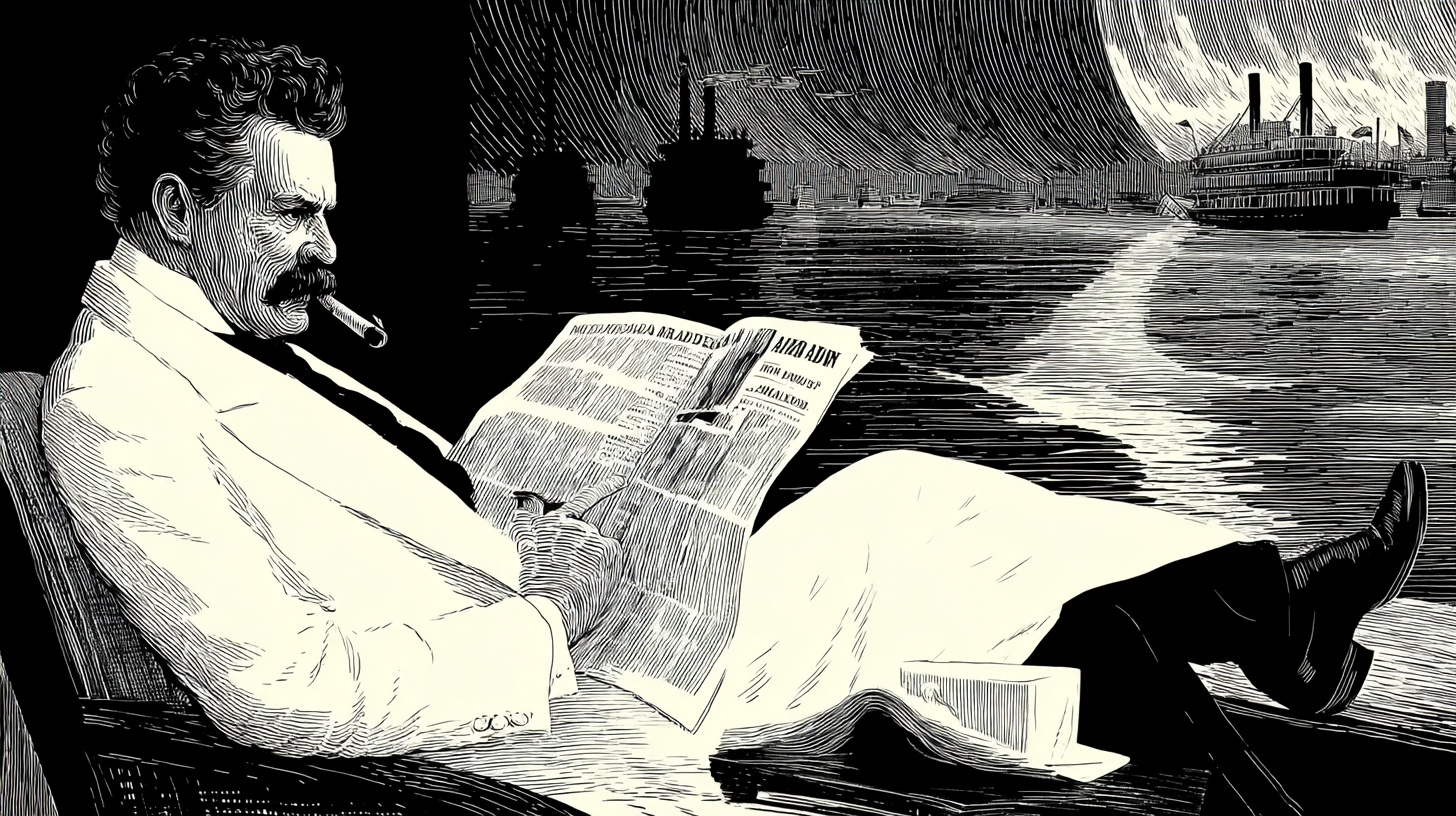
I am sitting on the porch in Hannibal, where it is twenty-eight degrees and the clouds have arranged themselves in that half-hearted way that suggests the Almighty has not entirely made up His mind about the afternoon. It is partly cloudy, which is the weather of a nation that cannot decide whether to weep or set off fireworks, and so does both. The Republic is two hundred and fifty years old today, and I have been asked to say a few words about it. I warn you now that I have never in my life kept a promise to be brief, and I am too old to begin.
Two hundred and fifty years. When a man reaches such an age he is either a saint or a fossil, and a nation is no different, except that a nation has the advantage of never being obliged to remember what it did last week. I have watched, from my comfortable distance beyond the grave, the President ascend to Mount Rushmore to deliver a speech about his own accomplishments, standing beneath the stone faces of four dead men who are in no position to contradict him. It is a shrewd choice of company. The dead make excellent witnesses precisely because they have stopped talking, and I speak here as an authority on the subject.
I am told there was some quarrel over whether the whole business was a celebration of the country or an advertisement for one particular gentleman, and I confess I do not see why it cannot be both. That is the beauty of the Fourth of July: it is the one day a year when a man may wrap himself in the flag, charge admission, and call it patriotism. Meanwhile up in New York the mayor rose to remind everybody that this country was largely built by people who arrived here with nothing but a bundle and an accent, which is true, and which is exactly the sort of true thing that gets a man in trouble on a holiday. The immigrant, you understand, is celebrated warmly in our songs and watched narrowly at our borders. We love the huddled masses in the abstract and inspect them closely in the particular.
Over in Belgium they honored our anniversary in the most American fashion imaginable: they set off fireworks and burned marks into the side of a museum. I could not have staged a finer allegory if I had labored at it for a month. There is the national character in a single scorch mark. We arrive somewhere with the best intentions and a great deal of gunpowder, and we leave behind a smudge on something old and valuable, and then our ambassador confirms it with a straight face. A people that can damage a Belgian building from three thousand miles of enthusiasm is a people to be reckoned with.
But I would not have you think the world spent the day watching us. The world, I am sorry to report, has other engagements. In Iran they are burying their Supreme Leader with a pomp that would make a Pharaoh blush, and the dignitaries of some hundred nations have flown in to stand solemnly around the coffin of a man several of them privately could not abide. That is the great courtesy of a funeral: it lets a fellow pay his respects to a corpse he would not have crossed the street for while it breathed. Millions are expected in the streets of Tehran. I have noticed that grief, like patriotism, scales beautifully. One weeping man is a tragedy; a million is a photograph.
In Europe the weather has turned murderer. France alone counted better than two thousand souls lost at the peak of the heat, with the thermometer climbing past forty degrees and the continent bracing for worse. Now, I have made my living joking about most things, but I have never found much comedy in a heat that kills the old and the poor while the rest of us discuss it as though it were a spell of bad luck rather than a bill coming due. We have grown very sophisticated. We can measure the temperature to the tenth of a degree and count the dead to the last name, and we have not yet worked out how to be ashamed of the arithmetic.
Down in Venezuela they are still pulling people out of the rubble, and where they cannot pull them out alive they lay them in tents and let the families come and look. A rescuer called it a war zone, which is the phrase we now reach for whenever the ground itself declines to cooperate. The whole earth sent help, in its way. The Japanese dispatched a medical team, and a famous footballer sent a message to a boy in a hospital bed, and I suppose a kind word from a rich man is worth something, though I notice it weighs considerably less than a shovel.
And through all of it, mind you, the great globe of humanity was chiefly occupied with soccer. Argentina was very nearly humiliated by Cape Verde, an island most of the shouting men could not locate on a map, and was rescued in extra time; Egypt beat Australia on penalty kicks and dedicated the victory to Gaza, where they watched the match against a backdrop of bombed buildings, which is either the most defiant hope I have ever heard of or the saddest, and I decline to decide which. Colombia squeaked past Ghana by a single goal. I do love that a species which cannot agree on borders, gods, or the temperature will unite, weeping and embracing strangers, over the trajectory of a ball. It is the nearest thing to a common religion we have got, and its saints wear numbers.
There is one item, though, that I cannot leave the porch without. In Turkey they have arrested a comedian for telling jokes about the powerful. Now here is a thing I understand in my bones. When a government commences to jail its humorists, it is confessing something it did not mean to say out loud, namely that it is frightened of a laugh. A tyrant can survive an army easier than a punchline, for the army he can shoot at, but the laugh has already escaped and is loose in the streets, repeating itself in every tavern. Lock up the comedian and you have merely proved him right, and given him better material than he had before. I would send that fellow my congratulations if the mails ran to his cell.
So the Republic turns two hundred and fifty, and I raise my glass to her: a magnificent, maddening, big-hearted, thin-skinned old fraud of a country, forever mistaking her fireworks for her ideals, and every so often, by pure blessed accident, living up to the better one. Happy birthday, America. Try not to burn down anything you'll miss.