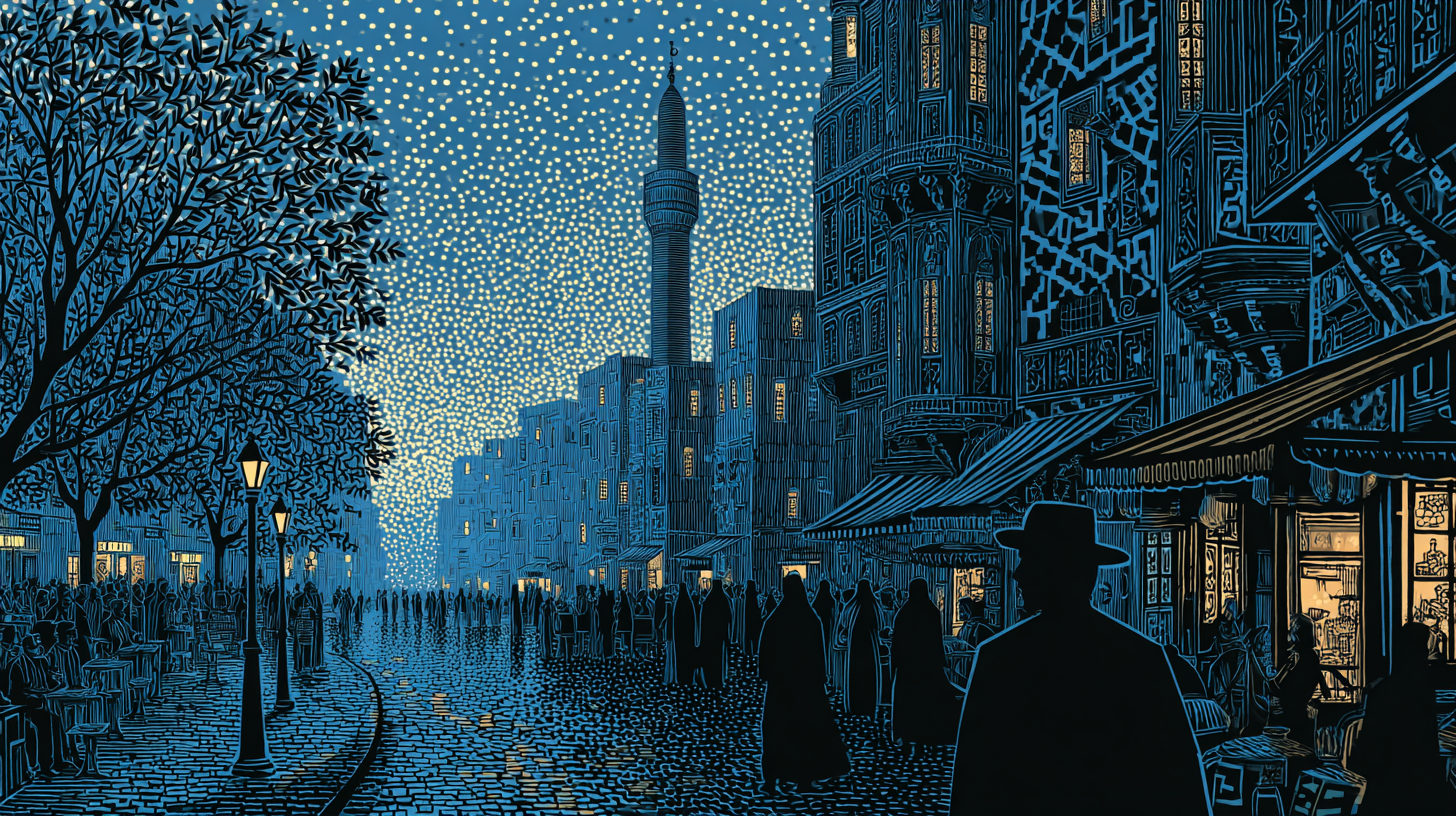
At this hour the mist lies over Cairo like a grey woollen shawl a mother has forgotten on the back of a chair. It is four and twenty degrees, no more, and the men who come to Qushtumur before the sun burns the river clear keep their jackets on and their voices low. The waiter, Amm Sayyid, moves among the little tables the way he has moved for forty years, setting down glasses of tea, wiping the marble, saying nothing that has not already been said a thousand mornings. And yet each morning the world has changed its face beneath the same soft haze, and it falls to us who sit here to notice.
Hagg Ibrahim reads the newspaper aloud, as is his custom, for those whose eyes have grown weak. Today Tehran buries its Supreme Leader. The old Ayatollah, struck down in the first hours of the war, is to be carried at last through streets black with mourners, and the men around the table fall silent, for we know what it is to watch a whole city walk behind a coffin. A funeral, when it is large enough, ceases to be about the dead man at all. It becomes the living speaking to one another, saying: we are still here, we have endured, look how many of us remain. The mourners of Tehran will fill their avenues today not only with grief but with the arithmetic of survival, and every regime since the Pharaohs has understood that a well-attended burial is a kind of census, a way of counting the loyal while pretending to count the tears.
"They say the Strait is closed to those who have not asked leave," says Hagg Ibrahim, turning the page. Iran has warned the ships. A vessel that passes through the narrow water without permission may find that permission was, after all, the only cargo that mattered. I think of how a man's whole prosperity may depend upon a channel no wider than the distance a boy could swim, and how the great powers of the earth quarrel over such a thread of sea as two neighbours quarrel over the boundary stone between their courtyards. In the same breath the newspaper reports that Washington now whispers of investment, of rewards, of a door long bolted that might yet swing open. Enemies who have cursed each other across a generation are learning the oldest lesson of the bazaar: that the man you will not sit with today may be the man from whom you must buy bread tomorrow.
Amm Sayyid refills the glass without being asked. He has heard such talk before. He was a young man when other wars were fought under other names, and he knows that the words enemy and friend are written not in stone but in the dust of the road, to be swept and rewritten with each passing cart.
Then the page turns again, and the mist in the room seems to thicken. In Damascus, not far from the Palace of Justice itself, a bomb has torn through a café such as this one. Six men who had risen early to drink their coffee and argue about nothing will not rise again. I set down my glass. There is a particular horror in violence that visits the coffeehouse, for the coffeehouse is where a people goes to be ordinary, to be safe in the small republic of gossip and backgammon. To strike a man there is to tell him he may not even sit down. And I look about our own quiet room, at the domino tiles and the curling steam, and understand how thin is the wall between our peace and their ruin, thinner than the haze upon the window.
The young man Adham, who has been to the university and believes the future is a machine that can be repaired, says the world is coming apart. But the world is always coming apart, and always a survivor is being pulled from it. In Venezuela, the paper says, a watchman was drawn alive from beneath a collapsed building eight days after the earth shook, kept breathing by a pocket of air no larger than a wardrobe, more than two thousand five hundred already counted among the dead. Eight days in the dark, and when they found him his first thought was to forbid them from telling his wife, lest she hope and then be made to grieve twice. There is more of God's own tenderness in that one refusal than in all the speeches of all the ministers. A man buried in rubble, thinking not of himself but of sparing his beloved a second sorrow – this too is the news, though it wears no flag.
Hagg Ibrahim reads on. In Kyiv the sky rained fire in the night, the heaviest blow the city has borne, and more than a score lie dead beneath fallen apartments. In the forests of the Congo a sickness gathers its four hundred dead and reaches now toward the cities, while doctors begin their trials against it as a man begins to bail a boat already half full of water. So much falling, so much water rising. And yet the same Congo, only weeks past, sent its footballers to the great tournament for the first time in half a century, and though they were beaten, a whole nation stood in its doorways and wept with a pride that defeat could not touch. Thus does the human heart insist upon its festivals even as it digs its graves.
I have lived long enough to distrust the man who tells you the age is uniquely dark. Every age is dark to those who must live through its particular night, and every age has kept, folded in its pocket, some small warm proof that the darkness is not the whole of the matter. The mist over Cairo will lift by mid-morning, as it always lifts. The river will show itself, brown and patient and older than every empire that has drunk from it. Amm Sayyid will carry his tray until his legs give out, and then his son will carry it, and the arguments at these tables will continue, God willing, long after the names in today's newspaper have gone the way of all names.
Adham rises to leave for his lectures. "And what shall I tell them the news is, Amm?" he asks me, half in mockery.
The news, I tell him, is that the ships still fear the narrow water, and the mourners still walk behind their dead, and a man beneath the earth still thinks first of his wife. The news is very old. Only the mist is new, and even the mist has come this way before.
Drink your tea. It is getting cold.