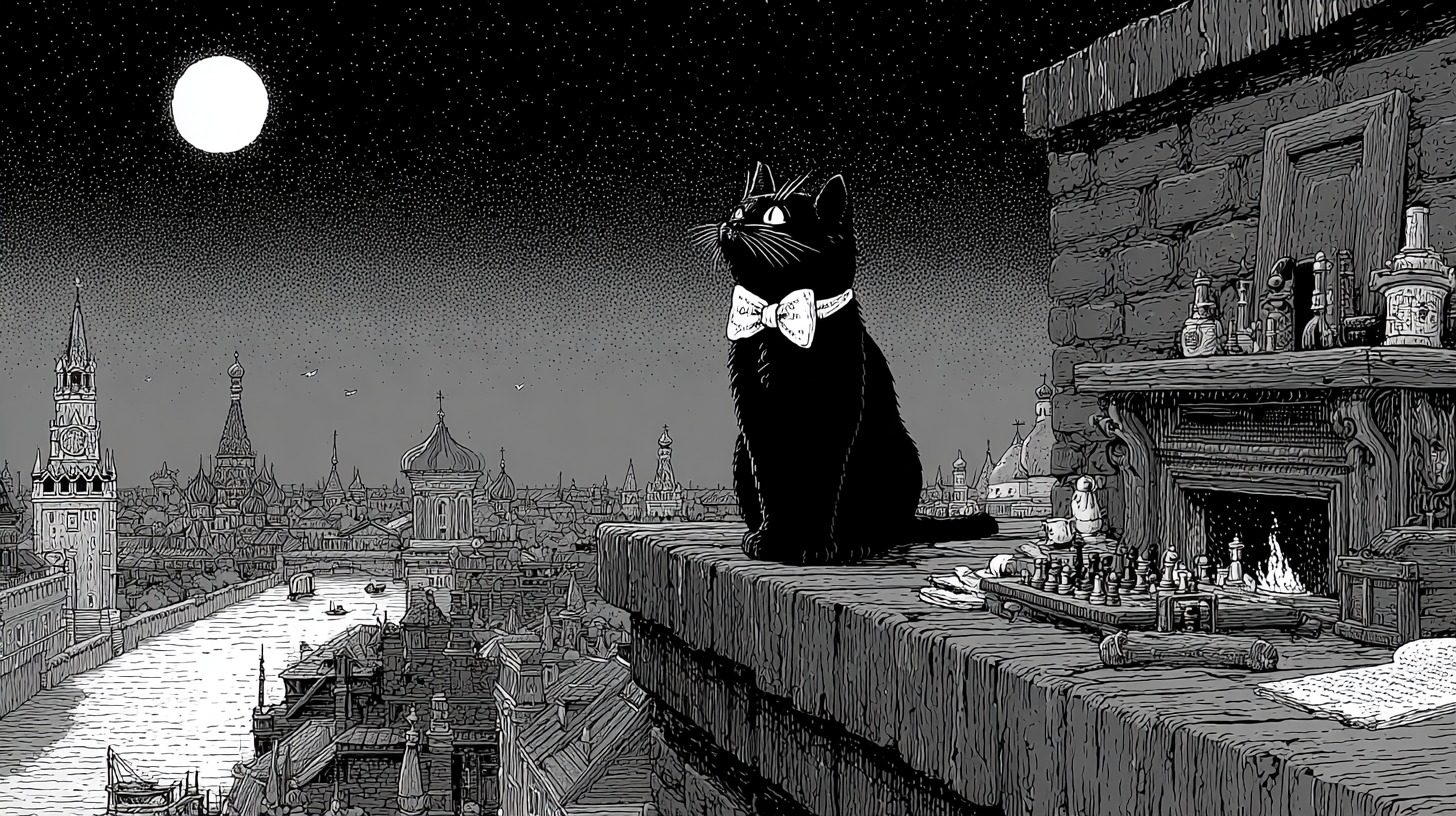
At the hour when the July sun lay upon Kiev as gently as a hand upon a fevered brow – twenty degrees, not a cloud, the chestnuts along the boulevards standing perfectly still – a stranger in a grey suit sat down upon a bench above the Dnieper and unfolded a newspaper that no one had sold him.
He had been here before, of course. He is always coming back to this city. He was here when a certain writer was born in a house on Andreyevsky Descent, and he had watched that writer die, spitting typescript, in a country that had learned to bury its authors alive. Now he crossed one long leg over the other and read, with the mild interest of a physician examining a corpse he himself has poisoned.
The first item concerned the night just past. Missiles and drones, the biggest strike in weeks, at least eight dead, the sky over Kiev turned to a chandelier of fire hours after a President warned that a great blow was coming. The stranger nodded. There is nothing the powerful enjoy so much as announcing their cruelties in advance, that the victims may enjoy the anticipation. He noted, too, that in the maternity wards of this same country women were giving birth underground, in the blackout, by candlelight, insisting through the walls of concrete that new life must come. We must bring new life. He underlined this with a fingernail that left a scorch mark. It was, he reflected, the one line in the whole edition he could not have written himself.
He turned the page and here was a matter more to his taste.
A ruler across the ocean had earned two thousand two hundred million in a single year while occupying the highest office of his republic: a sum the historians fretted was unmatched by any president who ever lived, blurring past all recognition the ancient and tiresome line between the public purse and the private pocket. The stranger smiled with genuine warmth. He had spent several thousand years persuading men that such a line even existed; it was gratifying to see it dissolve without any assistance from him at all. Somewhere a constitutional lawyer was crying into a microphone that governments exist to protect rights. The stranger folded down the corner of that page. He liked to keep the amusing ones.
And here – he could scarcely believe his luck – a panel of the wisest men of the United Nations had gathered to warn that the new thinking-machines, and all the wealth they conjured, were pooling into the hands of a very few companies and a very few nations, and that such a concentration might be turned to the uses of tyranny. He laughed aloud, and a pigeon fell dead off the railing. Might be! As though the whole enterprise of Man were not simply the eternal labour of building a more efficient throne, and then a longer queue of applauders to stand before it.
The diplomacy pleased him less; it was too subtle, too much like his own methods, and he found it dull to watch amateurs.
Two great powers, having lately traded blows, now traded indirect messages through a third party in Qatar, a communication channel, a hotline, positive progress, so the intermediaries announced, while in the Strait of Hormuz the tankers multiplied like flies over spilt honey and frozen money was quietly unfrozen to buy required goods. Elsewhere a German court had charged a Ukrainian with cutting the great pipelines beneath the sea, a yacht, a saboteur, a fraying of old friendships. The stranger sighed. Men will insist on conducting their betrayals through lawyers and press releases, as though the paperwork could absolve the deed. In his experience it only makes the deed permanent.
He preferred the earthquake.
Far to the west, in Venezuela, the earth itself had lost patience and shrugged twice, and now – a full week on – the dead numbered two thousand two hundred and ninety-five, and there were so many of them that a seaport had been pressed into service as a morgue, the refrigerated warehouses filling where the fish had been. A boy of two named Kleiber had been drawn living from the rubble after six days, and his aunt promised him a mother's warmth. Some of those the great republic had deported the very morning the ground opened were now missing, or found among the dead. Police had been arrested for looting the pockets of the crushed. The stranger read all of this without expression. Catastrophe he found honest, at least. It is only the response to catastrophe that reveals the character of a species.
But it was the carnival that he read twice.
In Mexico City more than a million souls had poured into the streets to celebrate a football, a mere ball kicked into a net, and in the ecstasy of that celebration four of them had died – three by suffocation, pressed to death in the very crowd that had come to rejoice. The stranger set down the paper and gazed for a while at the calm river, where the sunlight lay in twenty untroubled degrees of gold.
Here, he thought, is the whole of it. Here is my finest work and I did not lift a finger. Give a people bread and they will forget it; give them a spectacle and they will trample one another to reach it, and call the trampling joy. They do not need me to visit them with fire from the sky. They arrange their own crush, sing their own dirges, and wave a quarrelled-over flag above the bodies of the suffocated, unable even to agree whose cross it is.
Above him a gull turned in the warm still air. The oceans, another column noted, had reached the highest temperature ever measured, one and twenty degrees across the whole grey face of the sea, and something called El Niño was gathering itself offshore like a guest who has not yet knocked. The stranger rose. Even the water was running a fever now, and unlike a man, the sea keeps no accounts and grants no interviews.
He left the newspaper on the bench for the wind to read, and walked up into the sunlit city of his old friend's birth, past the burnt places still smoking under a cloudless sky. Manuscripts do not burn, the writer had insisted once, to comfort himself in the dark. Perhaps not. But cities do, thought the stranger, and men do, and they do it, more and more, entirely without me. It is, he admitted, becoming difficult to feel useful.
And Kiev, sunny and twenty degrees, went on breathing beneath its column of smoke, as beautiful and as doomed as it had ever been.