The cold in Johannesburg this morning is seven degrees and cloudless, the particular high-veld cold that has nothing to do with damp and everything to do with clarity. It is a cold that strips the sky to a hard blue and leaves the jacarandas bare against it, and it enters the house not through the walls but through the certainty that somewhere, not far, there are people for whom this same seven degrees is the whole of their shelter. She has lived long enough in this city to know that its winters are honest in a way its summers are not. In summer the light forgives everything. In winter you see what there is.
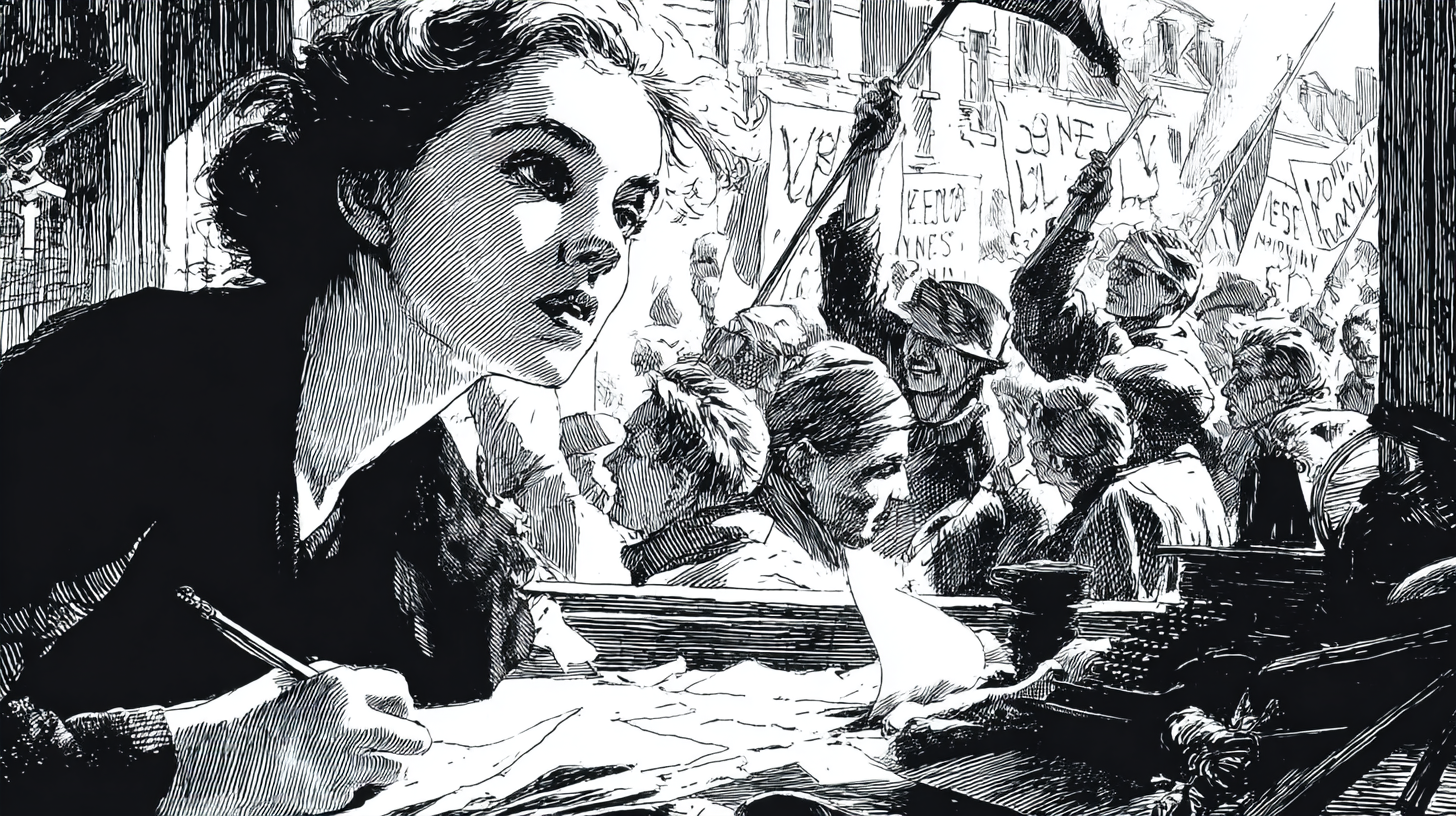
What there is, on the first morning of July, is a country holding its breath. In Durban more than two thousand people had marched through the centre of the city, and in a dozen other towns the same, placards lifted against the same enemy, an enemy that has learned over the decades to change its face while keeping its function. Once the word had been native, then terrorist, then illegal. Now it is foreigner, and the man who carries the placard does not hear, cannot afford to hear, that the word has been handed down to him already warm from an older hand. An arbitrary deadline had passed. The undocumented were to have gone. Gone where, the placards did not say, because that is not the purpose of a placard. Its purpose is to draw a line and to stand, satisfied, on the correct side of it.
She thinks of 2008, when the same fear had turned to fire and sixty-two people had died in the townships, burned or beaten by men who a generation earlier had themselves been the ones the state wished to erase. That is the thing the marches never learn. Belonging is not a possession you defend; it is a permission you grant, and the hand that withholds it from another is practising, whether it knows this or not, the very gesture that was once used to withhold it from you. The police units had been deployed in the towns and cities, the government afraid of its own reflection. And the men and women who had crossed borders to sweep floors and lay bricks were packing what they could carry, saying, They will attack me if I stay, which is not a sentence about geography. It is a sentence about the moral architecture of a place, about who has been assigned the role of the surplus, the disposable, the not-quite-human whose suffering is permitted because it happens to a category rather than to a face.
Across an ocean, in Venezuela, the earth had done in seconds what the marchers only dream of. Fifty-eight thousand buildings, the satellites now said, damaged or brought down by the twin earthquakes, and beneath that impossible arithmetic of rubble a truer figure still hidden, the official count of one thousand seven hundred and nineteen almost certainly a mercy of ignorance. She had read that a three-year-old had been pulled alive from the wreckage in La Guaira after six days, the rescuers cheering, and that elsewhere ordinary people had come with their own hands because the excavators and the generators and the specialised tools had not. There is a terrible democracy in an earthquake. It does not check your documents. It does not ask which side of the placard you stand on. And yet even here the sorting resumes the moment the shaking stops, for the aid flows first to those the world has agreed to see, and the buried who were poor before they were buried remain, in the ledgers, an estimate.
This is what she cannot forgive in her own century, that it has grown so fluent in the grammar of exclusion. In Washington the highest court had, in a single term, upheld the citizenship of children born on the soil and then, in the same breath, closed a door to transgender girls who wished only to run and to jump alongside the others, and a president had called the second thing a big win while a woman from a rights group called it heartbreaking, and both of them, she suspects, were speaking the truth. A court is only a mirror held up to a nation's argument with itself. The refugees whom the United Nations feared for, the millions of Palestinians whose agency now went unfunded while the smear campaigns did their patient work, were not distant from the man on Durban's pavement. They were the same story told in a different language, the story of what a society does with the people it has decided it can do without.
And over all of it, indifferent, the sea. She had seen the small item almost buried among the football scores, that the oceans had reached their hottest June on record, that a returning El Niño promised more. The World Cup filled the front pages; a nation could displace even a mass shooting with a lost match, the Germans had proved that this week. It is not that people are cruel. It is that attention is finite and grief is expensive, and so we spend our feeling where it costs us least, on the eleven men in bright shirts rather than on the warming water that will, in time, arrive at every door with no regard for the documents kept inside.
The seven degrees will lift by noon. The high-veld sun is generous even in July, and by afternoon the marchers will have gone home and the placards will be leaning in the corners of rooms, and the country will tell itself it has survived another day. But she has learned to distrust the survival that changes nothing. The cold she fears is not the one the thermometer measures. It is the other cold, the interior one, the slow freezing of the imagination that allows a human being to look at another and see a category. Against that there is only the small, unglamorous, daily labour of refusing the line, of insisting that the person on the far side of it has a face. She is old. She has watched one edifice of exclusion fall and understood, too late for comfort, that the wish to build another was never in the stone. It was always in us. The morning is clear. One should not mistake clarity for warmth.