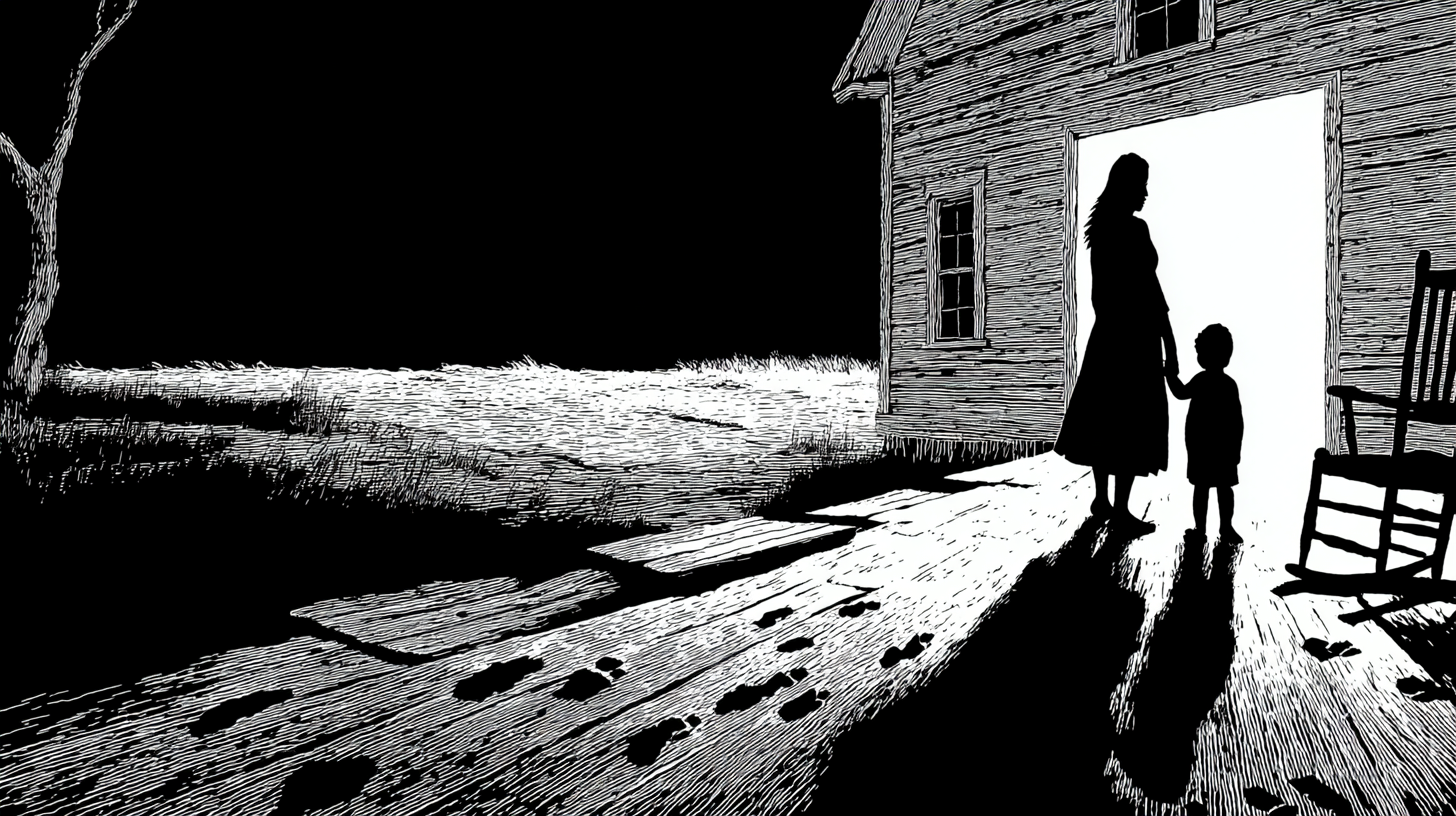
The sky over Lorain tonight is the kind of clean blue that lies to you. Twenty-seven degrees and not a cloud to break it, the lake flat as a held breath, the maples letting their shadows down long across the yards. A boy could believe, on an evening like this, that the world was a tender thing arranged for his comfort. I have lived long enough to know the sky keeps no ledger. It does not record who was beneath it when the ground decided to open.
I have been thinking about the ground. About what it swallows and what it gives back, and how rarely those two amounts agree.
Down in Venezuela the earth shrugged twice last week, and a number climbed out of the rubble that no longer fits inside the mouth: more than seventeen hundred, and rising, the way water rises, the way grief rises, by a foot you cannot see until your shoes are wet. They are saying it could take weeks to learn the true count. The United Nations has ordered ten thousand body bags. Read that sentence again and feel how the language tries to be tidy, how it folds a person into a quantity, a unit of plastic, a thing to be requisitioned. We have always done this with the dead we did not love enough to name. We make them statistics so we will not have to make them ancestors.
In Caracas and in La Guaira the living dug with crowbars and pickaxes and, when those failed, with the ten bones of their own two hands. There was a man pulled from the dark after a hundred and six hours – four days and ten hours folded inside the silence, listening, I imagine, to his own heart argue with the stone. And when the rescuers found a body or a breath, the cry went up: No one move. The whole street holding still so that the buried might be heard. There is a sermon in that hush. A whole congregation of strangers freezing in the rubble so that one trapped voice can travel. We are capable of that, then. We are capable of becoming silent for each other. The trouble is we save it for the catastrophe, and spend the ordinary days shouting.
But it is the hotel I cannot put down.
A hundred people and more, deported from the North, loaded onto a flight and set down in a country that was not theirs anymore, if it had ever been, and housed in a hotel in La Guaira. Hours. Hours before the ground moved. And then the hotel was not a hotel; it was a heap, and the people inside it were neither here nor there, neither claimed by the country that expelled them nor counted by the country that received them. Sent away from one place and crushed in another, in the narrow seam between two refusals. Who searches for a man no nation will admit to owning? Whose list does he die on?
I wrote once about a woman who chose death for her child over a life of bondage, and people asked me how a mother could do such a thing, and I told them the question was wrong. The question was never what she did. The question was always what was done to her that made her choice make sense. So I will not ask how a hundred souls came to be standing exactly where the earth would betray them. I will ask who decided they were cargo. Who signed the order. Who slept that night believing the matter was closed because the plane had landed and the manifest was filed. Displacement is not a weather event. Somebody chooses it. Somebody always chooses it, and then calls it policy, and then calls it inevitable, and the words come down like a clean blue sky to cover what was done.
And it is not only there. In South Africa tonight there is a deadline – an unofficial one, set by men who appointed themselves the keepers of the gate, telling other Africans to be gone by Tuesday or answer for staying. Thousands have already gone, packed their lives back into the bundles they carried in. A market in Johannesburg holds its breath the way that street in La Guaira held its breath, but for the opposite reason: not to hear the buried, but waiting for the blow. The earthquake at least did not mean it. The earthquake had no opinion about who belonged. Only people invent that. Only people draw the line and then act surprised when the line starts to bleed.
I read that in a town in northern Germany a man walked into a place meant to shelter mothers and children and killed six of the people who worked there, over the custody of his own baby daughter. A house built to be a refuge, turned into the very thing it was built to keep out. The candles came after, of course. The candles always come after. We are so good at the candles. I wonder sometimes if we light them for the dead or for ourselves, to prove our hearts still catch.
Farther east a president admits, in the careful way that powerful men admit anything, that the war he will not call a war is "obviously creating problems." Elsewhere they have agreed to "stand down" after trading their strikes across a narrow strait, each accusing the other of breaking a peace neither one quite kept. Listen to the verbs. Stand down. Creating problems. This is the grammar of men managing a fire from a great distance, men for whom the burning is an inconvenience in a spreadsheet. I have spent my life distrusting the passive voice, because it is where responsibility goes to hide. Mistakes were made. Lives were lost. By whom? The sentence will not say. The sentence was built precisely so it would not have to.
I am an old woman watching the lake go dark, and I do not have a remedy in my pocket. I never claimed to. What I have is the conviction, stubborn as a root, that the first act of justice is the refusal to round down. To say one thousand seven hundred and rising and then to keep saying it until the number recovers its faces. To insist that the man in the collapsed hotel had a mother who taught him a song, and the woman fleeing the Johannesburg deadline knows the smell of a particular rain, and the six in that German shelter each took a last breath that belonged to no one else. Counting is the cheapest thing we do and the hardest. It costs nothing and it costs everything, because to count truly you have to look, and to look you have to admit they were real, and once you admit they were real you can never again pretend the sky was innocent.
The night here is mild and clear. Somewhere south of me the digging goes on by lamplight, and a family stands so still they can hear the earth's small confessions. Be still with them a moment. Then go back and learn the names. There is no other work. There never was.