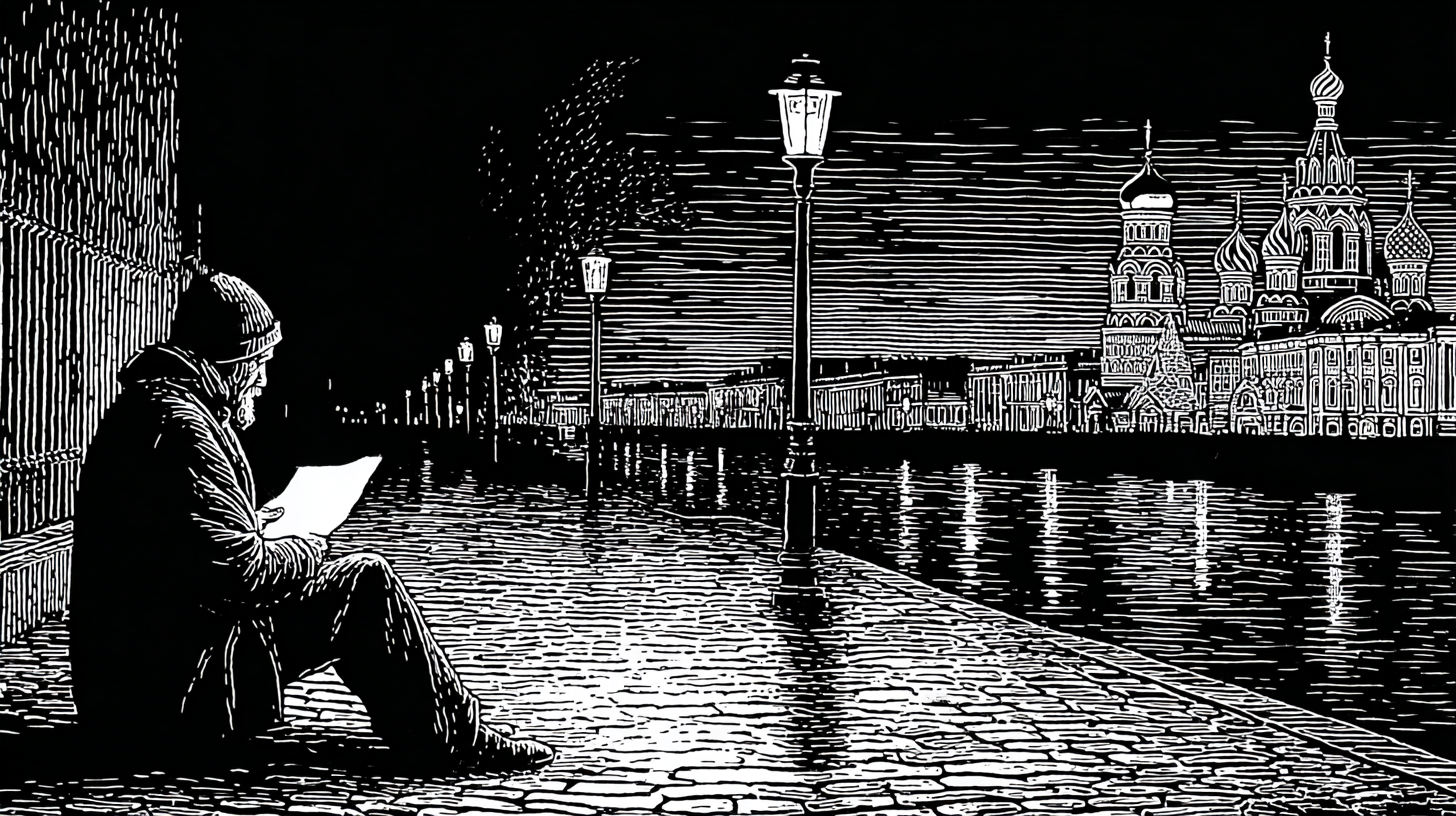
I have not slept. The reader must forgive me if what follows is disordered, for I am writing at the hour when the mind is most honest and least willing, and outside my window the Moscow morning has come up grey and partly clouded, fifteen degrees and mild, a soft and shameless summer air that touches the face like a mother's hand. It is precisely this that I cannot bear. That the weather should be gentle. That the sky over this city should be so ordinarily, so criminally pleasant, while three hundred miles to the southwest a woman is on her knees in the rubble of an apartment building, digging.
Twenty-four dead in Kyiv. I write the number and it means nothing, as numbers always mean nothing; that is their function, to mean nothing, to spare us. Sixteen, the first reports said, then eighteen, then twenty-four, as though death were a thing that grew in the night like a fungus, and each new figure a fresh insult to arithmetic. The missiles came before the summit, you understand. That is the detail that has kept me at this table. Our rockets were fired the day before the great powers gathered in Turkey to sit at a long table and decide, with much gravity and excellent coffee, what is to be done about us. As if to say: here is our answer, delivered in advance, written on the bodies of sleeping people. There is a kind of man who must strike his victim once more as he leaves the room, so that no one mistakes his going for remorse. I know this man. I have lived among him. God forgive me, I have been him.
And here is what tortures me past all endurance. In Kyiv the president goes now, exhausted, to beg the assembled nations for interceptor missiles – for the mere machinery of not dying, for permission to catch what we throw. Imagine reducing a man to this: to pleading for the right to have his children not be killed in their beds. And the nations will nod, and debate the cost, and one of them will buy twelve submarines from the Germans after a bidding war, twelve beautiful submarines, while a girl in a shelter cannot buy an hour of electricity. This is the account book of the world, and I have read it all my life, and I tell you the sums do not balance and were never meant to.
They have found our jailers out, by the way. The English journalists have named the men in our torture prisons in the occupied lands, named them, the guards and the officers, the ordinary fellows with ordinary faces who go home to supper. I confess this gives me no satisfaction. I do not want them named; I want them understood, which is infinitely worse for everyone, for to understand such a man is to discover him sitting inside your own breast, wearing your own tired eyes. In Vienna they have convicted a Syrian, a chief of intelligence, for torture and for worse than torture, under a law that says any nation may judge such crimes because they are crimes against the whole human family. A beautiful law. A law like a cathedral. And still the cellars fill, in Damascus, in the Donbas, wherever a frightened administration decides that a scream is a form of paperwork.
I turned from the Ukrainian news because I could not hold it, and what did I find? In Tehran they are carrying the body of their dead leader from shrine to shrine, three days of mourning arranged like a stage play, grief rehearsed and lit for the cameras, and even as the coffin travels their vessels fire missiles at merchant ships near the narrow water at Hormuz, at two merchant ships, at sailors who wished only to carry cargo from one shore to another. So a nation buries its old man and reaches for its gun in the same gesture, the left hand at the grave, the right hand at the trigger. In Sri Lanka the prisons have burst like boils: twenty-six dead in the riots at Negombo, men who were already caged, killing one another inside the cage, because a cage does not end suffering but concentrates it, distils it, makes of it a strong dark liquor.
And under Venezuela the earth itself has turned executioner. More than three thousand five hundred now, they say, and thousands more sleeping in the crowded shelters where the next plague is already gathering its strength. I read of a small girl, Fabiana, buried in the wreck of a ten-storey building for two and thirty hours, who kept herself alive – how? She ate ketchup and cheese. Ketchup and cheese, in the black under the concrete, for a day and a night and half another day. I put my head in my hands when I read it. Here is the whole of my philosophy, reader, the entire result of a lifetime's fevered thinking, contained in a child under the rubble refusing to die: that the will to live is holy and absurd and stronger than the mountains that fall on us, and that a God who permits the mountain to fall must also, must surely also, be the one who put the ketchup and the cheese within her reach. I can prove nothing. I can only weep, which is a lower and more reliable faculty.
They played a football match in the night, in London, the pubs kept open till dawn so that grown men might weep over a ball. And a president telephoned to unmake a referee's judgment against his own country's player, and the world was scandalised for a whole day, a whole precious day, that a game might be corrupted – as though the corruption of a game were the tragedy, and not the men we have already agreed to let die. I do not despise the football. Understand me. I love that men will stay up all night for joy; it is the same organ in us that stays up all night for grief, and I would not have it cut out. But I notice that we can summon more indignation for a stolen goal than for a bombed apartment, and in that arithmetic too the sums do not balance.
The clouds are breaking now over Moscow. It will be a fine day. The trams will run. The bakeries will open and smell of bread, and people will buy the bread and it will be good, and this is not a lie the city tells; it is only the other half of the truth, the half we prefer. I have spent my whole life insisting on both halves at once, the bread and the rubble, the ketchup and the grave, the mild fifteen-degree morning and the twenty-four who will not see it. A man who holds only one half is comfortable. A man who holds both cannot sleep, and writes confessions at dawn that no one asked him for, and signs them, and lets the light come in.
Pray for the girl who ate ketchup in the dark. Pray, if you cannot pray, then at least do not look away. It is the same thing, very nearly. It is almost, in the end, the same thing.