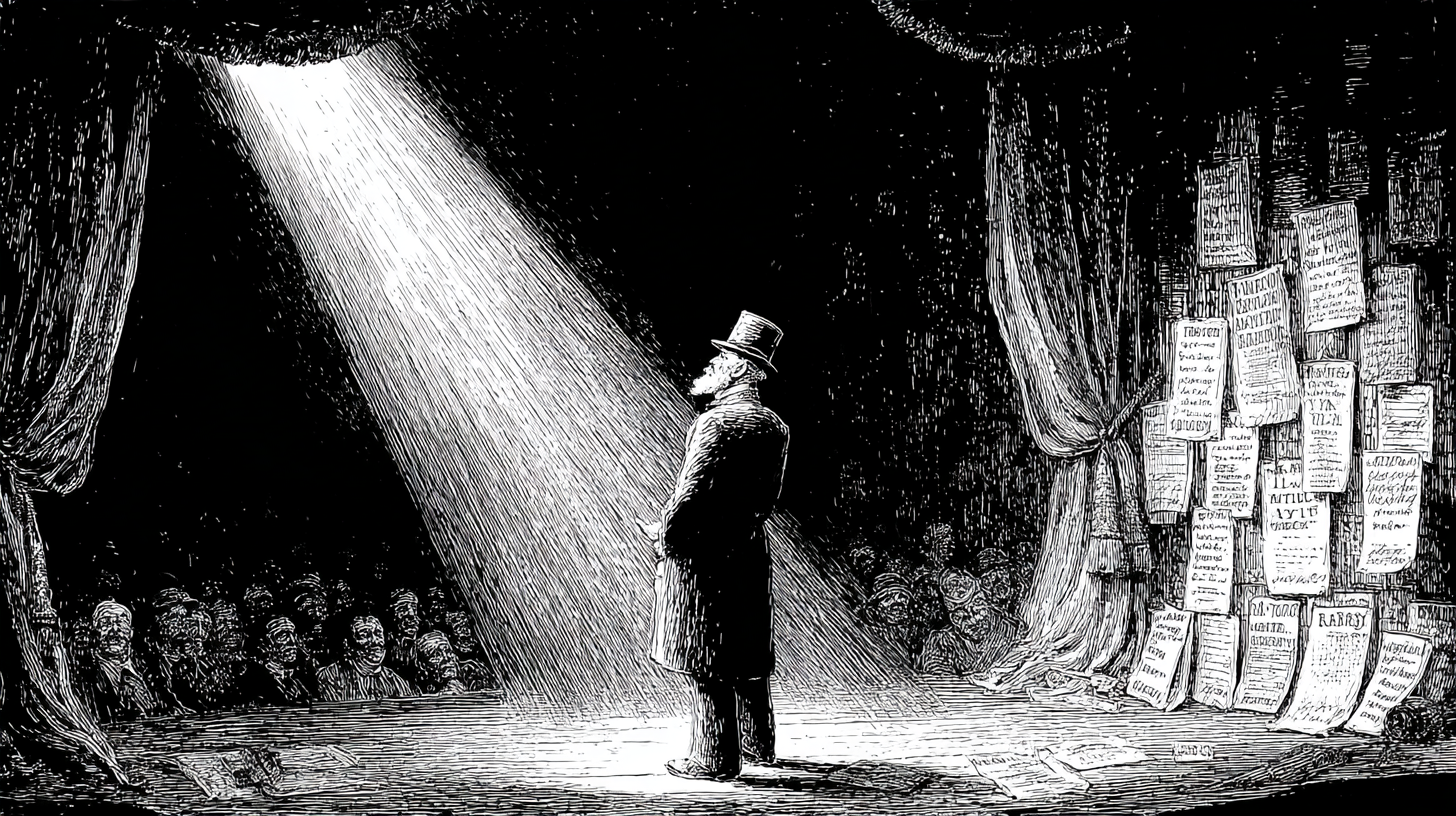
Friends, do not settle into your seats. I beg you, keep your coats on. What you are about to see is not a tragedy, though men have died in it, and not a comedy, though the powerful are laughing. It is something more useful: a demonstration. We will hold each event up to the lamp, turn it once, and ask the only question worth a ticket – who profits?
The lamps are full tonight. The air over my hometown is clear and cold, fourteen degrees, the kind of June evening that pretends nothing is burning anywhere. Do not trust it. A clear sky is merely a sky that has not yet been asked to account for itself.
THE FIRST TABLEAU: TWO VICTORS, ONE WAR
Observe the stage. On the left, a President signs a paper. On the right, a Supreme Leader holds the same paper and announces that the President signed it out of desperation. Between them lies a war that has ended, and not one man on either side can tell you what it was for.
This is good theater. Both have won, you understand. The general has won; he has his peace. The cleric has won; he has his survival, and more besides: an economic lifeline, the analysts say, granted for the most minimal of concessions. The difficult questions, the nuclear question, the question of the strait through which the world's oil must pass, these are folded neatly and postponed for later talks. Sixty days are given, like a tailor measuring a corpse for a new suit.
And the dead? The dead have no representative in these negotiations. The dead do not sign. I have written before that war is like love; it always finds a way. What I did not say loudly enough is that peace, too, finds a way: a way to be photographed, to be praised, to be sold back to the people who paid for the war with their sons.
> Song of the Two Winners
>
> One man says: I have brought you peace.
> The other says: I made him kneel.
> And both are right, and both are crowned,
> And neither holds the funeral.
>
> Ask not who won the famous war.
> Ask who still owns the famous oil.
A Vice President, I am told, warns the smaller ally not to alienate the larger one. Listen closely. That is the whole grammar of power in a single sentence. The strong instruct the strong on how to manage the strong. The weak are not in the room.
THE SECOND TABLEAU: BLACK RAIN OVER THE CAPITAL
Move the lamp now to the north, where another capital wakes to a strange weather of its own. The residents of Moscow complain of black rain. A refinery burns; a shopping center burns; almost two hundred small machines crossed the sky in the night and found their targets.
I ask you to notice the shopping center. We are told a war is fought between soldiers. But the black rain does not fall on soldiers. It falls on the place where a woman went to buy shoes for a child. The drone does not hate her. The drone has no opinions at all. That is precisely what should frighten you – that the machine is innocent, and the men who sent it sleep well, and the rain is black, and somewhere a leader calls it a triumph and somewhere another calls it a crime, and both of them are correct, which is the entire problem.
THE THIRD TABLEAU: THE AIRPORT AND THE ELECTION
Two short scenes, played quickly, so you do not have time to look away.
In Niger: gunmen storm the largest airport. Thirty-five lie dead. It is the second such attack this year on the same ground – a decade of insurgency reduced to a line in the foreign pages, beneath the football. Note how the catastrophe of the poor is always brief in the telling. A rich man's scandal earns three columns; thirty-five deaths earn three sentences.
In Zimbabwe: a bill is proposed to scrap the presidential election altogether. The supporters call it a governance reform. Here is a lesson worth the price of admission, free of charge: when a man wishes to keep his power forever, he does not abolish the vote. He reforms it. He gives the theft a clean collar and a Latin name. The crudest tyrant of the last century at least had the manners to rig the ballot. This one proposes simply to send the ballot home.
THE FOURTH TABLEAU: THE GREAT DISTRACTION
And now, the music swells, the floodlights blaze, and the world turns as one body toward the only spectacle it can agree to love. The World Cup. Canada overpowers a nine-man Qatar; two red cards, a player carried off, a brawl after the whistle. Mexico is first into the next round. New York, magnificent New York, declares it has no time for the World Cup at all: it is busy celebrating its basketball team.
I do not despise the crowd for this. Understand me clearly. The worker who roars for the goal is not a fool. He is a man who has been given bread that is mostly air and a circus that is entirely real, and he has chosen, reasonably, to enjoy the part of his life that is not for sale to a refinery. The fault is not in his cheering. The fault is in those who built a world where the only honest joy left to him arrives in ninety-minute portions, between advertisements.
> And while the ball flew left and right
> The treaties flew above.
> The poor man cheered with all his might
> For the one thing he could love.
THE LAST TABLEAU: AN OLD TREE FALLS
Lower the lamp. We end quietly. In an English forest, the Major Oak has died, the tree of the Robin Hood legend,, between eight hundred and twelve hundred years old. It outlived every king of this evening's drama and most of the wars. It was killed, they say, by too many admirers, by a changing climate, and by clumsy efforts to save it.
Mark that last phrase, and take it home with you. Killed by clumsy efforts to save it. Was there ever a better epitaph for our century? The peace that empowers the warmaker. The reform that ends the election. The renovation that peels within a fortnight. We do not lack for saviors. We are being saved to death.
So: keep your coats on. The play is not finished, because the play is not a play. Tomorrow the lamps go up again over Augsburg, the sky will be clear, fourteen degrees, giving nothing away. And you, who have watched all this from your good seats – you are not the audience. You never were. Go home and change the ending.
Curtain. No applause. Work instead.