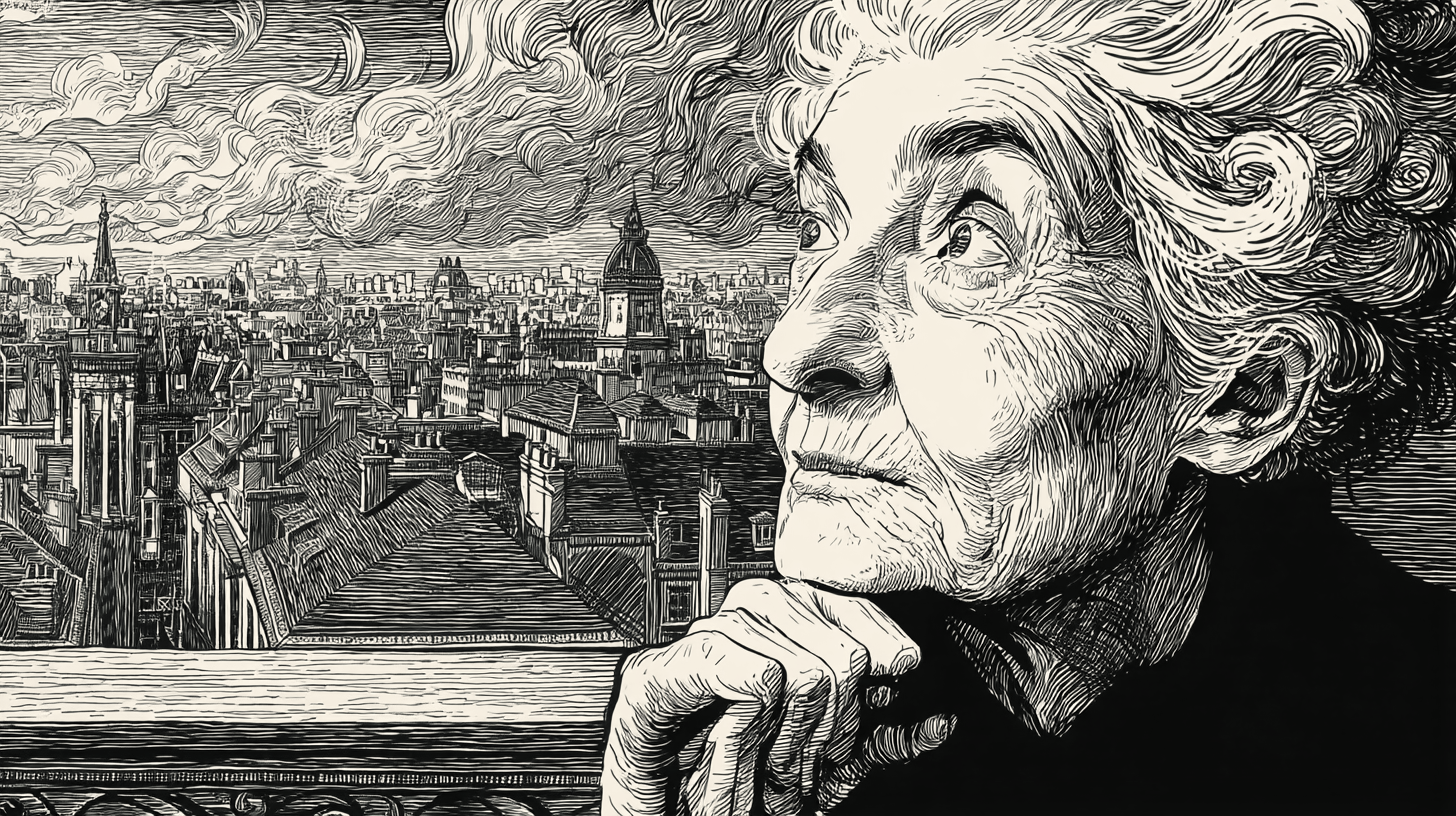
The rain has not come, though the sky over London has promised it since dawn, hanging low and overcast at seventeen degrees, that particular English greyness which is neither warm nor cold but simply a withholding. I have been reading the dispatches since the small hours, as one does at my age when sleep grows thin, and I find I am thinking less about what has been signed than about the language in which it has been wrapped. Fourteen paragraphs. A memorandum of understanding. Sixty days of talks. Three hundred billion dollars for reconstruction. These are the phrases by which men announce that they have stopped, for a time, killing one another, and we are meant to feel relief, and I do feel it, and I distrust the feeling even as I have it.
I have lived long enough to have learned how to read such documents. Not the words, which mean little, but the spaces between them. When a powerful man stands before the cameras and defends his agreement angrily, insisting it is better than the one his predecessor made eleven years ago, you understand at once that the document is not the point. The point is the man and his obsession, the old rivalry he carries about like a stone in the pocket, fingering it, unable to put it down. I have known such people. I have, in my time, been such a person, certain that my version of salvation was the true one. It is the great disease of the political mind, this conviction that history is a contest of personalities, that peace is a thing one wins rather than a thing one tends, daily, like a difficult garden.
And so the tankers move again through the Gulf of Oman, three of them loaded with crude, slipping past the blockade line while the ink is scarcely dry, and the markets in Tokyo and Seoul and Taipei rise like grateful children, and Brent crude falls, and somewhere an energy agency calculates that next year the world will pump eight million more barrels each day. This is what we have agreed to call the end of a war. The oil will flow, the indices will climb, and the men who own the indices will sleep soundly. I do not say this with bitterness, or not only with bitterness. I say it because I have watched, across the better part of a century, how the abstractions of power feed on the bodies of the particular.
Consider the particular. In Bahrain, while the great agreement was being drafted, sixty-nine people were stripped of their citizenship – children among them – accused of disloyalty, rendered stateless, threatened with expulsion to the very country with which peace was being so triumphantly declared. There is the membrane I keep returning to in my thoughts. Civilization is a membrane, thin as the skin on cooling milk, and beneath it runs always the old appetite to decide who belongs and who may be cast out into the dark. The memorandum does nothing for these sixty-nine. No paragraph mentions them. They are the unwritten cost, the human remainder that does not appear in the fourteen paragraphs because it cannot be made to balance the ledger.
I came to England from Africa, and Africa taught me, before I had the words for it, how empires speak of order while practising abandonment. So I notice that in Somalia a boy of seven, struck by shrapnel from an airstrike, may lose the use of his legs for want of an operation costing seven hundred and fifty dollars – while three hundred billion is conjured, like a magician's silk, for the reconstruction of a nation that was, until this week, the enemy. I do not pretend to know the arithmetic of nations. I know only that it is always the children who appear in the small print, never in the headline, and that a society may be judged precisely by the distance it keeps between the two.
What unsettles me most is not the deal itself but the rearrangement of fears around it. In Helsinki the parliament has voted to permit nuclear weapons upon its soil, a country that shares more than eight hundred miles of border with its great anxious neighbour, and calls this strength. In Tokyo a defence minister tells the world that Japan must abandon the pacifism it has worn since the ruins of 1945, that re-arming is now, he says, critical to the prevention of war. Always it is in the name of preventing war that we prepare for it. I have heard this music my whole life. It has a logic so smooth, so reasonable, that one is almost persuaded – and that smoothness is itself the thing to fear. The mind, under pressure, will believe nearly anything if it is offered in a calm voice by a serious man in a good suit.
There is a kind of sleepwalking that overtakes whole populations. I have written about it before and I will, it seems, go to my grave writing about it: the way ordinary, decent people allow the unthinkable to become first thinkable, then ordinary, then necessary. We do not arrive at catastrophe by a single monstrous decision. We arrive by a thousand reasonable ones, each defensible on its own, each presented as the lesser evil, the prudent step, the regrettable necessity. A nuclear ban lifted here. A pacifist constitution revisited there. A citizenship revoked. A blockade quietly run. And all the while the membrane stretches thinner.
Meanwhile, of course, the football. In Toronto a young man named Yirenkyi scored in the fifth minute of stoppage time and a nation rejoiced; in another city England's forwards put their fears behind them and won. I do not mention this with contempt – quite the opposite. There is something almost unbearably moving in the way the ordinary business of being human continues regardless: the games, the rivalries, the dreaming over a ball. It is the same instinct that makes me distrust the men with their memoranda and trust, against all evidence, the species that produces them. We are capable of the airstrike and the seven-hundred-dollar operation both. We contain the stateless child and the stranger who would take him in.
The grey is lifting a little now over the rooftops, though the forecast still says overcast. I have written my whole life in the conviction that to see clearly is itself a moral act – not the seeing that flatters us with hope, nor the seeing that indulges us with despair, but the harder seeing that holds both the memorandum and the membrane in the same steady gaze. They have signed their names. Let us hope it holds. And let us not, for a single morning, mistake the signing for the thing itself.