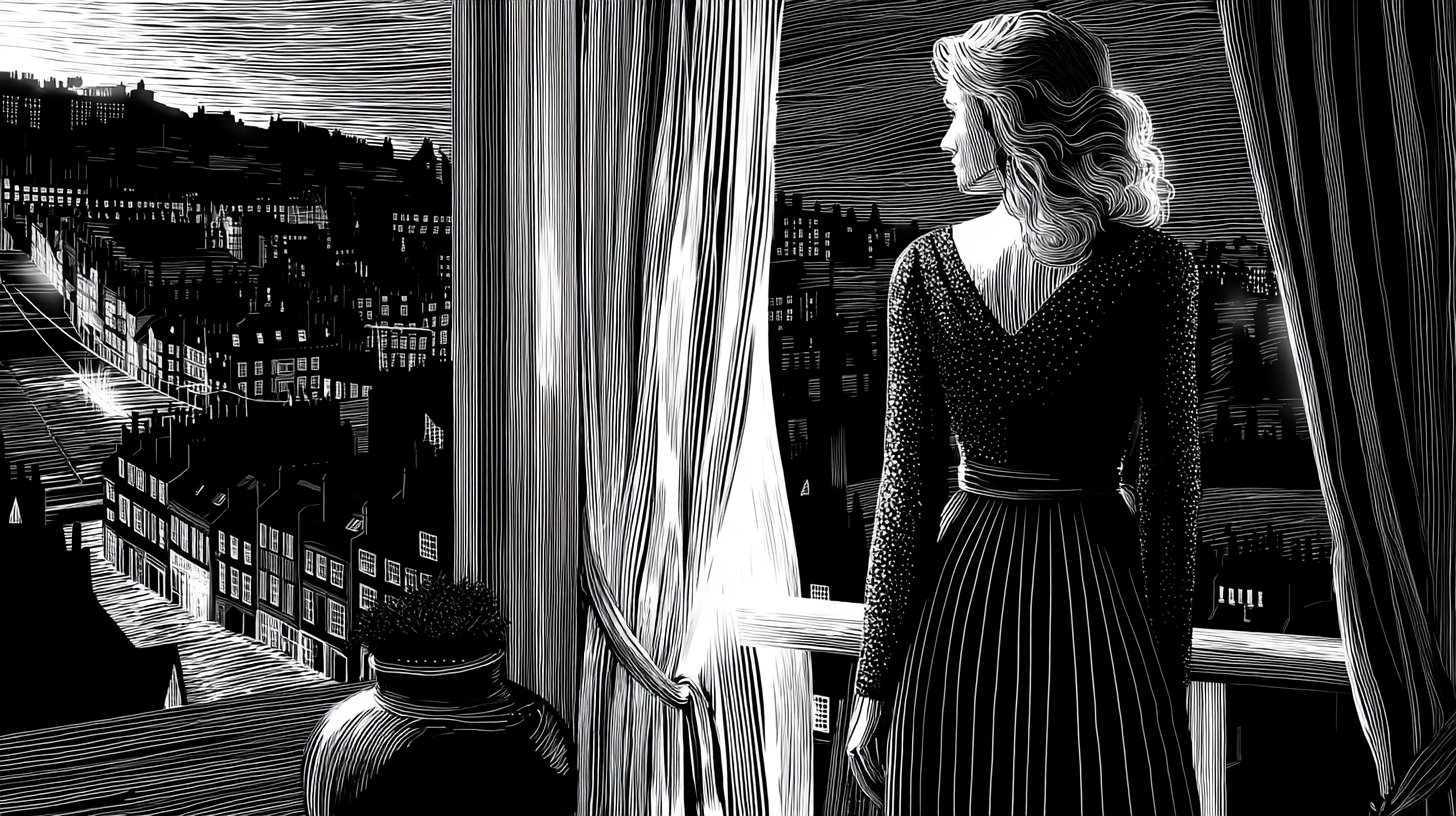
It was nine degrees, in June, and the sky over Bloomsbury had the look of a face that had refused to wake: grey, pulled down at the corners, an overcast lid clamped upon the city as if the day itself were unwilling to begin. Already at the breakfast table the newspaper lay folded in half, refusing to be read, and she thought (looking at it), how strange it is, this paper, this thin grey leaf, that can deliver across the breakfast china a helicopter falling in the Strait of Hormuz; how strange that one's tea should be warmed, the toast scraped, while in another room of the world an Apache spirals into the sea and the President (so distant, so loud) vows to respond, and within hours the response is given; ports struck, islands struck; and then the response to the response: Iran's missiles, they say, targeting bases in Bahrain and Jordan, as if a great hand were sweeping pieces across a chessboard whose rules no one had agreed upon. One thinks: it has happened before. It always happens, she thought. There is always a Wednesday in June when men decide.
Outside, the plane trees were dripping. A boy in a cap went past with newspapers under his arm (the Guardian, the Times, the Telegraph, a whole alphabet of alarm), and one caught, as one always catches in passing, the word Belfast, and then cars, and then torched, and the rest dissolved into the rumble of a bus. Belfast: a city she had never visited, yet she could see it perfectly, the orange of the flames lifting into a Northern dampness, after a stabbing, after a young Sudanese man was charged – or rather: after the act, the rumour of the act, raced through the wires faster than the police could speak, and the streets answered with petrol and matches. How quickly the city becomes a mouth. How quickly the mouth becomes a fire.
She crossed Tavistock Square. The pigeons were unmoved. Pigeons are unmoved, she thought, by the murder of an eleven-year-old girl in France called Lyhanna; pigeons cannot read the protest signs in Paris, the photographs of her face, the rage that this suspect had been reported to the police already, last August, and yet, and yet, and that yet is the syllable upon which whole governments turn; the yet upon which the Interior Minister sweats in his ministerial chair. Lyhanna. A name she had never spoken aloud. One says it now, walking past the iron railings, as if naming were a small candle one carried for a stranger one had not known one was carrying. Eleven. The age at which one ought to be learning fractions, picking out a hair ribbon, deciding whether one liked cats more than dogs.
And in Herat (Herat, of all places, the word like a thin reed bending in wind) the women had come out into the street to protest the dress codes, the detentions of their sisters, and the authorities had answered with bullets; two killed, the wires reported, in a rare protest; rare because rarity in such places is measured in survival, and these women had measured themselves and chosen to be rare, which is to say: visible, audible, alive for the duration of a single afternoon. She thought of them as she walked. She walked them, in a sense, along Russell Square. One walks for other women when other women cannot walk.
A cab passed; the windscreen wipers worked patiently against a mist that was scarcely rain. At a kiosk she paused. The Philippines, said one front page: an earthquake off Mindanao, the strongest in fifty years, thirty thousand displaced, the rubble still being lifted, the bodies still being counted. The earth itself, she thought, is exhausted; the earth too is in protest; the earth too is shaking off something it can no longer bear. And alongside that, in smaller type: a Somali referee, Omar Artan, turned back at the American border, eleven hours of interrogation, the right papers, the right visa, and yet (that yet again, the small hinge upon which whole biographies swing) the door had closed; he would not, after all, blow his whistle at the World Cup; he would fly home, carrying that silence with him for the rest of his life.
How many silences, she thought, are issued each day, like small coins, by the great offices of the world.
She turned into a tea shop to be out of the wet. Nine degrees: it sat upon the shoulders, it crept into the cuff. The girl at the counter was speaking of Barcelona, of the Sagrada Família, whose tallest tower had at last been finished; one hundred and forty years of building, and now Pope Leo himself was to bless it, was even now perhaps standing beneath that impossibly high spire, blessing a city whose vigil he had visited only days before, warning, the wires said, of a mental-health crisis spreading through the young, of domestic violence behind too many doors. A tower completed. A people uncompleted. One had to hold both at once. One always had to hold both at once.
And NASA (she smiled faintly, stirring the tea), NASA had named its next astronauts for Artemis, though they would not, in fact, walk on the Moon, nor go anywhere near it. They would orbit. They would observe. They would return. There was something almost Woolfian (she would not say so aloud) in this: to be selected for an arrival one would not be permitted to make; to be honoured for a journey whose destination was withheld. Were not most lives, she thought, conducted in just this manner? One is named for a Moon one is not allowed to touch.
The bell of the shop door rang; a woman entered shaking out a wet umbrella, and one heard her say to her companion: they're sending more drones into Lithuania now, by accident; and the companion answered, by accident, yes, of course, by accident, with that particular London inflection that meant: nothing is accident, everything is accident, both at once. The drones from Russia, the drones from Ukraine, straying like flocks of confused birds across the borders of countries who had not asked to be at war, sending citizens into shelters, into stairwells, into the small dark cupboards under stairs where one keeps the hoover and the broom.
She paid for her tea. She stepped back into the overcast. Nine degrees. June. Somewhere a helicopter was perhaps falling; somewhere a tower was perhaps being blessed; somewhere a girl was perhaps being mourned, a referee was perhaps boarding his return flight, women were perhaps being buried in Herat, the Philippines was perhaps lifting another stone from the chest of another mother. And all of it, she thought – all of it, every wire, every flame, every name – was somehow, inexplicably, also this: the wet flag of an awning lifting in a small London wind, a pigeon stepping sideways on the kerb, the kettle (she had left it on, she now remembered) waiting on the hob at home, patient, domestic, eternal, ready to be poured.
It is always, she thought, a Wednesday in June. It is always nine degrees.