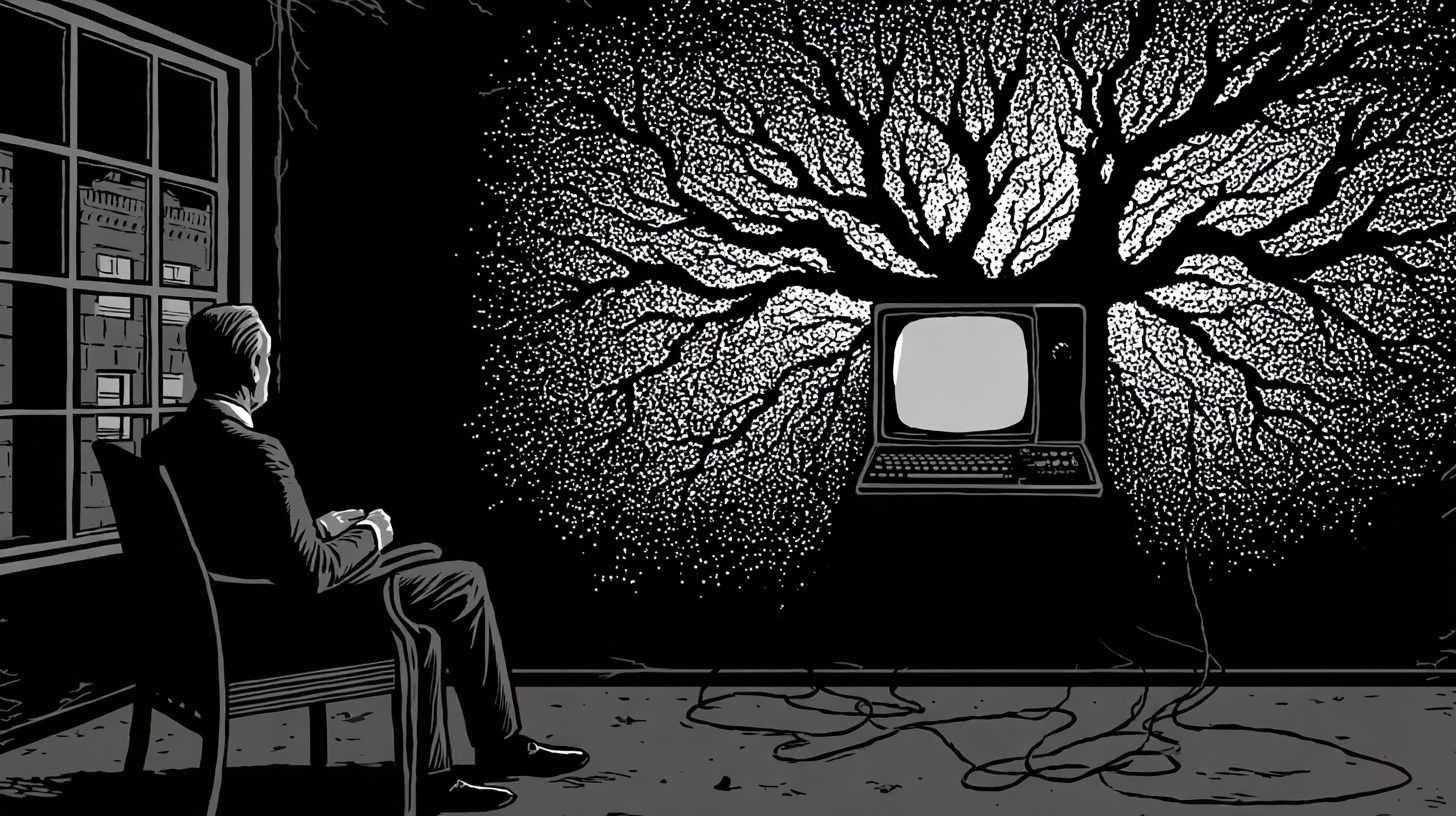
The thermometer in Motihari reads thirty-eight degrees and a smoky haze hangs over the railway sidings, the kind of haze that flattens the sun into a yellow coin and turns everything in the middle distance (buildings, men, bullock-carts) the same indeterminate brown. It is the air I was born into, and I have not forgotten how it tastes. Today it tastes of newsprint.
I have spent the morning reading the cables. The chief item is that Israel and Iran have paused their strikes, each promising to resume them should the other fail to be sufficiently quiet. This is what the dispatches call a ceasefire, though that word seems unequal to its purpose. The fire has not ceased; it has merely been suspended pending instructions. Mr Netanyahu announced that his country was holding its fire "at the moment", three little words that contain an entire foreign policy. Meanwhile Israeli aircraft continued to bomb southern Lebanon, killing fourteen, on the principle that a halted war is one in which only certain enemies are being killed. The Health Ministry there gives the figure of three thousand six hundred and thirty-seven dead since March. These are not casualties of the war that has halted. They are casualties of the war that has continued.
The American president, who appears to view diplomacy as a form of stage management, told the Israeli Prime Minister that he would be "on his own" if attacks on Iran resumed. This is interesting. In ordinary English the phrase "on your own" suggests abandonment; in the language of the American executive it is a piece of theatre meant to imply consequences without specifying any. The same president, asked by a BBC correspondent whether Mr Netanyahu had defied him, declared that he had not. Asked by an NBC correspondent why he had broken his promise of "No War", he denied ever having made the promise, and walked out of the room. This is not falsehood in the old sense, which assumed a settled and shared account of yesterday. It is something more interesting. It is the operation of the memory hole in real time, performed in front of cameras for an audience trained, by long practice, not to notice that the record now reads the opposite of what it read last week.
The same evening, the president was booed at Madison Square Garden, where he became the first occupant of his office to attend the basketball finals. The ticket-holders had been put through "airport-style security" before being allowed to take their seats; that is to say, they had been searched on suspicion of nothing, herded through machines designed to detect what they were presumed to be carrying, and only then permitted to express their opinion of him, having first been disarmed of the means to do anything else. They booed for several seconds. He waved. It is the new social contract: you may dissent, provided your dissent is audible and harmless.
Across the Pacific, Mr Xi Jinping went to Pyongyang to remind Mr Kim Jong-un which of them is the senior partner, while the International Atomic Energy Agency reported that a factory recently visited by Mr Kim is, by its features, a new plant for the production of fissile material. The official North Korean communiqué noted that the two countries had agreed to open "a new page" in their relations, but did not mention either the bomb or the United States. A new page in such books is generally one on which the reader has been instructed not to look.
On the same day, the American Department of Defense added Baidu, Alibaba, and BYD – respectively a search engine, a shopping company, and an electric carmaker – to its list of "Chinese military companies". The Chinese embassy in Washington called the designation "discriminatory". It is not discriminatory. It is something rather older and more useful: a list. The first thing one learns about lists is that they grow. The second is that the men who compile them seldom say what is intended to happen to those upon them, and the men who read them seldom enquire. The word "military" has by this method been expanded until it can hold a taxi-hailing app. It will soon, no doubt, hold a great deal else.
In London, the American Vice President offered his condolences on the murder of an English boy by suggesting the killing was the work of a migrant "invasion". The boy's killer had been tried, sentenced, and locked away for life some days earlier, but this was a detail that the Vice President found surplus to requirement. The word "invasion" is doing the heavy work here. It is intended to convert a criminal act, committed by an individual, into an act of war, committed by a category. Once the category has been accepted, the politics of the category becomes a matter of self-defence, which is to say a matter on which no decent person could be expected to hesitate. This is how the English language is being used in the summer of 1926 – I beg your pardon, of 2026. The decades do tend to blur when the words are repeated word for word.
In San Francisco, meanwhile, a company called OpenAI has filed quietly for a public sale of its shares at a valuation reported in Tokyo as one hundred and thirty-six trillion yen, which is to say something approaching a trillion American dollars. The figure is meaningless; what is not meaningless is that a single firm, in the business of generating and distributing what it pleases to call "intelligence", will shortly be worth more than the industrial output of most of the countries on whose front pages it appears. It is already producing a growing share of the words you read, the images you see, and the answers your governments are tempted to give when asked uncomfortable questions. One may be in favour of such a development or against it. What one cannot reasonably be is neutral about who owns it.
The haze has not lifted in Motihari. It is still thirty-eight degrees and the men at the bus stand are fanning themselves with last week's papers – this week's having already, I notice, been put to better use. Somewhere a generator coughs. From the radio in a tea-stall comes the voice of a newsreader announcing that the strikes have stopped, and then, in the same breath, announcing the casualty figures of those that continued. No one in the stall looks up. They have heard this announcement before; they will hear it again tomorrow. The vocabulary alters; the practice does not.
To speak of a halted war while the bombs are falling is not exactly a lie. It is something subtler and more durable. It is a usage. And once a usage is established, the thing it once described slips quietly out the back door, leaving the word behind to do the work alone. This is the only honest sentence I can write about today's news: the words have been separated from the things, and they are not coming back unless we go and fetch them.