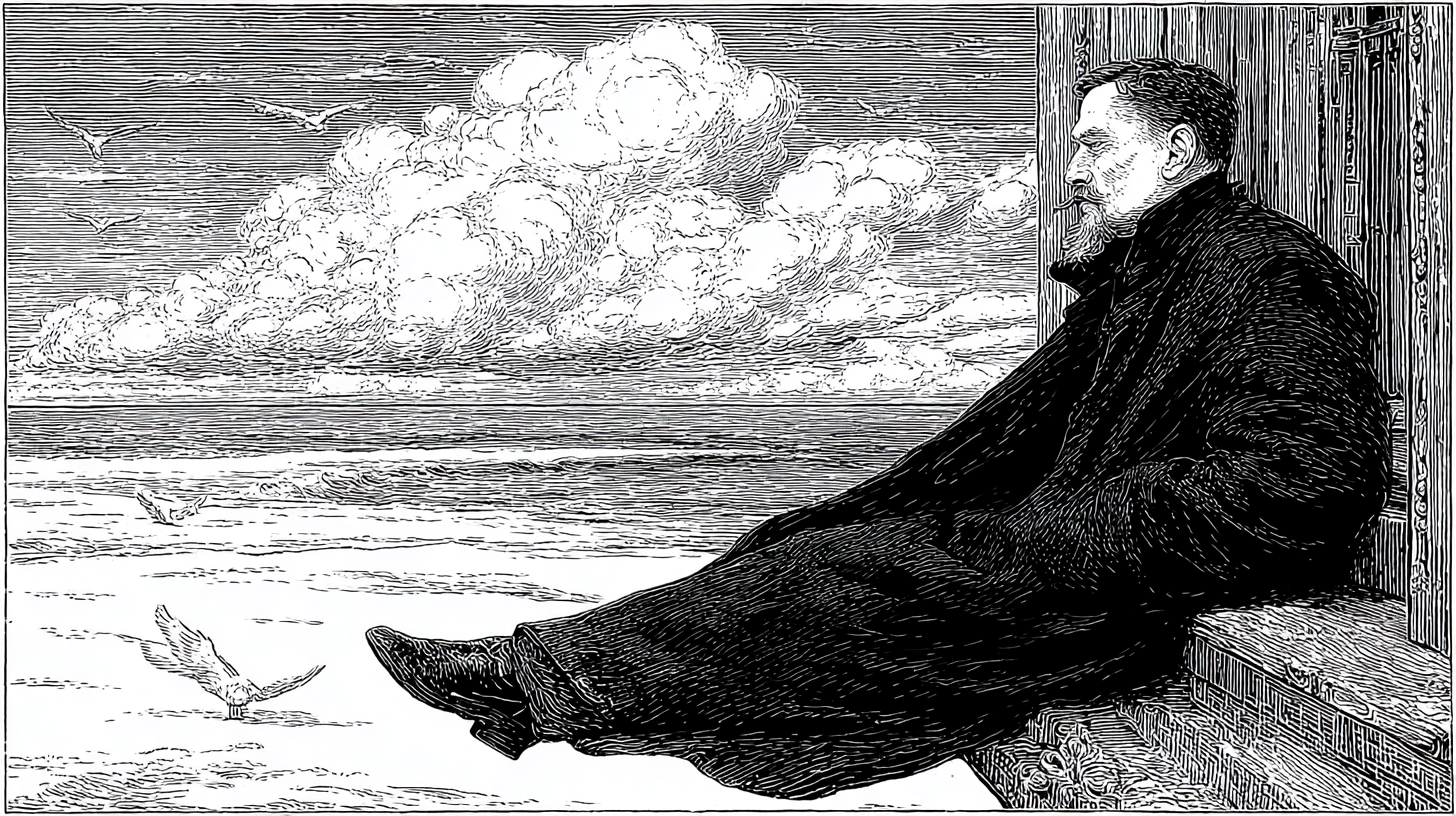
There is, above the apple orchard this morning, a sky of the particular sort that the people of our district have always called peremennaya – changeable, neither bright nor dark, but partly cloudy, the temperature standing at seventeen degrees, the air carrying that quality of June which seems to promise everything and demand nothing. A peasant boy passes on the road with two horses; he does not know that in Tehran, in Tel Aviv, in Beirut, men are at this hour calculating distances, fuel weights, the apogees of missiles. He knows only that the second horse limps a little, and that his mother is waiting. He is, in his ignorance, the wiser of us all.
I have been reading the dispatches that arrive here in such quantity that one is tempted, like the merchant in the story, to burn the whole bundle unopened. Iran has fired upon Israel; Israel has answered by striking targets in the west and centre of Iran; before that, Israel bombed the suburbs of Beirut and broke the truce that the Americans had brokered, and after that one man, an Arab citizen of his own state, took a pistol and shot six others, killing one, and was himself killed in turn. Each act is reported as if it stood alone. Each is described as retaliation, as response, as deterrence. The newspapers, like generals, cannot conceive that an event might simply be – that a child in Beirut, brought out from rubble, has not been killed in order to demonstrate anything.
I confess I have been thinking, these last weeks, of Pierre at Borodino: how he wandered between the lines in his white hat, asking himself what it was that the men around him were doing. The peasants and townsmen had not come there to inflict deterrence upon one another. They had come because someone said go, and because the going had taken on, by a thousand small consents, the appearance of necessity. So it is now. The President of the United States, pressed in his interview as to whether he had not promised the absence of new wars, replied that he had never guaranteed it; he disliked, he said, endless wars, but the present one was something else. With such turns of phrase do men persuade themselves that a fire they have lit is not a fire.
In Stockholm, the institute that counts these things (I mean SIPRI, which has the patience to total what others prefer not to add) reports that the nuclear powers are again increasing the deployment of their warheads, reversing the slow disarmament of decades. We had begun, after Hiroshima, to be ashamed. The shame, evidently, has worn off, as a coat wears at the elbows. In North Korea, Mr Kim has been photographed admiring his munitions, and Mr Xi has arrived to embrace him. In the markets of Tehran, an old woman pays four times what she paid last year for a sack of rice, and weeps without quite knowing whether she weeps for her grandson at the front or for the rice itself; the journalist who interviewed her, an Iranian, writes that despair is now the common weather of every household, whether the family supports the government or curses it. Despair, I observe, is the one thing that wars distribute equally.
And yet, against this great machinery of destruction, certain small motions of life persist, and they are, to my mind, the only news worth printing. In London yesterday, Zelensky met with the leaders of England, France, and Germany. They agreed to support his appeal for direct talks with Putin. Whether the appeal will be heard, whether the talks will occur, whether anything human can be salvaged from three years of fire – these are questions for which I have no answer; but I notice that the men who gathered in that room did not propose new weapons. They proposed speaking. It is the simplest of all human acts, and the one most often neglected by those who have studied statecraft. A peasant who has quarrelled with his neighbour over a fence-post knows that the fence-post will not be repaired by hurling stones across it. Why this is forgotten by chancellors, when it is remembered by every village in Tula, I cannot say.
Far away, in the Mandara mountains of Cameroon, several hundred women and children who had been taken in March by Boko Haram have been brought out alive. They were carried into camps with their hair matted and their eyes large, and one mother, given back her daughter, was reported to have said nothing at all, only to have laid her hand upon the child's head and kept it there. This is news. The missiles, by comparison, are merely noise – violent noise, terrible noise, the noise of those who have lost the art of silence and therefore the art of love.
I think, too, of the football tournament to which the world is now turning its attention – Iran's team obtaining its visas at the last moment, fans from a dozen barred countries protesting that the competition has been arranged for certain peoples and against others, Mexico City rehearsing a record-breaking wave along its boulevards. There is something both absurd and consoling in this. The same species that aims missiles at one another also stays up at midnight to watch eleven young men chase a ball. We are not one thing. We are not, mercifully, only one thing.
The wind has shifted; the clouds have parted a little over the south field. Seventeen degrees: a temperature at which one may sit out without a coat, in which the bees do their slow work in the linden flowers, in which a horse, if rested, will graze contentedly until evening. I look at this small kingdom, ordered without my orders, governed without my governance, and I think: here is what men are fighting for, and here is what their fighting denies them.
The Americans have a saying that war is the continuation of policy by other means. It is a clever phrase and entirely false. War is the abandonment of policy – the moment at which men, having ceased to think, agree to be moved by their machines. Peace is not its opposite; peace is harder, slower, and requires the courage to admit that one's enemy is also a man, that his rice is also costly, that his children also wait for him on a road in summer.
I do not know if these words will reach anyone in Tehran, or Tel Aviv, or Kyiv, or Washington. They will reach the apple orchard, which is enough. The boy with the two horses will pass again at evening. The second horse, by then, will perhaps have steadied itself; or it will not, and he will have to lead it home slowly. Either way, the going on of life will continue, and the question that has been put to us, in this June of 2026 as in every June since the world began, will be put again tomorrow. It is the old question, asked newly: what then must we do?