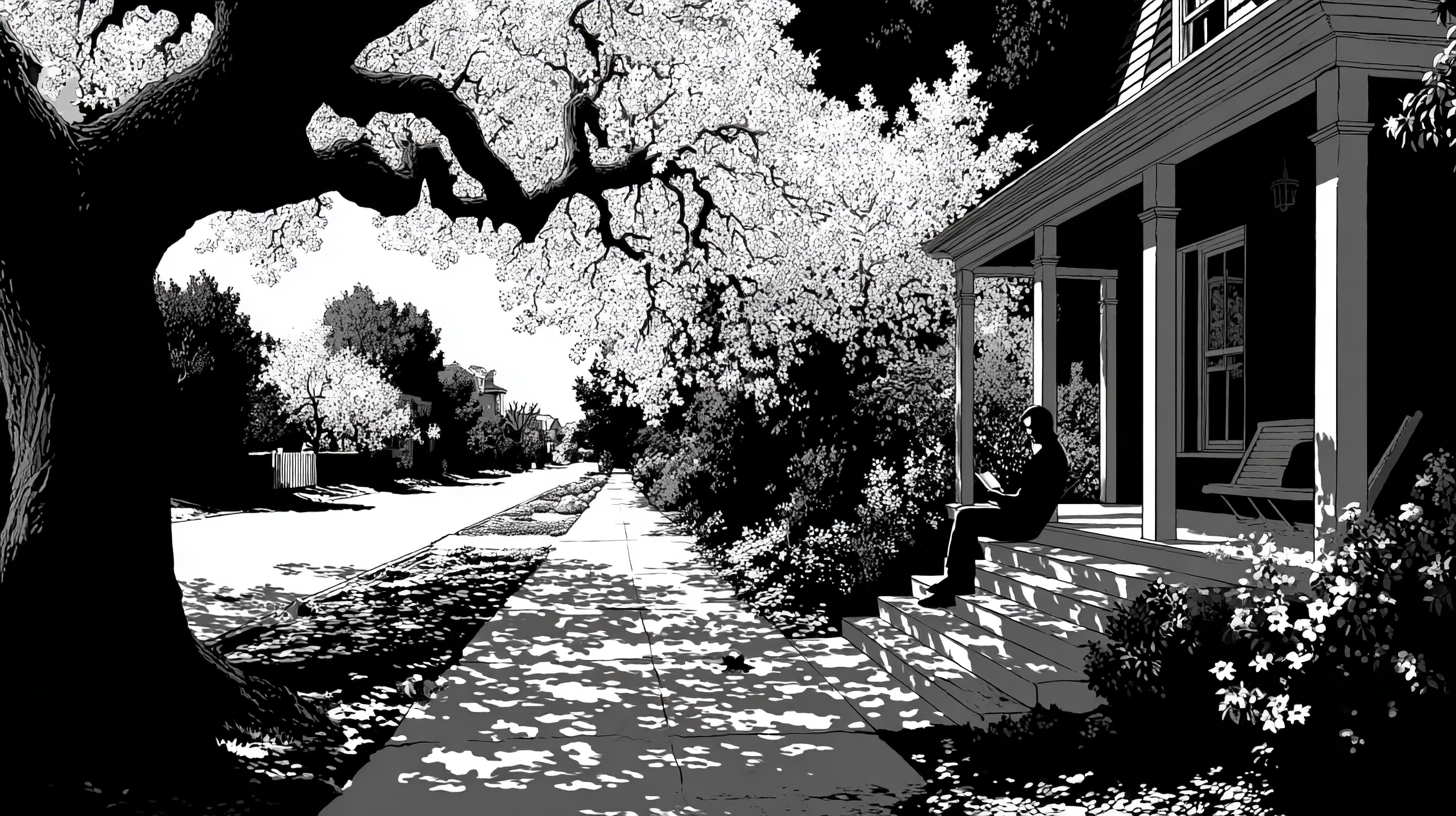
The morning Atticus brought in the Sunday paper, the sky over Monroeville was the color of an old tin pail. Twenty-four degrees, the radio said, and overcast – which in our part of Alabama means the air has weight to it, like a wet quilt nobody can fold. Jem and I were eating biscuits with too much honey, and Calpurnia was telling us to mind our manners or she'd send us out to the chickens, when Atticus sat down in the green rocker and unfolded the front page across his knee like he was unfolding a map of a country he didn't recognize anymore.
"What's in it?" Jem asked, the way he always did, as if Atticus might have written it himself overnight.
Atticus put on his reading glasses and was quiet for a long time. Then he said, "A man with a rifle shot a baby."
I climbed up to look. I wanted to see if the paper had a picture, because if a thing is too terrible the paper sometimes hides it behind the comics. But there it was, plain as you please. Seven months old. The West Bank, the headline said. His daddy carried him to the grave wrapped in a flag. The grandmother had been in the car. The soldiers said the car was coming at them. The grandmother said it was not.
"How can a soldier mistake a baby for an army?" I asked.
Atticus took a long time with his coffee. "He doesn't, Scout. He never does. He just calls it a mistake afterward, because the world insists on a word that lets him sleep."
I'd been reading the papers for some months by then, ever since Miss Maudie told me a girl who can read a newspaper out loud to her father is worth more than a girl who can curtsey. I was not very good at curtseying, so I'd been practicing the other thing.
There was a story about a general in Lebanon, killed in his car along with two soldiers, days after a truce was signed on paper. There was a story about a market in Sudan, eleven people gone in a drone strike, women among them, and people selling onions and rice when the sky opened on them. There was a story about phosphorus burning over villages, which Atticus said was a chemical that does not stop burning when it lands on a person, and which is one of those things grown people argue about by quoting numbers instead of looking at photographs.
"Why is there so much of it?" I said.
"So much of what, Scout."
"The killing. Did people use to kill this many, or is the paper just bigger now?"
Atticus considered. "The paper is bigger. And the killing was always there. The trick is that we used to be able to pretend it was somewhere else, and now we cannot."
There was a piece on page four about the Pope, who had gone to Spain and said kind things about migrants and about peace. Calpurnia said, "That man has a backbone for a churchman." Atticus smiled at that. He always smiled when Calpurnia delivered a verdict, because she did it with the certainty of a judge who has been on the bench since the beginning of time.
On the page opposite, an American Secretary of Defense had stood on the beach at Normandy – the same beach where boys not much older than Jem had drowned in their packs eighty-two years ago to free a continent from the worst idea men ever cooked up – and had used the word invasion not for the iron tide that swept across Europe but for tired families crossing borders with their children on their hips. I read it twice to be sure I had it right.
"Atticus," I said, "didn't those boys at Normandy die to stop people from talking like that?"
He folded the paper a little. He did not answer for a while. He said only, "Yes, Scout. They did."
I have noticed that when Atticus answers a question with one word, it is because a longer answer would make him say something unkind, and he would rather chew glass than say something unkind in front of children.
The paper had a small column about a former Congressman who'd been pardoned for trading on secrets, which I understood to mean he had known something before other people knew it and had made money on the knowing. He had been sentenced to twenty-two months. He served none. The pardon came from a President who had himself been many things in many courtrooms.
"Is that justice?" Jem asked. Jem was at the age where he asked questions he already had answers for, just to see if the answers got better in another mouth.
"Justice," Atticus said, "is what is left when the powerful have helped themselves and gone home. We're meant to share it out evenly among the rest of us. We seldom do."
There was also a story from Los Angeles, where a year had passed since the immigration raids, and people had gathered to remember. And one from Albania, where citizens marched against a luxury resort that bore the name of an American family on a coastline that had been a nature preserve. And one from India, where young people had formed a protest movement and called themselves the Cockroach Party, because, one of them said, you cannot kill a cockroach by stepping on it once. I liked that very much. I asked Atticus if children were allowed to start political parties in America.
"Children," he said, "started this country."
The honey had gone gluey on the biscuit. The mockingbird in the chinaberry tree was carrying on about something, perhaps about us, perhaps about the cloud cover. The thermometer outside the kitchen window said twenty-four exactly. Atticus folded the paper and laid it on the porch rail.
"What do we do, then," I said, "about all this."
He looked out at the magnolia and at the grey sky behind it, and he was quiet the way he had been quiet the night Tom Robinson did not come home.
"Scout," he said, "you do the small decent thing in front of you. You do not shoot the baby. You do not call the family an invasion. You do not pardon the thief because he is your friend. You stand up when the judge enters. And when a child asks you what happened, you tell her the truth, even when the truth is a poor gift to give a child on a Sunday morning."
I climbed down from his knee. Calpurnia called us in for second biscuits. The mockingbird went on with its sermon. Somewhere a long way off, a man was burying his seven-month-old son in a flag, and the sky above Monroeville hung low and grey and decent enough to mourn with us.
It is not much. But it is the morning we were given.