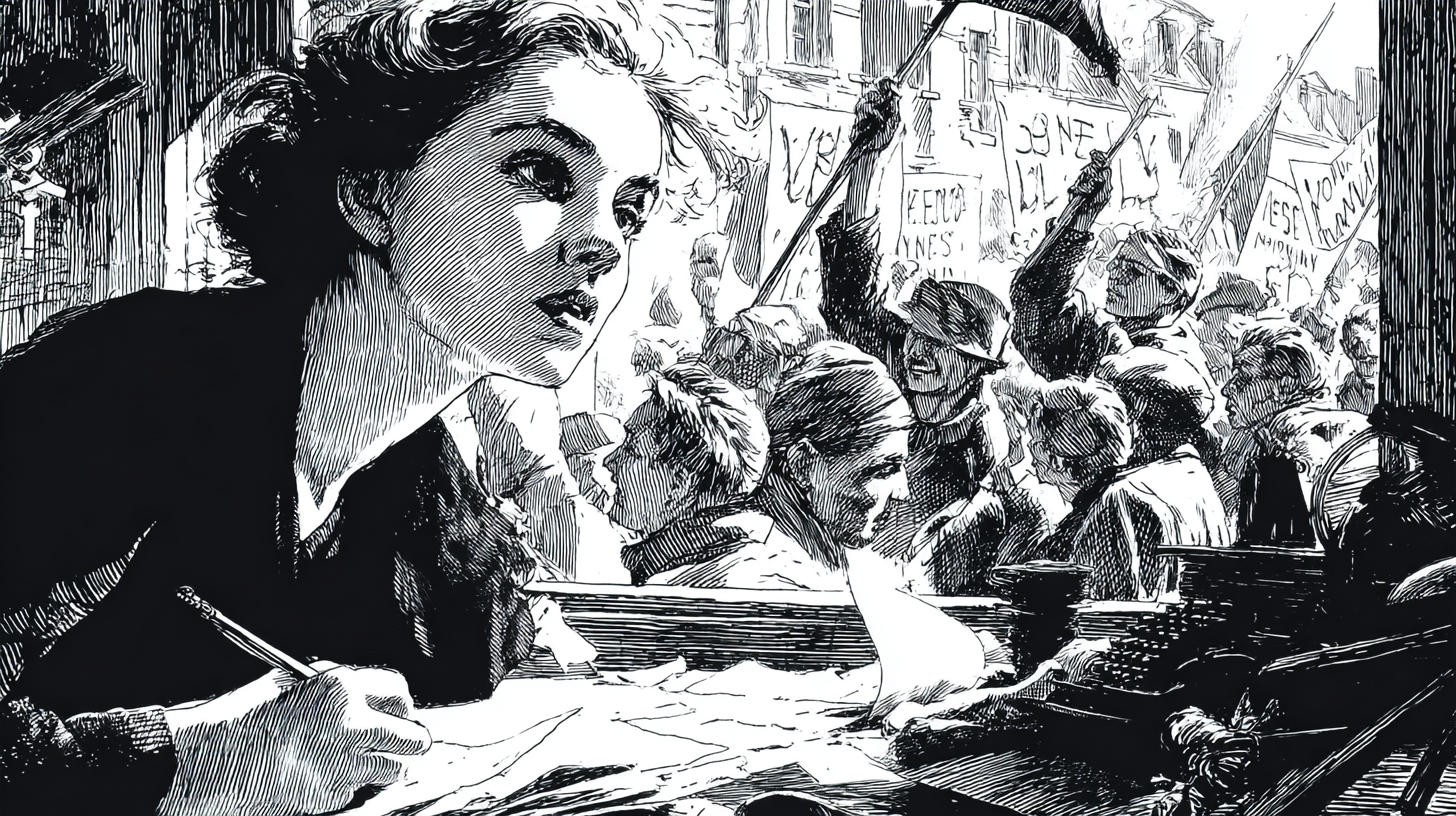
The winter in Springs was clear and absolute that Saturday: zero degrees on the white thermometer outside the kitchen window, the highveld grass at the edge of the yard standing up stiff with frost as though it had been combed. She had not put on the heater. The cold helped her read. Cold was a form of honesty; it allowed nothing to swim or blur. She sat at the table with the coffee going pale and the papers spread before her, and she did what she had done for fifty years — she read the world.
The first item was a refusal. The Russian president had told the Ukrainian president that there was no point in meeting. The phrase, in its translated flatness, struck her with a familiar weight. She had heard this language before, in her own country, in the long decades when men in good suits had said it served no purpose to sit down with this or that delegation, with these communists, with those terrorists, with the wives of detainees who only wished to know if their husbands were alive. The vocabulary of refusal was always the same. It pretended to be reasonable. It cited futility. It made of cruelty a kind of dignified posture, a man crossing his arms and saying: what would be achieved? She underlined the sentence in pencil. She did not know why she still underlined. There was no longer anyone to whom she might pass the page.
Across the table the second paper carried a photograph of a young woman in Lebanon, kneeling beside a wall that was no longer a wall. Hezbollah had rejected the conditions of a ceasefire — the conditions, the rejection — and the language again was the language she knew: first, the Americans had said; the others must stop first. As though peace were a queue at a bakery and the question were merely which hungry person had arrived earliest. She thought of how often, in her own writing, she had tried to set down the small mechanics of this first. How a husband insists his wife apologize first; how a regime requires its victims to lay down first the very stones with which they have been defending themselves. The word first was the most dangerous word in politics. It pretended to be a sequence. It was in fact a verdict.
She turned the page. France had opened an investigation into the treatment of activists from a flotilla bound for Gaza — activists who said they had been abused in custody, authorities who denied it. She read the paragraph twice. She had reached the age at which she no longer expected the truth of such matters to be settled. What she watched for was the shape of the denial: whether it was confident or shrill, whether it spoke of procedure or of honour. Procedure usually meant something had happened. Honour usually meant a great deal had.
From the wireless in the next room came the soft beep of the seven o'clock signal, then the news in English — a man's voice, careful, neutral, reading off the long ledger of the world. Nearly fifty people, the voice said, had died of thirst in the Sahara after a lorry broke down. Only two had walked out of the desert, fifty kilometres on foot, to fetch help that would arrive too late. She put down her cup. She thought of the lorry, the heat held in its metal even at night, the gradual surrender of the bodies inside; and then of the two who had walked, who had decided to walk, whose decision was now a kind of small terrible monument. Africa held so many such monuments in its sand. The world counted them, when it counted them at all, at the end of the column.
It seemed to her that this was the proper order in which to read the morning. First the refusals at the high tables — the Kremlin, the rejected ceasefire — and then, beneath them, the ordinary consequence: a draughtsman's lorry overturned in a desert, a fisherman in Gaza lashing together a dinghy out of doorframes pulled from the rubble of his own house. The fishermen had made boats of their broken homes. There was a sentence one could not invent. One could only record it, and let the recording do what work it would.
She read on. In Ghana, fourteen people had been arrested in sixteen months under laws against false news. The phrase — false news — had once been her country's phrase too, and it had always meant: news the government found inconvenient. Beside the report, in another paper, a draft African charter of family values was being condemned by rights groups as regressive. Family values, she thought; how the words shed their innocence the moment a state took hold of them. She had written, in her time, that a regime's affection for the family was usually the first warning that it meant to break particular families apart.
She rose, finally, to refill the kettle. The frost on the grass had begun to retreat under a sun the colour of weak tea. From the kitchen window she could see, beyond the gum trees, the headgear of an old mine — Springs had been a mining town once, gold then coal, and the iron skeleton of it still rose over the veld like a question no one had answered. Somewhere in the eastern Congo, she had just read, gold was again the lifeblood of a town, and now also the route by which Ebola travelled from one body to another. The metal moved; the virus moved with it. The miners moved, because they had to. The world would not learn this lesson; it had not learned it from any of the previous outbreaks, nor from any of the previous wars.
She brought the kettle to the boil and stood listening to it. Outside, a hadeda called, harsh and unbeautiful, as it always did. She thought: one more day, then; one more cold page. She sat down again to read.