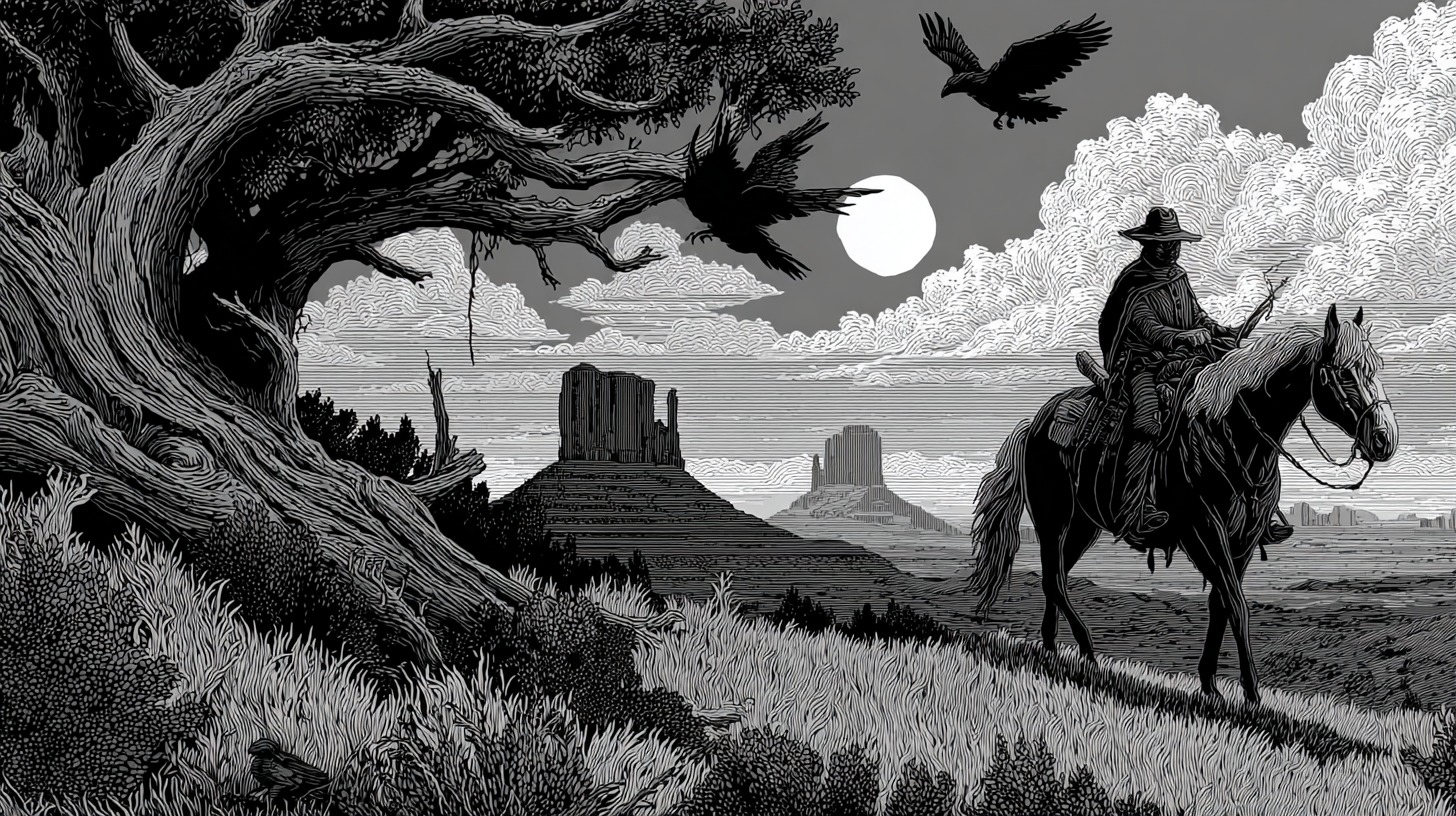
The rain came down out of the western sky at seventeen degrees and the man stood at the window in Santa Fe and watched it darken the tile and the old adobe wall beyond and listened to the gutters running. The piñon smelled wet. A small lizard had folded itself under the lip of a clay pot and lay there with its black eye turned upward as if it too were waiting for word from the world.
He turned from the window and crossed the room. On the table the radio muttered to itself in a tongue half English half static. Out of the noise came names of places where the dying was being done. Qeshm. Kyiv. Mossel Bay. Beirut. He poured coffee from a pot grown cold on the burner and stood with the cup in both hands and listened.
They were striking each other across the Gulf again. The Americans had put their fire upon an island in the strait and the Iranians had answered with missiles toward the kingdoms of Kuwait and Bahrain and the missiles had been knocked down or had failed of their own accord and fallen burning into the sea. The voice on the radio said self-defence and the man set the cup down and did not drink. There is a word men use when they do not wish to look at what they have done. It is older than any book and shorter than truth.
He had read once that the Mediterranean was a sea of bones. Now the Black Sea also and the Sea of Marmara and that narrow place called the Strait of Hormuz where the oil moved beneath the tankers like a black and patient blood. A boy somewhere in Tehran would wake in a room of plaster dust and would not know the name of the country that had killed him. A boy in Kyiv had already woken or had not woken. Twenty-two were dead in the capital. The Russians had told the city for a week that the strike was coming and had let the telling work upon them and then had struck. There is a torturer's logic in such delay. The bombs that fall and the bombs that do not fall both fall.
A man called Zelensky had asked the Americans for more missiles for the air. The Americans were busy with their own missiles. The Russians had opened an economic conference and were inviting western businessmen to come and shake their hands above the long table while in the south the towns were burning. The world had grown adept at this. To trade in one room and to bury in the next and to call the arrangement civilization.
In the high country of Lebanon the planes still went out over the cedars and over the ruined villages and the partial truce held and did not hold. There was a thing the dead call a ceasefire and there was a thing the living call it and they are not the same thing. Hezbollah had learned to fly small machines that hunted men by the heat of their breathing. The papers said the Israeli campaign had begun with high hopes and had become an impasse. High hopes. The man at the window thought on those words a long while. He had seen the country itself once long ago and remembered the white stone and the goats and the children with their black eyes and he did not know what hope a campaign could hold that ended in such an arithmetic.
In Tunis they had given an old man named Ghannouchi life in prison for forming what they called a terrorist alliance and somewhere in Britain a student named Henry Nowak had been stabbed and handcuffed by the very officers who watched him die. In South Africa five Mozambicans had been killed for the crime of being from the wrong side of a line drawn upon a map by men long since gone to dust. The cruelty of nations is not in their wars only. It is in the ledger they keep and in the smallness of the spaces they will not share.
He went out to the porch. The rain was thinning. To the west the cloud broke and a column of light fell upon the Sangres and lit the wet juniper and ran down the slope like something poured. Seventeen degrees. The cooler air come down off the mountain. Somewhere a dog was barking and would not stop.
He thought of the boy stabbed in the British city and of the boys in the Gulf who would not see another summer and of the women in Zimbabwe whose small electric carts had been taken from them by men with badges and ledgers, taken in the name of order and licensing and the long thin reasons men give for grinding the poor. He thought of a town in Kenya where two had died protesting the building of a quarantine for the foreign sick, and of the foreign sick themselves, and of the great old word contagion which means only to touch together.
The weather service had said it would be a year of El Niño. Eighty percent likely. The temperatures would rise across most of the earth and the rains would come where they were not wanted and would not come where they were. The wires said this in the same flat voice that they said the missiles and the markets and the football scores and the man who had been mauled by a bear in a Japanese steel works and the divers in the Bahamas who had at last found the burnt hull of a pirate's ship beneath the Nassau harbor. The world is one long sentence and the wires only punctuate it.
He thought also of his own country. A president who had again called the great northern republic of Canada the fifty-first state and the Canadian trade minister sitting across a table the wood of which had been logged perhaps in that very country, and in the south of his own land a congressman had won a primary without anyone having seen him for months. There is a politics that does not require a body. There is a politics that requires only a name and a logo and the loyalty of men who have stopped looking.
The rain quit. The lizard came out from under the pot and went its slow way across the wet tile. The man stood there a long time. The dark was coming down out of the canyon and the cottonwoods stood black against the last green of the sky and the wires went on speaking in their tongue half English half static of all that had been done and all that would be done.
He closed the door behind him. The coffee was cold. The world had not asked.