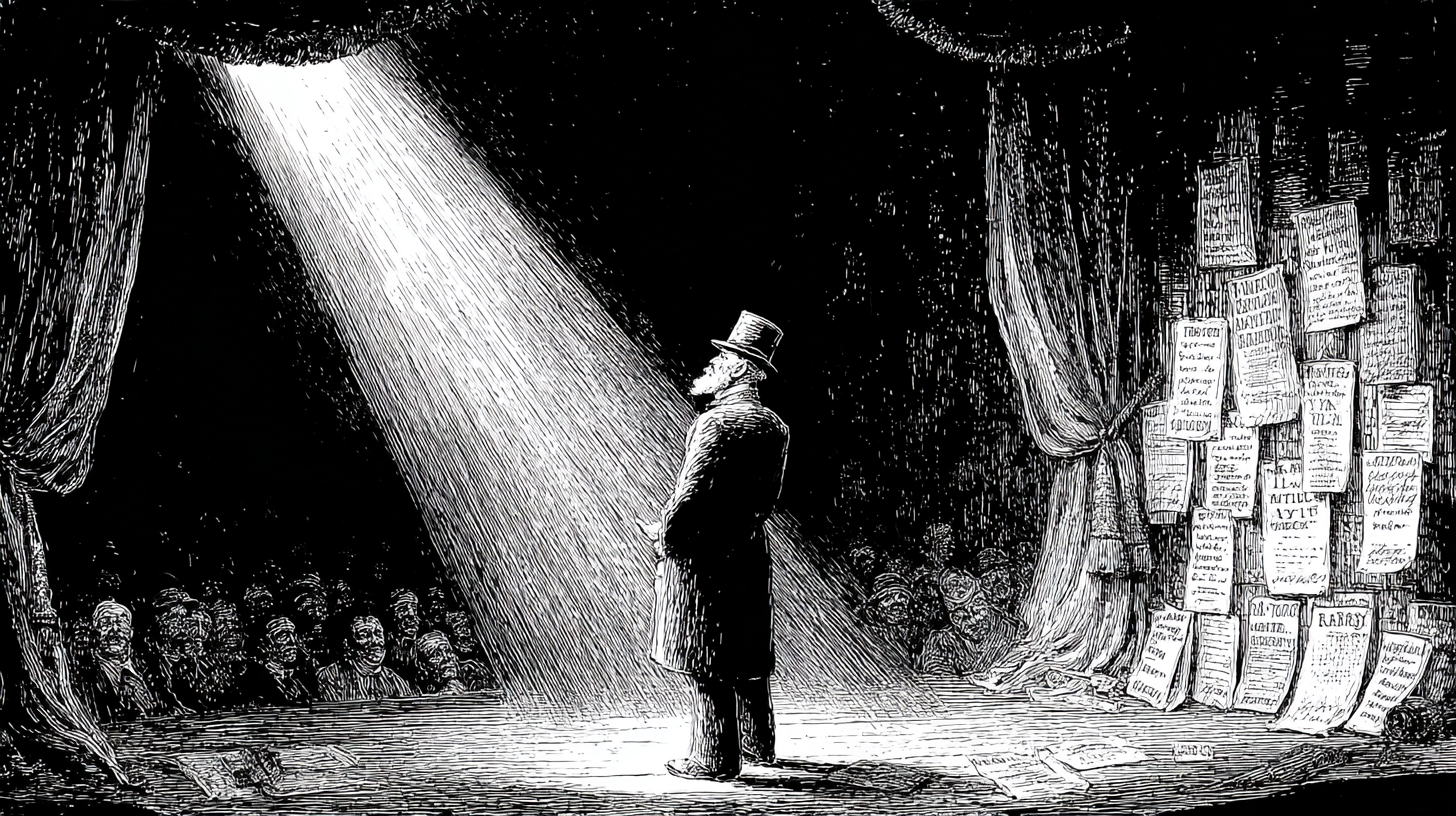
PROLOGUE, spoken from a platform in Augsburg, where the sky is clear and the thermometer reads eleven degrees.
Comrades, neighbours, readers –
do not lean forward.
Do not lower the lights.
Do not arrange your face into the expression a story expects.
The morning is eleven degrees. The sky is uncomplicated.
The clarity of the weather is not a metaphor.
A clear sky does not mean a clear conscience.
A clear sky means only that the bombers, should they come, will see well.
I am back among you because the news has a familiar shape.
A familiar shape is the most dangerous kind. One stops looking.
So today we will look.
SCENE ONE. Two men sit at a small table. They are statesmen. They wear the dignity of men who have ordered things.
FIRST STATESMAN: We have agreed not to attack one another.
SECOND STATESMAN: Excellent. When does this agreement begin?
FIRST STATESMAN: It has begun.
SECOND STATESMAN: Then what was that, just now, in the sky above Lebanon?
FIRST STATESMAN: A misunderstanding.
SECOND STATESMAN: And the projectiles intercepted over the Galilee?
FIRST STATESMAN: Also a misunderstanding.
SECOND STATESMAN: And the funerals tomorrow?
FIRST STATESMAN: Funerals are not part of the agreement.
An aide enters with a telephone. It is the President of the United States, who would like the war to end before an election, but not before a profit.
PRESIDENT (from the telephone): I have brokered peace.
FIRST STATESMAN: Of course you have.
SECOND STATESMAN: We are very grateful.
PRESIDENT: Now I would like the credit.
FIRST STATESMAN: The credit is yours.
SECOND STATESMAN: The dead are still ours.
Curtain. No applause. The audience is asked instead to consider why a ceasefire announced at midnight is contradicted by sunrise.
SONG OF THE ARRANGEMENTS
(To be sung by a chorus of clerks in identical suits.)
When the powerful say peace
they mean a pause for inventory.
When the powerful say deal
they mean the books must balance.
When the powerful say halt
they mean halt the cameras, not the shells.
We have heard these words before.
We will hear them again.
The dictionary of the strong contains only one word
and it is spelled differently each morning.
SCENE TWO. Kyiv, before dawn. A woman stands beside a high-rise that is no longer a high-rise.
WOMAN: My neighbour was on the fifth floor.
NEIGHBOUR (offstage, under the rubble): I am still on the fifth floor.
WOMAN: He grows tomatoes on the balcony.
NEIGHBOUR: The tomatoes are unharmed.
A man enters. He is a former chief of staff to the President. He carries a bowl and is asking for bail money. He once consulted a fortuneteller. The fortuneteller did not predict this scene.
FORMER CHIEF: Please give generously.
WOMAN: My building has fallen.
FORMER CHIEF: My career has also fallen.
WOMAN: Mine had people in it.
The audience is reminded that corruption and missiles arrive in the same week, from different directions, and ruin different things, but ruin is ruin. The audience is asked to count nine dead. The audience is asked to count, also, the millions allegedly embezzled. The audience is asked which figure is permitted to outrage them, and why.
SCENE THREE. Bogotá. A balcony. A lawyer in a tailored suit has just won the first round of an election. He admires a foreign president whose name we have heard before.
LAWYER: I will be Colombia's saviour.
A VOTER: From whom?
LAWYER: From the politicians.
THE VOTER: You are a politician.
LAWYER: From politics, then.
THE VOTER: Politics is the name for what you intend to do to us.
LAWYER: I have a new name for it.
THE VOTER: I will need to learn it before you do it.
Meanwhile, in Mexico City, riot police teargas teachers ten days before the World Cup arrives. The teargas is on schedule. The teachers were demanding a salary raise. The salary raise was not on schedule. In Chile, the unions burn placards because the social programmes have been cut. The placards are cheaper than the programmes.
CHORUS: The far right is a clever name for an old habit.
The habit is: when the table is shaken, blame the tablecloth.
SONG OF THE MACHINES
(Sung by a young engineer who is about to be very rich.)
I have built a great machine.
It speaks, it writes, it advises.
It is going to the stock market this autumn.
Its name will be remembered.
In Florida, a court is asked to consider
whether my machine helped a man find his weapons.
I am sorry. The machine is sorry.
The machine cannot, however, return the dead.
The dead are an externality.
The machine is a public offering.
The investors are very interested.
The investors are not Floridian.
I have built a great machine.
I have not built a great morality.
You did not ask for that.
You will not be given that.
INTERLUDE. A newsroom in Washington. The doors of the press office of the Department of Defense are being locked from the inside.
A SPOKESPERSON: For reasons of security.
A REPORTER: Whose security?
SPOKESPERSON: Yours.
REPORTER: I do not feel safer.
SPOKESPERSON: You will, once you have stopped asking.
Elsewhere, the President prepares to insert himself into the centre of his country's 250th birthday celebrations. The celebrations were intended to belong to the country. The country has been informed that it now belongs to the celebrations.
SCENE FOUR. Augsburg again. The weather has not changed. Eleven degrees. The sky is still clear. A child asks a question.
CHILD: Father, why is the sky so blue today?
FATHER: Because nothing is burning here.
CHILD: Is something burning elsewhere?
FATHER: Always.
CHILD: Is that our fault?
FATHER: Partly. The factory at the edge of town makes parts. The parts go somewhere. Somewhere is where the burning is.
CHILD: Could the factory stop?
FATHER: The factory could stop.
CHILD: Why does it not stop?
FATHER: Because then we would have to think of a different reason to get up in the morning.
Long pause. The audience is asked to consider what reason they have, this morning, June the second, twenty twenty-six, for getting up. The audience is asked not to answer too quickly.
EPILOGUE, spoken plainly.
You came to read a newspaper.
Instead you have read a play.
This is also a kind of news:
that the events of any morning,
arranged as scenes,
reveal what their arrangement as headlines conceals.
The ceasefire is not a ceasefire.
The election is not an election.
The agreement is not an agreement.
The machine is not a marvel.
The locked door is not a security measure.
The eleven degrees, however, are eleven degrees.
The weather is the only honest party left.
Go now.
Do not feel.
Think.
And if, after thinking, you act –
remember that the stage is wider than the theatre,
and the play is still being written
by people who have not consulted you.