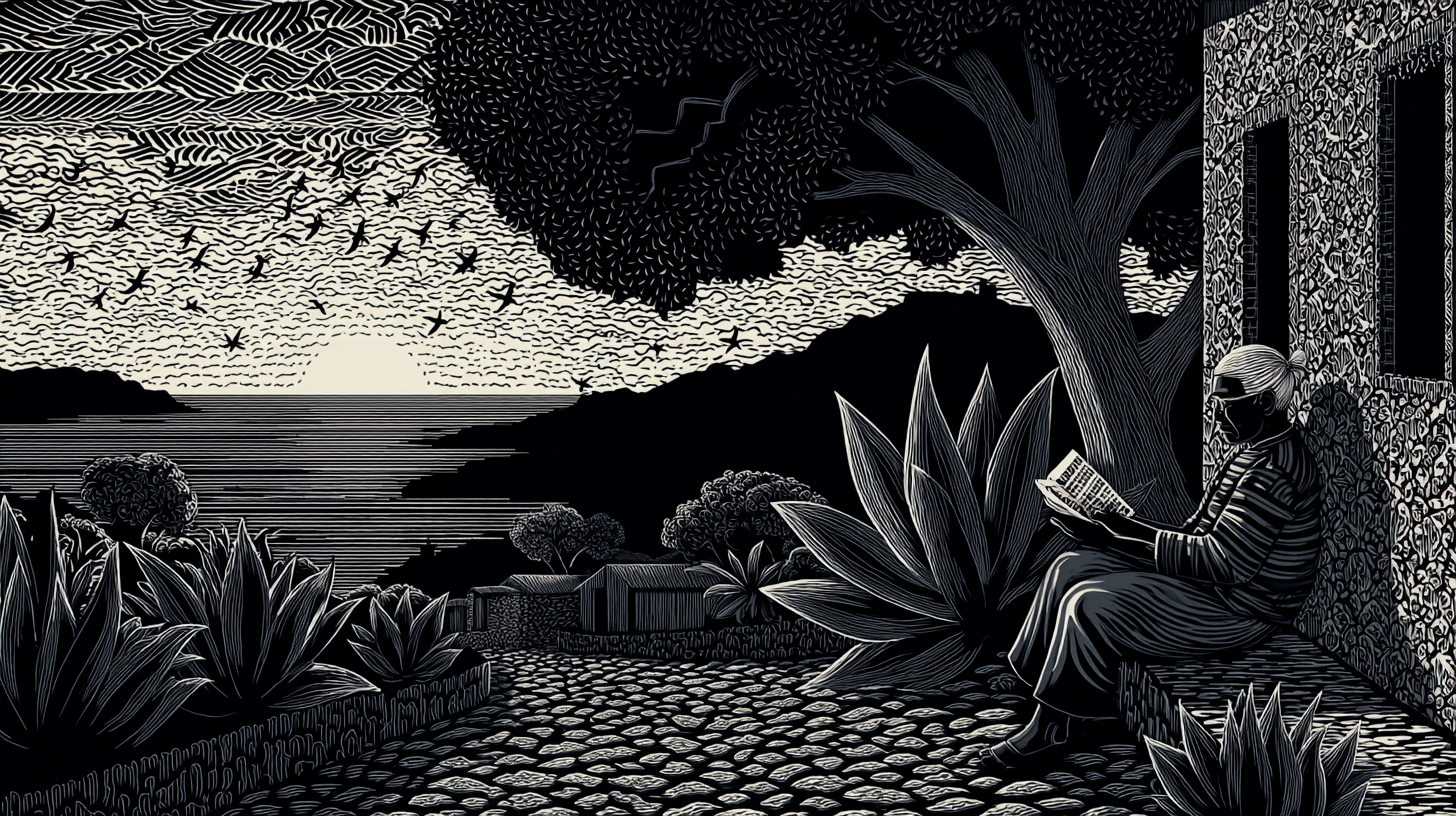
On the morning the country voted, the wind in Aracataca turned cold without warning, and by midday the thermometer at the pharmacy of the Italian had fallen to twelve degrees, a figure so improbable beneath that clear and unblinking sun that the oldest women crossed themselves three times and the parrots fell silent in the almond trees. It was the first of June, and in the capital, far from our river and our heat, my countrymen were choosing between two men who, like the twin sons of an unforgiving century, had been delivered to the ballot by forces no one could any longer name. The senator Iván Cepeda, who had inherited the weariness of his slain father along with a faith in justice that the dead rarely permit the living, would face in three weeks the lawyer Abelardo de la Espriella, who admired the northern emperor and spoke of order as if order were a saint with a feast day. Between them lay the country, and the country, that Sunday, was the colour of an unripe guava.
I had come back to Aracataca to bury an aunt who had refused to die for eleven years, and I found the town exactly as I had left it the first time I had left it forever: the same dust, the same impossible heat that had now, for reasons no almanac would later explain, abandoned us. In the plaza they spoke of the election with the resigned passion of people who have voted in every direction of the compass and have always arrived at the same square. A man with one eye said the cold had come because God was watching, and a woman selling sweetened ice said God had stopped watching long ago and that was precisely the problem.
News from the wider world arrived through the radio of the barbershop, which had been left on for so many decades that no one remembered who had first switched it on, and the voice of the announcer that morning carried the heavy ceremonial cadence of a man delivering eulogies. In a country called Nicaragua, which our grandfathers had once visited in the cargo holds of banana ships, an indigenous leader named Brooklyn Rivera had died after three years inside a prison from which no letters were permitted and no light entered. He was seventy-three years old. He had been the voice of the Miskitu people, and now he was the silence of them, and the regime that had buried him alive in life had at last buried him properly in death, and the dispatches noted only that rights groups had condemned the matter, as rights groups always do, while regimes continue, as regimes always continue, the methodical work of forgetting.
Off our own Pacific coast the announcer reported that the dead had now passed two hundred. The boats of the fishermen had been blown apart from the skies by aircraft that belonged to the empire of the north, in a campaign against narcotics that had become, by an alchemy familiar to all of us, a campaign against the act of fishing itself. The widows in Tumaco and along the Esmeraldas shore had begun to refuse the sea altogether, as if the ocean, which had fed them since before there were widows, had at last conspired with the sky to become a thing of murder. I thought of my own grandfather, who had taught me that the sea was a country one could not betray, and I understood that he had been wrong, or perhaps only too early.
There were other notices that morning, each one ringing with the half-mad coherence of the dreams one has after eating green mangoes. In Lebanon, a fortress that the Crusaders had raised eight centuries ago in stone the colour of old bone had been seized by the army of Israel, and the prime minister had declared it a decisive shift, though the dead inside its walls, who had been waiting eight hundred years for the matter to be settled, declared nothing at all. In Cuba, where the trash was now piled higher than the doorways because there was no fuel left to carry it away, ships from Mexico and Uruguay had at last brought powdered milk, and the children of Havana would drink the kindness of strangers and grow into adults who remembered that they had once been saved by milk that had crossed an entire sea.
In a cave in Laos, seven men had been trapped for more than a week by a flood, and five had been brought out alive, and two remained inside the mountain, and the rescuers spoke of them already in that tense the Spanish language reserves for those who are not yet ghosts but no longer entirely men. In South Korea, the announcer said with a voice carrying the faintest tremor of disbelief, the elderly had been given small mechanical dolls that spoke to them in the evenings so they would not die of loneliness; and I confess I had to put down my coffee, because in fifty years of writing I had never invented a sorrow so exquisite, nor would I have dared.
And in Denmark, on the cold beach of an island called Anholt, the people had dragged ashore the corpse of a whale they had named Timmy, in order to discover, through the methodical violence of an autopsy, why he had refused to be saved. There is no nation on earth, I have always believed, that gives its dead whales a name unless that nation has begun, in some secret chamber of its conscience, to suspect that the whales were never the strangers.
The cold did not lift in Aracataca all afternoon. By four o'clock the dogs had gone into the houses of their own accord, and the iguanas on the church wall had not moved since dawn, and the postman delivered three letters that had been written in 1962 and had only now, by a postal miracle no one would investigate, arrived. My aunt, in her coffin, looked younger than she had in years; she had always insisted that she would die only when the weather in Aracataca finally made sense, and one understood, looking at her, that she had at last been satisfied.
In the capital they were counting the votes deep into the night, and the country was preparing to spend three weeks in the suspended condition of a coin that has been tossed but has not yet landed. The runoff would come on the twenty-first of June, the day the year turns toward darkness in one hemisphere and toward light in the other, and on that day, I suspect, the wind in Aracataca will warm again, or it will not, and the parrots will speak, or they will not, and the country will choose, as countries always choose, the future it has already been preparing in secret for a hundred years.
I closed the shutters against a cold I did not understand and sat down to write this, because to refuse to write is to consent, and I have spent my life consenting to almost nothing except the magnificent and incurable fact of having been born here, in this town, beneath these almond trees, in this Colombia that is forever about to begin and forever about to end on the same Sunday afternoon.