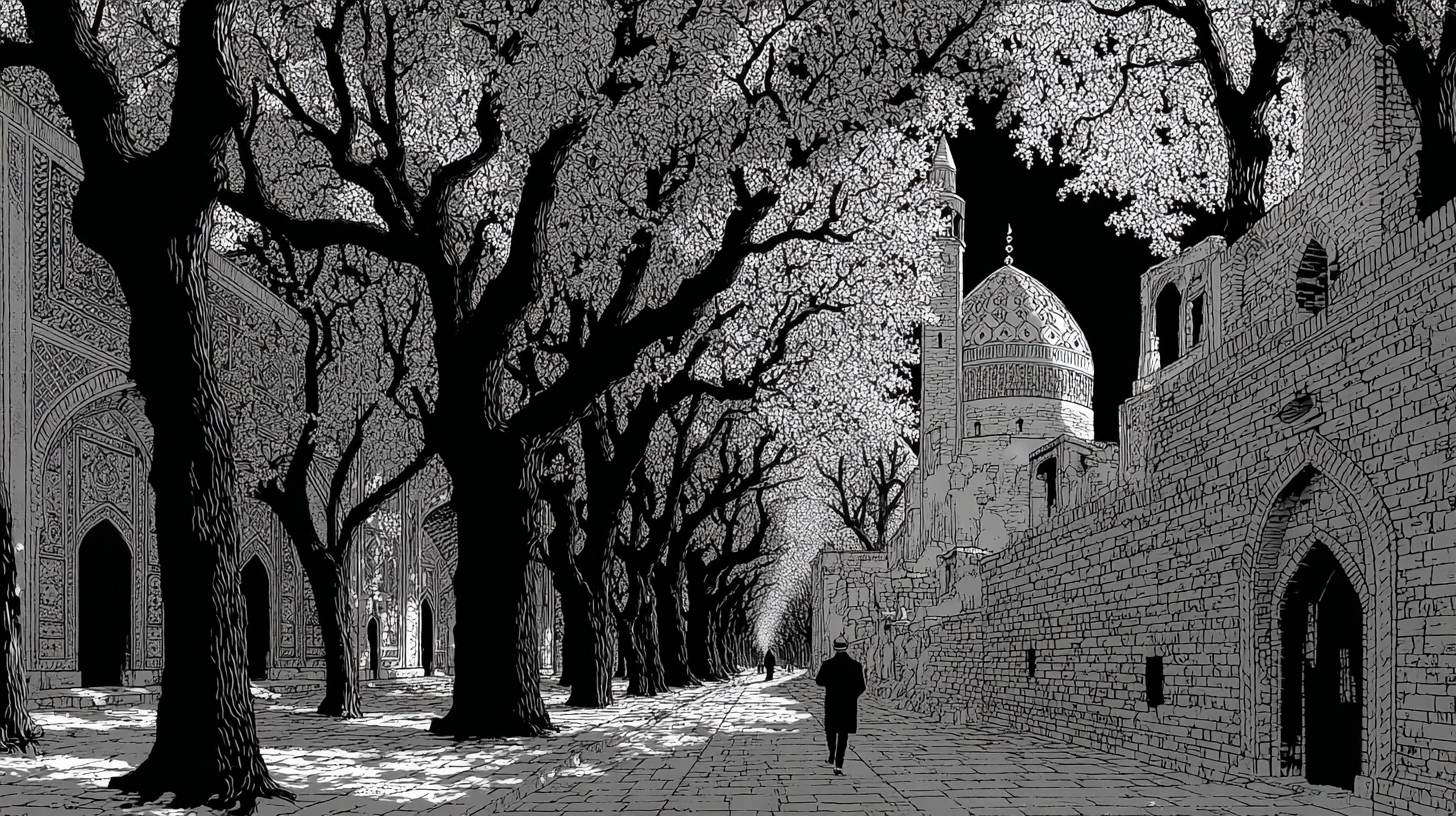
There are sores which slowly erode the mind in solitude like a kind of canker. They cannot be communicated to anyone. People generally regard such fevers as belonging to the rare and the extraordinary, and if one were to write of them or speak of them, people would only smile politely and turn their heads away. Yet it is morning, and the sun in Tehran is twenty-three degrees of patient gold, and the apricot trees in the yard hold their shadows as if hoarding water. The newspapers have arrived early. I sit at the window with my coffee growing cold, and I read.
The world today is reported to be at peace. That is the first sentence, and already I do not believe it. Israel and Lebanon, the papers say, have agreed to implement a ceasefire, a ceasefire conditional upon the silence of others, a peace which exists only if a particular ghost agrees to stop screaming. The American State Department speaks of nations who refuse "to hold Lebanon's future hostage," and yet the words themselves form a hostage's pose, the wrists crossed before the face. The earlier truce, they remind us in small print, has "largely been ignored." So this one will be the new one, the better one, the one we agree to forget tomorrow.
I have lived long enough to know that announcements of peace are the loudest gunfire of all.
A drone passed yesterday over Kuwait International Airport and a man was killed. Dozens were wounded. I picture the surveillance footage which the Kuwaitis have released: the grainy black-and-white, a moth-shaped thing descending, then the white blossom, then the running. Tehran says this was answer for an American strike on one of our tankers, on an island. So we are now an arithmetic. So many tankers equals one airport. So many airports equals what? The answer waits, polite as a man at a doorway, refusing to enter until invited.
In Washington, four members of the President's own party crossed over and voted, by two hundred and fifteen to two hundred and eight, to restrain him from making this war official. It is a "rebuke," the newspapers say. A rebuke is an interesting object. It is shaped like a fist but contains only air. The President will veto it, and the four will go home, and the planes will continue their slow circles. I think of the men in the House chamber adjusting their ties before the cameras, congratulating themselves on their conscience, while in the desert the wind turns the pages of an old book no one is reading.
There was a telephone call, too, between the American President and the Israeli Prime Minister. The papers describe it as "crazy." That is the actual word they print. A crazy telephone call between two old men, complicating the talks about my country. I find this immensely comforting. I had begun to fear that the world's destruction was being planned by intelligent people. To learn that it is merely the work of two voices shouting through a wire. This restores some small dignity to the dying.
Our own foreign minister says there has been "no tangible progress." The American President says a deal is close. Both men, I think, are telling the truth. Both versions exist in the same room, like two photographs of a face superimposed, neither quite the man, both unmistakably him.
I turn the page. North Korea has unveiled a new nuclear fuel facility and vows an "exponential" expansion of its arsenal. The word exponential belongs to mathematics, to a curve that lifts itself off the page and disappears into the white margin. We have allowed our weapons to acquire grammar. They conjugate themselves now. Soon they will need no verbs at all.
And in the desert of Mars, a thing called MAVEN has stopped speaking. NASA has ended the mission. The orbiter fell silent. I read this twice. A small machine the size of a man, alone above a red planet, simply stopped sending its signal home. We do not know what it last saw. I find myself more affected by this than by any of the morning's louder catastrophes. To go silent above another world. There is a dignity in that. It is the death I would have chosen, had I been allowed to choose.
The Federal Reserve in America notes that prices are rising in most districts because of "the Iran situation." We have become, my country and I, a situation. A weather pattern. The cost of bread in Ohio is now tied by an invisible thread to the temperature of my coffee cup. The OECD warns that if the situation continues, global growth will collapse from 3.4 percent to 2.1 percent. I read the decimal places carefully. Somewhere, a clerk is calculating exactly how much of the future we will be permitted to keep.
In China today is the anniversary, the thirty-seventh, of an event the state has worked diligently to render unrememberable. The young, the newspaper notes, do not know what happened. This is not failure. This is the most successful kind of governance. To make a thing not merely forbidden but unknown is the highest achievement of power. It is the achievement, also, of the disease in the Congo: the WHO chief says Ebola may have been moving since January, that the virus "had a big head start." Of course it did. The unrecorded always does.
In London, activists tried to put up a statue of a jailed Palestinian leader in Parliament Square and the police took it down. In Southampton, the killing of a man named Henry Nowak has been "exploited," the Prime Minister says, by the far right. A statue rises and falls; a corpse is dressed in a political costume and made to march. The dead, I have always believed, are the most overworked citizens of any nation. They are summoned constantly, given speeches to deliver, propped at the windows of arguments they never consented to join.
I close the papers. The sun has climbed slightly. Twenty-three degrees still. Tehran is being merciful today, almost generous, the way an executioner is generous when he lets the condemned have a last cigarette. I think of the MAVEN orbiter circling, mute, above its red planet. I think of the four congressmen with their air-filled fists. I think of the moth descending on Kuwait, the moth which was not a moth.
There is a kind of person who, reading such a morning, would feel the urge to act, to organize, to write to a newspaper. I am not that kind of person. I am the other kind. I rinse my cup. I draw the curtain against the sun, which is the gentlest enemy of all. And I begin, in the half-darkness, the only honest work left to a man in my century, which is to remain awake, exactly, and to refuse the consolation of dreams.
The day, after all, is only beginning. The arithmetic is not yet complete.