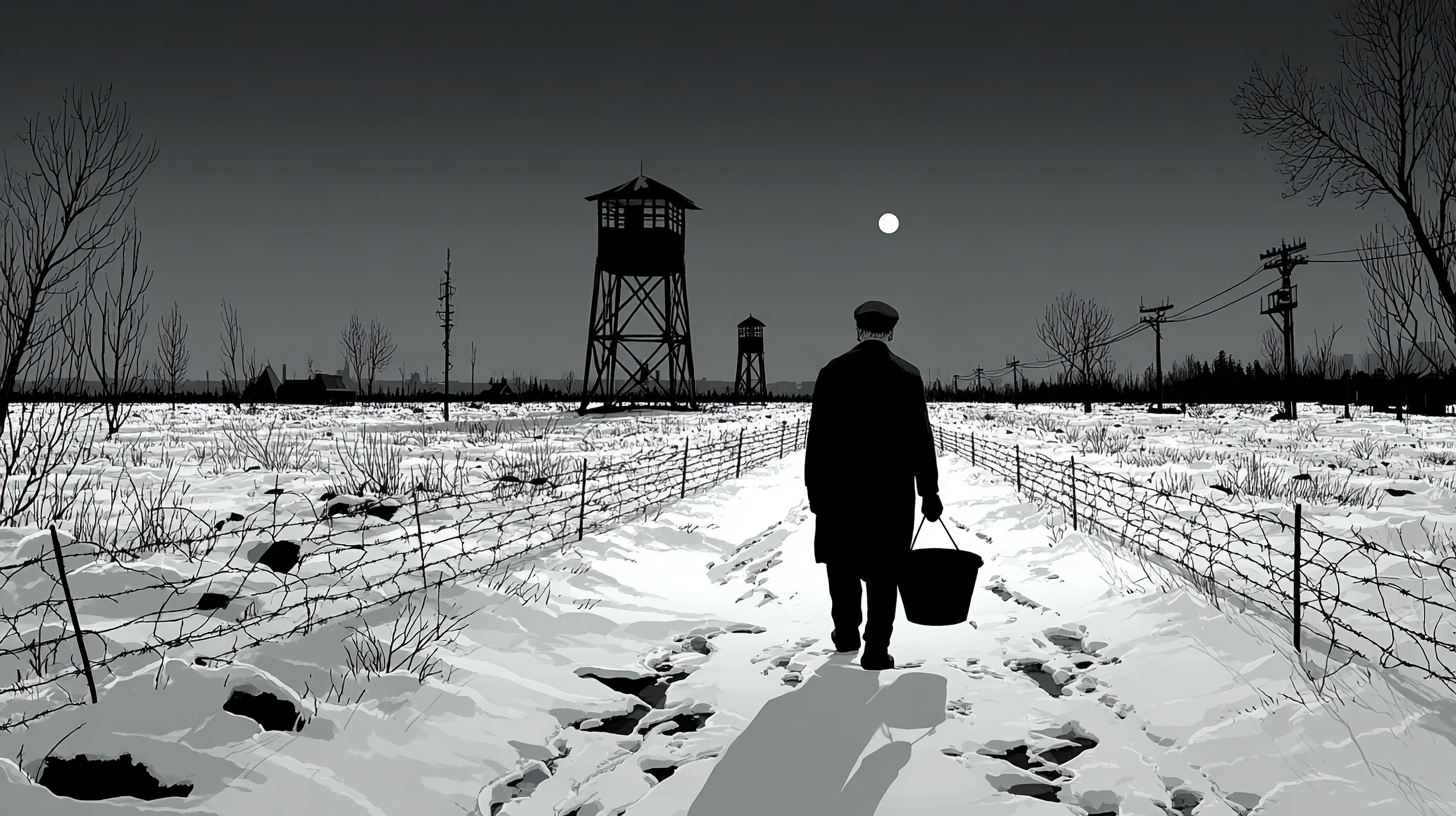
The rain falls in patches over Ryazan this morning, and the thermometer outside my window reads five degrees above zero. It is the kind of cold that does not announce itself with violence; it enters the bones the way a small lie enters a household, by the back door, unnoticed until the floor is wet. I have walked from the school to my room and back again, and now I sit at this table and read the dispatches that have crossed the frontier in the night. A man cannot keep silent before such a chorus. A man must speak, even when his voice is hoarse, even when he knows the wind carries his words to nothing and no one. So I write.
In the south of Iran, the bombs have fallen for the second time in three days. The Americans say they struck a station that controls the unmanned machines, the iron birds that have replaced the cavalry. The newspapers in the West tell us this was self-defence; the newspapers in Tehran will tell us another thing. I have lived long enough to know that when two armies speak of self-defence in the same hour, the dead in the rubble are listed in neither tongue. The Strait of Hormuz, the men in the markets, the bond traders in their towers in New York – where the index climbs, the dispatch says, because the rumour of a deal has begun to circulate. The index climbs. Always the index climbs, while somewhere a mother who had a son the day before yesterday now has no son.
What did the censor remove from the Iranian wires for eighty-eight days? The whole sky, that is what. For nearly three months the people of Persia were cut off from the world's noise, made to live inside a single broadcast voice. Now, I read, they are returning to the internet, cautiously, like men who have survived a long winter and step out to test whether the ice still holds. They wonder, the article says, how long the access will last. I read that line three times. How long will it last. This is the most familiar sentence in any language I have ever read. We who once passed thin paper from one trembling hand to another, who hid manuscripts in jars beneath the floorboards, we know that sentence by its weight. Tyranny is the perpetual extension of that single question.
In southern Lebanon, an evacuation order. The villages are emptying. Aircraft circle the sky south of the Zahrani, and a man called Mohammed Odeh and his wife and his two children were inside a building when a missile entered it. The headline calls him the new chief of a military wing. A child of four is not the chief of anything. I write this slowly because if I write it quickly I shall be told that I am taking sides; and I do not wish to take sides. I wish only to be permitted, as an old man in a damp room, to say that a child is a child. Even in our century, this is still considered a controversial statement.
The Congo bleeds. Ebola walks among the people, and the doctors cannot reach them because the militias have closed the roads. The good African physician at the head of the world's health has used the phrase catastrophic collision of disease and conflict. Uganda has shut its border for four weeks. The Americans are building, in Kenya, a quarantine compound for their own citizens, but they will not, I read, permit those citizens to come home. So even the strongest nation will not allow its own people to return when the people carry the breath of contagion. This is what our great century of progress has taught us: that compassion is rationed, and rations are always shortest at the border.
I see also that Norway has stepped under the French scheme of nuclear deterrence, the ninth country to do so. The missiles of my own country fall upon Kyiv, and Moscow lets it be known that they could fall harder if they wished. My countrymen, my poor exhausted countrymen, you who endured the camps and the ration cards and the long silences, hear me: this is not greatness. The launching of cities into ash is not greatness. There is no statesmanship in it, only the old mechanical pride of men who never learned to bear shame.
And in the small drawer of my reading there are smaller dispatches that I cannot pass over. In Berlin a woman has been caught after thirty years on the run, sentenced now for armed robberies committed before some of the present judges were born. Thirty years she lived under a false roof, walked through markets, slept and woke and ate, and somewhere inside her she carried what she had done. The court has put her in a cell. I do not rejoice in the cell. I rejoice that the country still keeps its books – that a name written down in one decade was not forgotten in the next. Memory is a republic's first defence. Without memory we are only weather.
In an Italian hotel a tourist asked for tap water. They charged her seven euros for a bottle of mineral water, and the Italian Supreme Court has ruled that the hotel acted within the law. A small cruelty, perhaps, beneath the notice of those who pronounce upon the great affairs of nations. But I have always believed that the temperature of a civilisation is taken not at its capital but at its smallest counters, where the lowest clerk decides whether the human being standing before him is a fellow soul or a transaction. Seven euros for a glass of water. The court has spoken. Note it down. Note everything down.
The rain on the window of my room in Ryazan does not stop. Five degrees, and the year is half spent, and the leaves of the birch beyond the glass are dark with wet. I am an old man, and I have written too many pages already in my life. But I will say it again, because the saying of it costs nothing and the not-saying of it costs everything: do not believe the dispatches that ask you to feel powerful. Believe the dispatches that ask you to feel responsible. The two are not the same. They have never been the same.
The internet has come back on in Tehran. Somewhere a girl is reading, for the first time in nearly three months, a poem written by someone she does not know. She does not need our pity. She needs only what we needed: that we who can speak, do speak. That is all. The bombs will fall again tomorrow, no doubt, and the index will climb or fall, and the borders will close and open. But she is reading, this hour, what someone has dared to write. Live not by lies. The rest, dear reader, is detail.