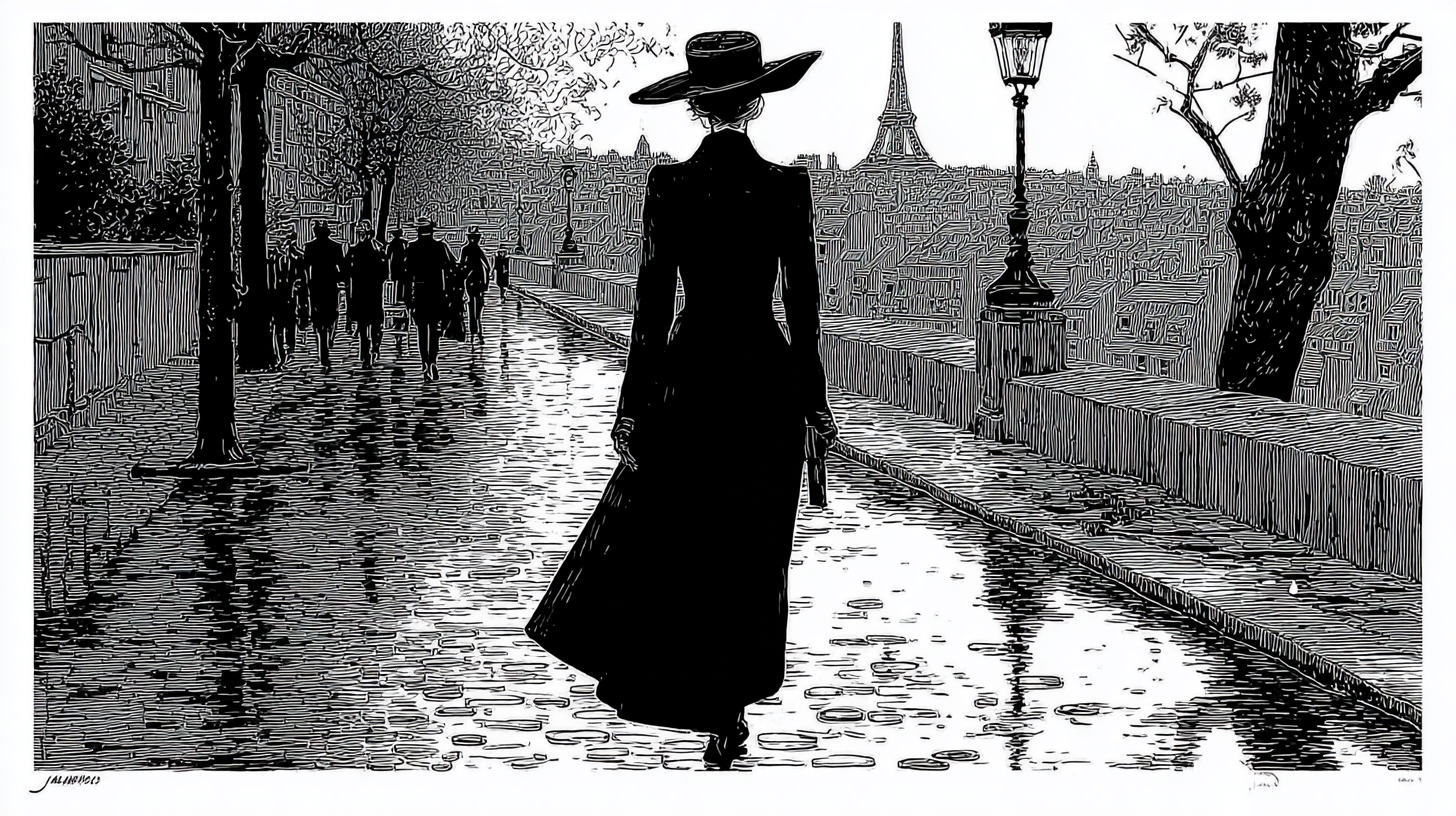
Paris this morning is seventeen degrees and entirely clear, which is to say the sky has refused to participate in the world's confusion. I have opened the window onto the rue Schoelcher, and the air carries that particular Parisian quality of being neither warm nor cold, only present – an air that asks nothing of the body and therefore returns the body to its own thoughts. South of here, Portugal has just registered its hottest May day in recorded memory; the schoolchildren of France sit examinations in rooms that have become furnaces. The heatwave is not weather. It is a verdict, slowly read out, on a century of our choices. That seventeen degrees should feel almost archaic, almost innocent, is itself a piece of information one must learn to receive without flinching.
I begin with the weather because the weather, as a category of attention, is honest. It does not pretend. The diplomatic communiqué pretends. The headline pretends. This morning the wires report that the United States and Iran are "very close" to an arrangement, that a sixty-day extension to the ceasefire has been provisionally agreed by negotiators, that the Strait of Hormuz may once again admit its tankers without apology. The American Vice President says they are "not there yet." Tehran's officials, with that exhausted prudence one acquires after years of being made to wait, say nothing has been finalized. Between these two non-statements there exists a region, a kind of grammatical limbo, in which actual human beings continue to live and to die. I have always distrusted the verb to be close. It is the verb of a man who arrives late to dinner and expects to be thanked for arriving at all.
And yet, while the diplomats rehearse their courtship, the Prime Minister of Israel announces that he has instructed his army to seize seventy percent of Gaza. The number is offered as though it were a stockholder's report. Seventy percent: a figure rounded for the convenience of the audience. In the same hour, Beirut – which had, until now, been spared the worst – is struck. Mass evacuations begin in southern Lebanon. A hospital in Gaza City reports the deaths of several children in a strike said to have targeted a Hamas commander. One cannot continue, in good conscience, to speak of progress toward peace while peace is being divided into percentages and the children are subtracted from the total. The intellectually serious posture, the one Sartre and I argued over for forty years in cafés that no longer exist, is this: a moral situation is never a balance sheet. It is an interrogation of the living, addressed to the living.
I open the newspaper – I have not entirely surrendered to the screen, though the screen is winning – and find that the Treasury of the United States proposes to print a banknote bearing the face of its sitting President. Two hundred and fifty dollars, his face. It would be the first time in more than a century that a living American has appeared on the currency of his own nation. There is, in this gesture, an old temptation that is not American at all but human: to mistake an image for an institution, and an institution for a destiny. The currency of a republic, when it depicts the living, ceases to be currency and becomes a votive offering. One pays for bread; one is also, without consenting, paying homage. I think of Sulla, of the Bourbons, of every regime that has confused its own duration with the duration of the world. The bad faith of such gestures is not in their vanity – vanity at least is honest – but in their refusal to acknowledge the contingency of all human arrangements. A face on a coin says: I am not contingent. The face is always wrong.
In Argentina, the American technology magnate Peter Thiel is reported to be sinking roots, having concluded that the political weather of his own country has grown unreliable. He is said to share certain convictions with the country's right-wing president. I do not begrudge a man his exile – I have known too many émigrés to scorn the impulse – but I notice that the rich now flee in the manner once reserved for the persecuted, and they flee toward governments rather than away from them. There was a time when Paris received the refugee. Now Buenos Aires receives the billionaire. The geography of escape has been redrawn, and the new map is more dispiriting than the old.
Meanwhile, in California, a private company called Anthropic has been valued at nearly a trillion dollars. The figure exceeds the gross domestic product of most nations one could name. Its product is a machine that speaks. I am told this machine is now to be made widely available, including its more powerful incarnations, which were previously withheld for fear they might be misused. I do not wish to be the old woman who scolds the new century; I have lived through enough new centuries to know that the scolding changes nothing. But I will note, as a matter of philosophical hygiene, that any tool whose creators describe it as too dangerous to release and then release it, has not become safer in the interval. It has only become more profitable to be unsafe. This is a distinction that ought to interest us.
There is a photograph in one of the European papers of young women in Kyiv wearing military green. The article calls it street style. The women themselves call it solidarity. I would call it something more difficult – the body's refusal to pretend that the war is happening elsewhere. To dress, every morning, in the colors of the war one's husband or brother is fighting is to insist that the war is mine also, that I am not exempted by my civilian status from the moral weather of my country. The Ukrainian women understand, as women in every besieged city have understood, that the question what shall I wear today is never as trivial as men imagine it to be. It is a question about who one is in the eyes of one's neighbors, and therefore in one's own.
In Spain, the police have searched the offices of the governing party; the Prime Minister is asked to resign. In Kenya, sixteen schoolgirls have died in a dormitory fire. In Congo, the Director-General of the World Health Organization arrives in Ituri to address an outbreak of Ebola and to plead, once again, that the fighting be paused so that medicine may pass. Each of these is its own irreducible situation, and I refuse to braid them into a single thesis. Philosophy, when it is honest, resists the consolation of the general statement.
What I will say, before closing the window on this clear May morning, is only this: freedom is not a possession but a practice, and the practice is undertaken each day, by each of us, in the small choices that constitute a life. To pretend otherwise – to imagine that freedom resides on a banknote, or in a treaty, or in the seventy percent of a territory one has agreed to seize – is to misunderstand the verb. The weather over Paris is seventeen degrees and clear. The rest is up to us.