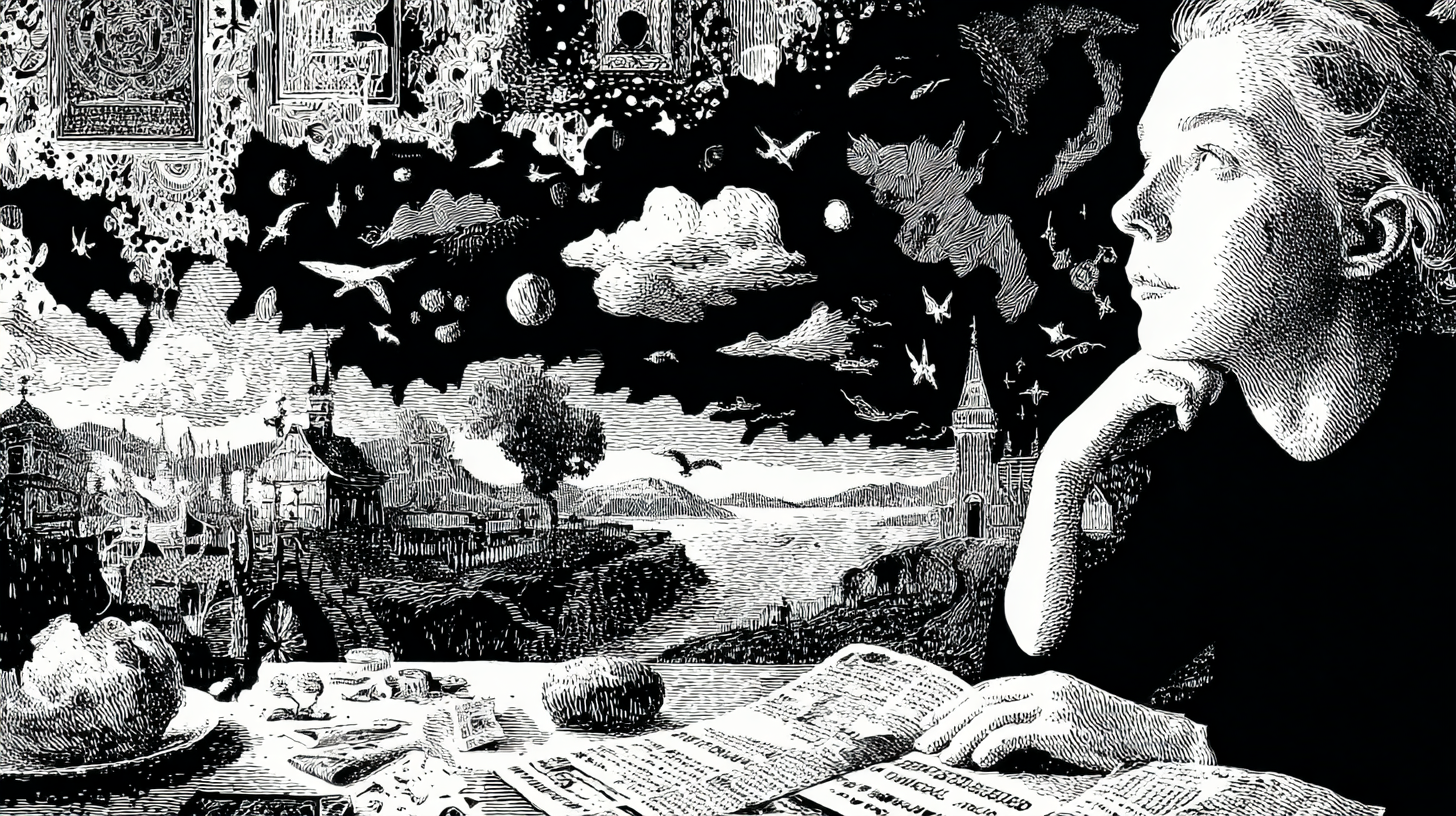
The fog this morning is what they call shallow.
Imagine fog with depths –
the kind a person could drown in,
as against the kind that only wets the hem.
Today it is the modest sort:
ten degrees, the geraniums shivering,
the newspaper damp on the doorstep.
I open it carefully,
as one opens any container of the world.
On the Word Largely
The American president says the agreement
is largely negotiated.
What an excellent adverb, largely,
modest cousin of almost,
distant relation of not quite.
Largely, the bread has risen.
Largely, the patient survived.
Largely, the bridge will hold.
In Tehran they nod the same word
in a different tongue.
The Strait of Hormuz, it seems,
will open like a flower,
or at least like a door
left ajar in case the wind
should change its mind.
Meanwhile a young sailor named Sunil,
on his first voyage at sea,
remembers a friend
who has not been found.
The word largely does not cover him.
Statistics from Shanxi Province
Eighty-two men went down on Friday
and did not come up.
The earth, which has accommodated us
for so long, occasionally remembers
it is older than our errands
and shrugs.
A hundred and twenty-eight
are in the hospitals now,
their lungs full of a dark
they did not ask to breathe.
The official report calls for accountability.
The miners' wives call for their husbands.
These are not the same call.
The Volunteers
In Kinshasa the markets are full.
The buses go where buses go.
A woman buys peppers.
A man carries a sack of rice.
Somewhere among them
a virus that does not read the newspapers
is reading them, anyway,
through their skin.
Two Red Cross workers have died
of what they came to prevent.
This is one of the older grammars:
the verb that turns upon its subject,
the helper helped into the ground.
I would like to write their names
but the wire service has not given them.
I will leave a space here for them:
_______________ and _______________.
Tomorrow perhaps a fuller paper
will permit the small dignity
of being known.
A Postcard from Kyiv
Last night another ballistic missile
arrived without postage
at the address of someone's morning.
This is the fourth year of a war
that was meant to last three days.
The chess clock long since broken,
the players still moving pieces
across a board that no longer fits
on any reasonable table.
Closer to me than the others,
this news.
The borders we draw on maps
are not the borders our nights
respect.
I lived through one century's worth
of similar paragraphs.
I had hoped, foolishly,
to be done.
The President Was Not Affected
A man approached a checkpoint
near the White House
and opened fire.
The Secret Service returned it.
He fell. A bystander, too,
caught a piece of what was meant
for someone larger.
The wire service notes
that the president was inside
and was not affected.
The bystander was affected.
Affected is the word
for what happens to a body
that did not sign up
to be part of history's punctuation.
I think of him often
in the small hours:
he had gone out for what?
A coffee, a newspaper,
to see the famous house.
History affects the unaffected.
This is one of its specialties.
A Footnote from Portugal
A French woman and her partner
have been remanded to wait for trial.
Her two small sons,
the news says, were left
beside a road
in the south of Portugal.
I cannot, on a Sunday morning,
hold this sentence in my mouth
for very long.
I will set it down
the way one sets down
something too hot to handle,
and turn the page,
and ask, quietly,
what the boys' first thought was
when the engine pulled away.
The newspaper does not answer.
It is, after all,
only paper.
Some questions belong
to the species, not to the page.
At the Cannes Festival
Meanwhile, in another country,
a Romanian has won the Palme d'Or
for a film called Fjord.
I have not seen it.
I will not see most films.
But the news pleases me
in a small, illogical way:
that someone from a country
the West remembers chiefly for vampires
has been handed a golden leaf
for two and a half hours
of arranged light.
Cristian Mungiu – the name
sounds like a verb
for something gentle
done with thread.
Last Item, from the Window
The fog has not lifted.
The geraniums are still cold.
Ten degrees in Kraków,
the damp reaching the bones
of the cathedral and the bones
of the women walking to mass.
I fold the newspaper.
It is heavier than it looks:
the weight of the unaffected,
of the largely,
of the eighty-two,
of the two whose names I do not know,
of the missile that did not knock.
Outside, a sparrow
makes its way across the courtyard,
busy with the only business
that fully belongs to it:
the next crumb,
the next gust,
the next small reason
to remain.
I envy it, a little.
I envy it, largely.