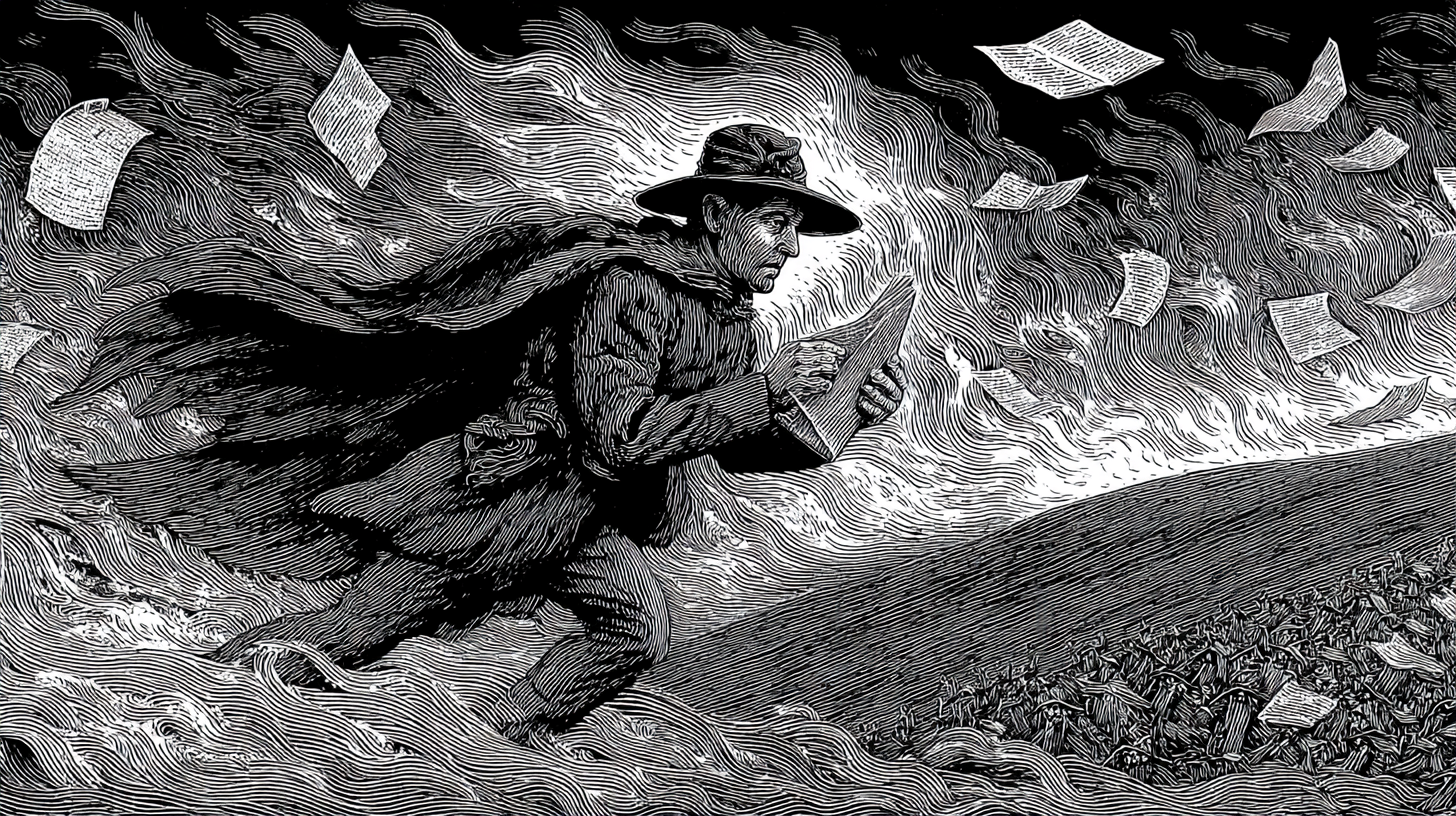
The thermometer on the back porch reads thirteen degrees Celsius this morning, and the sky over Waukegan is the soft gray-blue of an old enamel saucepan, partly cloudy, the kind of sky that cannot decide whether to keep its rain or give it away. I sit out here with my coffee and the newspaper folded into a useful triangle, and I think: it has finally happened. The thing we drew with crayons in 1939 has happened. The thing the boys in the back of Mr. Tridon's classroom whispered about, with their freckled noses pressed against the geography book, has happened. The largest rocket ever built lifted off this morning, and a man on the television called it Starship V3, and I am not sure whether to weep or applaud, so I do both, quietly, into my cup.
You must understand what it means to a boy from Illinois to see a rocket leave the ground. It is not a machine. It is a kind of prayer, white-hot and answered backward, with the answer coming first and the question following all your life. When I was nine I read Edgar Rice Burroughs under a striped awning and could feel the red dust of Mars settling on my eyelashes, and now there are engineers in Texas who have built the long silver bone of the thing I dreamed, and they have stood it up on its tail and lit the fuse, and it has gone. It has gone, neighbors. And we are still here, on the porch, with the dandelions coming up between the flagstones.
The papers say the Pentagon has finally opened its drawer of orbs and discs and fireballs – decades of sightings, swarming in all directions, the way fireflies swarmed in the back lot behind the Coca-Cola sign in 1928. Eighty years of pilots saying I saw a thing, and admirals saying Tell no one, and now, suddenly, here is the file, dropped on the kitchen table like a wet newspaper. I find I am not surprised. The sky has always been crowded. We were merely too polite to look up. And the question is not whether they came; the question is whether, when our own white rockets begin to climb in earnest, we will recognize ourselves as the orbs swarming in someone else's sky.
There is a kind of vertigo in this. To be at once the watcher and the watched. To be the boy in the porch swing and the dot of light some other boy is pointing at, from some other porch, on some other world where the evening smells of cinnamon instead of cut grass.
But the same morning paper, you see, gives with one hand and takes with the other.
In the Democratic Republic of the Congo the suspected cases of Ebola have tripled in a week, and the World Health Organization has spoken the awful phrase very high risk. Almost seven hundred and fifty people, the article says, walking the dusty roads between fear and a clinic that may or may not have gloves. Along the border with Uganda, the screening tents go up like white mushrooms after rain. And I think of the rocket, the great silver finger pointing at Mars, and I think of a child in Akobo who will never see it, and I am ashamed of how easy it is to look up rather than across.
The Russian president threatens retaliation; he says a student dormitory has been struck, and there will be blood for it, and he is already replacing his governors with generals, building a new elite out of men who learned governance in trenches. In New York the diplomats have failed, for the third time running, to agree on a final document at the nuclear treaty conference – the Americans and the Iranians, two grim chessmen, knocking the board into the air. In Britain the hate crimes rise, the article says, fed by lies traveling at the speed of fiber optic, and in the West Bank a family's dog is beaten so terribly that a video of it travels around the world before the family can bury the animal.
These are the things, you see, that the rocket cannot outrun. It does not matter how fast you go; the suitcase you packed comes with you. We will land on Mars carrying our shouting and our fevers and our old religious quarrels, and we will set them down on the red sand, and we will recognize them at once, like familiar luggage spinning on a foreign carousel.
And yet.
A man named Kami Rita Sherpa, who is to mountains what the rest of us are to staircases, has climbed Everest for the thirty-second time. Thirty-two times! It is not the number that astonishes me. It is the patience. To go up the same enormous white thing, again and again, because it is there and because he is who he is. There is your rocket, I want to say to the engineers. There is the slow, breathing rocket, made of one man's lungs.
In Mexico, the papers say, an ancient ball game is being revived. Three thousand four hundred years old. The same hip-thrown rubber, the same stone hoop, the same shouting from the bleachers, only now the bleachers are plastic chairs and the bleachers' grandfathers' grandfathers' grandfathers played here before the Spaniards came. Three thousand four hundred years. We send a rocket toward Mars while another set of hands keeps a thing alive that is older than most of our gods. Both, I think, are the same gesture. Both are humanity saying: we were here, we are still here, we will not let it go.
Even a Canadian Grand Prix driver, the small inset reports, has collided with a groundhog at speed. A groundhog! Brought low, mid-corner, by a creature whose ambitions had never exceeded the perimeter of his own field. I laugh because I must. The world insists, always, on this comedy of scales. The rocket, the groundhog, the dormitory, the ball game, the porch swing.
The neighbor's screen door slams. Somewhere a sprinkler is rehearsing its slow circle. The sky is still partly cloudy at thirteen degrees Celsius, and I have stopped pretending to read. The rocket is gone now, on the underside of the planet, falling forward along its long ellipse. The orbs are catalogued. The microbe is moving. The boy on the porch is older than he ever expected to be.
I want to tell the young people something, and I think it is this. The rocket will not save you. It will not, by itself, redeem the dog in the West Bank or the child in Akobo or the dormitory full of students or the diplomats walking out of the conference hall in their gray suits. But it will, if you are very lucky, remind you that you belong to a species that built it. The same species that beat the dog also built the rocket. The same hands. Choose, every morning, which set of hands you mean to lend yours to.
I will finish my coffee. I will go inside and put on a sweater, because thirteen degrees is colder than it looks. And then I will write, because that is the only ball game I know, and it is at least four thousand years old.
The sky is partly cloudy, and the future is partly cloudy, and the porch swing creaks, and we are not finished yet.