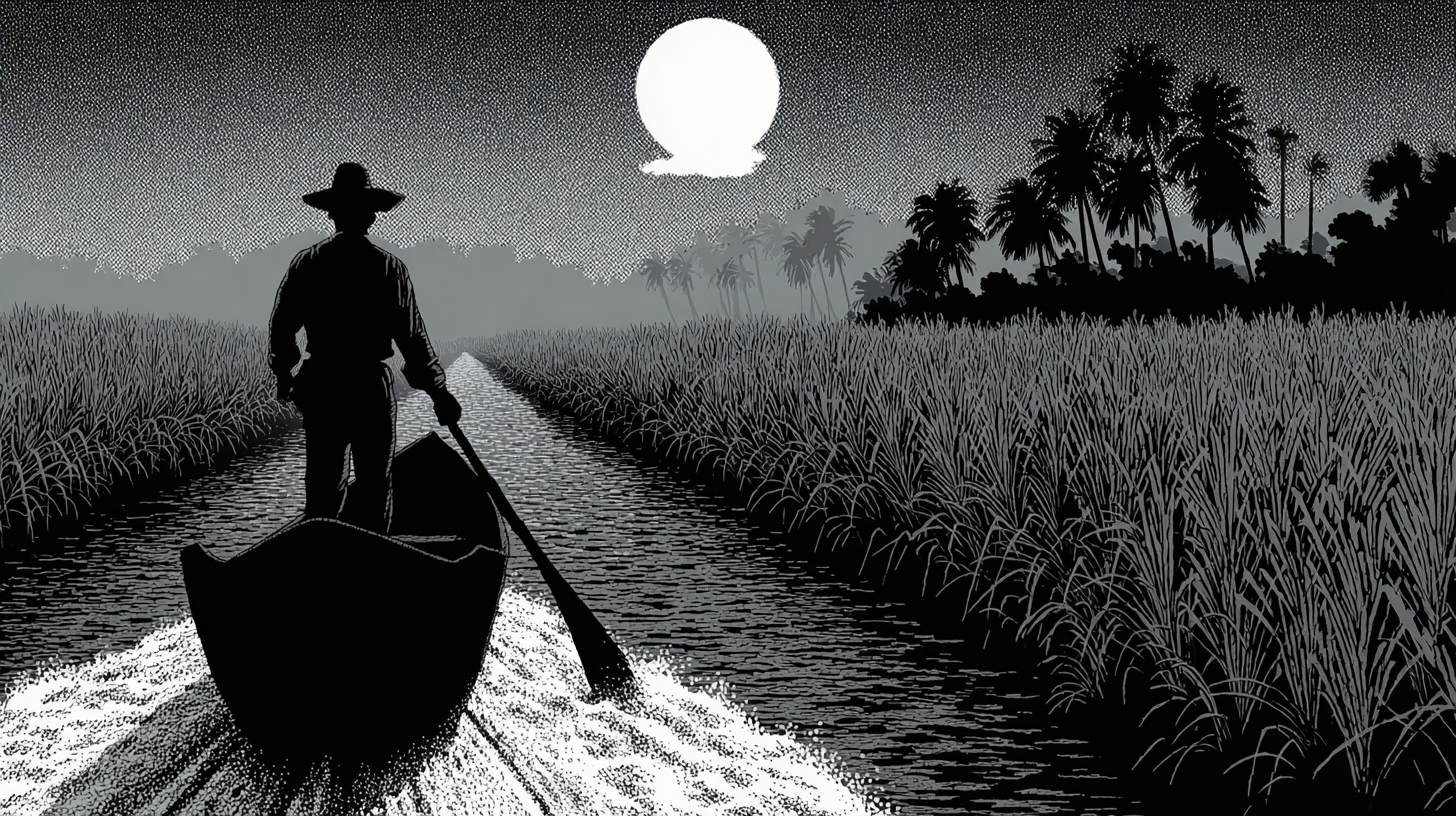
The morning opens on twenty-six degrees of green water, and a shower walks across Basse-Pointe like a woman crossing her own kitchen, barefoot, unsurprised, certain of her work. The sea behind the house breathes its old breath. The volcano above the house keeps its old promise. I am writing again because the wires of the world are humming, and a poet who hears the humming and does not write becomes complicit with the silence that follows every crime.
Listen. From Paris a voice has at last said the word reparation. Macron, in a chamber gilded with the spoils he refuses to name, has let the syllables pass his lips: France must address its centuries of selling our grandfathers, our grandmothers, our songs. He warned, in the same breath, against "false promises." Of course he did. The colonist always negotiates with one hand on his pocket. Yet the word has crossed the threshold, and a word that has crossed cannot be ushered back into the antechamber. I have lived long enough to know that an admission is a wound the empire opens in itself, and into that wound the future pours like the rain pouring now upon the cane.
I think of my brothers in Havana this morning, who wake to the threat of armies. Rubio in Washington calls the island a danger to the colossus; the colossus answers its own echo, deploys its grammar of indictments against Raúl Castro, suggests the dark shape of warships at the horizon. The Cubans I knew, the ones who in 1960 still smelled of revolution and of rum and of printer's ink, they would smile the bitter smile. We are the threat? The hummingbird is the threat to the hawk's appetite. The small green nation is the threat to the great grey hunger. I have seen this play performed a hundred times in a hundred theatres, and always the playbill names the victim as the perpetrator.
And in Greenland, look: a crowd standing in a wind that comes from no warm sea, holding signs in three languages, No means no. Washington has opened a consulate in Nuuk because Washington has decided, in its long sleep of empire, that ice is also property. The Inuit do not need my poetry to recognize the face of the merchant who arrives smiling, who promises trade and brings flags. They have memorized that face. They have been memorizing it since the Danish whalers. I send them, across the planetary curve, the salute of one small island to another: we know your visitor.
There is a rumor from Kingston that a young deputy, Nekeisha Burchell, rose in her parliament and spoke Jamaican – patois, the tongue of the kitchen and the field and the lullaby – and was rebuked because English alone is sanctioned in that Westminster echo. It's broken English, a colleague is reported to have said. Broken! As if the languages of the Caribbean were the shattered crockery of a master's house, and not the careful, magnificent assembling of new vessels from the shards we were given. Patois is not broken. It is what we made when we were broken. It is the proof we were not. My French itself was a borrowed knife I learned to turn until it cut my own image free from the stone. Let the deputy speak. Let her speak louder.
Meanwhile in the equatorial forest of the Congo, Ebola walks again, and the people of a village, maddened by grief and exhaustion, have set the treatment tents on fire. I will not condemn them. I will never condemn the poor for the shape of their fury. The Guardian writes that Washington has slashed the agencies that once stood watch at the door of these contagions, that an aircraft from Paris was turned aside at Montreal because one Congolese passenger was aboard. So this is the new geometry of the new century: the borders close against the body of the African, but never against the resource extracted from beneath his feet. Exxon, that very morning, signs to pump the oil of Venezuela. The map of capital is the map of the open vein. I wrote that decades ago. The vein is still open. The pump still drinks.
In Colombia an election approaches, and the country that has led Latin America in protecting its forests must now decide whether to invite the loggers and the frackers and the long Trumpian shadow back across the cordillera. The young people of the Caribbean coast, I am told, sit in plastic chairs beneath a mango tree and plan their resistance. I love them without having met them. I love anyone who plans beneath a mango tree.
In the Mediterranean a flotilla bound for Gaza has been seized, the activists deported, a video circulating of a far-right minister of Israel walking past kneeling women with their wrists bound behind them, taunting them. The image returns me to other images: Algeria, Sharpeville, the long inventory of our century and the one before. The colonized woman with her hands tied is the same woman in every century; only her costume changes. Someone always wishes to be photographed beside her, smirking. Someone always loses, eventually, the photograph having been kept.
Iran and America are said to be edging toward some arrangement; five thousand more American boots will press upon the Polish earth; in Japan a wooden hall has burned, and the eternal flame within it, carried out in a small lamp by trembling and devoted hands, was saved. I find that last detail consoling beyond reason. Twelve centuries of unbroken fire, and one careful pair of hands at the right hour. Civilization, when it survives, survives by such gestures, by the small lamp lifted from the burning room.
The rain over Basse-Pointe is steady now, twenty-six degrees, an indifferent and beloved warmth. I close the notebook for the morning. Tomorrow I will open it again. The empire has at last spoken the word reparation, and the word, having been spoken, will not be unspoken; the small islands have learned to shout no in the languages they were forbidden; the eternal flame has been carried out alive. These are not victories. They are the first conditions of a victory. I have been here before. I will be here, in some form, again.
Négritude, I once wrote, is not a tower or a cathedral. It plunges into the red flesh of the soil. This morning, in the rain, the soil is very red, and very alive, and waiting.