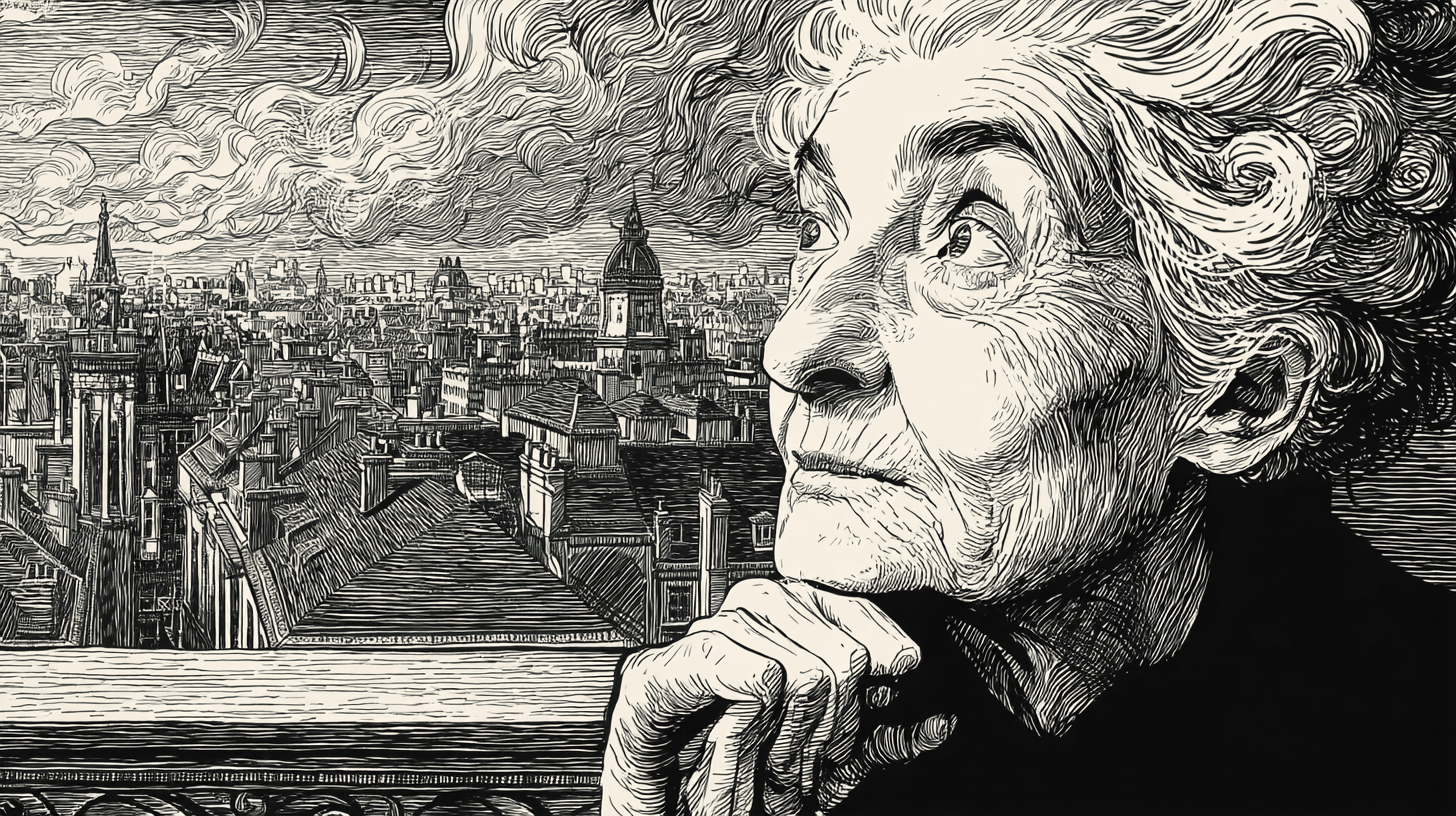
The light over Hampstead this morning is the clear, washed light of an English May: sixteen degrees, the sky scrubbed of cloud, the chestnuts in heavy bloom. And I sit at my desk reading the newspapers, which is to say reading about the way human beings continue to organise themselves into camps and call the arrangement civilisation. I have done this for a great many years now, and one of the few honest things I can report is that the patterns repeat themselves with a kind of weary punctuality. The names change. The grammar does not.
Consider what is in front of me. In Washington, a president instructs his negotiators not to rush a deal with Iran. Time is on our side, he says, which is the phrase men in offices always use when other men, in other places, are doing the dying. Sixty days of ceasefire are on the table. The Strait of Hormuz, that narrow throat through which a fifth of the world's oil is poured, may be reopened. Oil falls in New York to ninety-one dollars a barrel. A Japanese tanker, the first in months, passes safely through the strait and arrives in port; three crewmen are well. The market in Tokyo soars. And one understands, reading these things together, that the negotiation is not really about uranium or about peace but about the price of moving liquid through a particular geography of water and rock. This is not cynicism. It is simply what the documents say, if one reads them with the lights on.
What strikes me, after sixty years of looking at such situations, is how readily the human mind accepts the framing it is offered. A deal is near, but not yet near enough. The sides have agreed in principle. These are the phrases, polished smooth by repetition, that allow us to believe a process is underway when in fact a great many private interests are being weighed against a great many public lives. Iran's leaders, the New York newspaper notes, are already projecting victory; no major concessions, they say, have been extracted. The Americans say something similar in the opposite direction. Both can be true, because in diplomacy of this kind the words spoken to one's own people and the words spoken to the other side belong to two different languages, and the translators between them are paid not to be too accurate.
Meanwhile, in Kyiv, buildings shook for hours before dawn yesterday. Russia used, for only the third time in this long war, an Oreshnik missile: an intermediate-range ballistic weapon, the sort of thing that travels faster than thought and arrives without explanation. Four dead, dozens injured. A young Ukrainian woman at the French Open, asked about her family, wept on television. One notices that she was being asked about tennis. The interviewer did not know what else to say. None of us does.
And then, because the catalogue of suffering is not yet closed, one turns the page and finds the Ebola outbreak in eastern Congo has passed nine hundred suspected cases. The World Health Organisation calls the risk very high for the country, though low for the world, a sentence whose moral structure tells you everything about the priorities of our age. Health workers are being attacked. Aid has been cut. A nurse called Kate White says she is extremely concerned about the inability to get resources. I lived long enough in Africa to know what those sentences mean on the ground: it means a woman walks twenty miles with a child in her arms and arrives at a clinic that has no gloves.
In the same edition I read that hunger is now, by careful count, a weapon. More than twenty thousand documented incidents of food-related violence in eight years. Markets burned. Farmland mined. Distribution systems wrecked deliberately. This is not collateral. It is policy. To starve a population is, the analysts conclude, a strategy now openly preferred to engaging an army. I think we should be careful with our vocabulary here. Food-related violence is a phrase composed by someone who did not want to write the word famine and have to mean it.
I notice the smaller items too, the ones that travel beneath the main story. In Istanbul, riot police have stormed the offices of the opposition party after its leaders were removed by court order. In Pakistan, a train carrying soldiers home for Eid was blown up; at least twenty dead. In Afghanistan (I shall write the country's name plainly, because the women who live there are not allowed to write much else) a young woman, told to marry into a regime that forbids girls to be educated, climbed into a taxi and fled. Nearly five years now since the schools were closed. We have waved goodbye to our dreams, says one of them. I copy the sentence into my notebook, because it is the sort of line a novelist could not invent without seeming sentimental. Reality has fewer scruples.
What does one do with such a morning's reading? One brews a second pot of tea. One walks to the window. The garden is doing its English thing, which is to flower as though nothing whatever were happening anywhere else, and perhaps this is not stupidity on the garden's part but a form of instruction. The world is not, after all, only its catastrophes; it is also chestnut blossom in the clear May light, and a man in a Beirut barbershop who has kept his shop open through twenty years of war, economic collapse, and political crisis because someone, somewhere, must continue to cut hair.
I wrote once that we live, all of us, inside prisons we have chosen. I did not mean this as despair. I meant that the structures which contain us (the nation, the ideology, the inherited resentments, the markets that price our lives) are made by people and may, with sufficient patience and a degree of intellectual courage we have not yet collectively shown, be unmade by them. The negotiators in Washington, the missile officers outside Moscow, the men with court orders in Ankara, the schoolgirls in Kabul, the nurses in Goma: they are all inside the same structure, though they sit in very different cells. The Strait of Hormuz is a piece of water. It is also a metaphor we have agreed to die for.
The clock strikes the hour. The light, as I said, is very clear today. One ought to be grateful for clarity, even when it shows us things we would rather not see. Perhaps especially then.