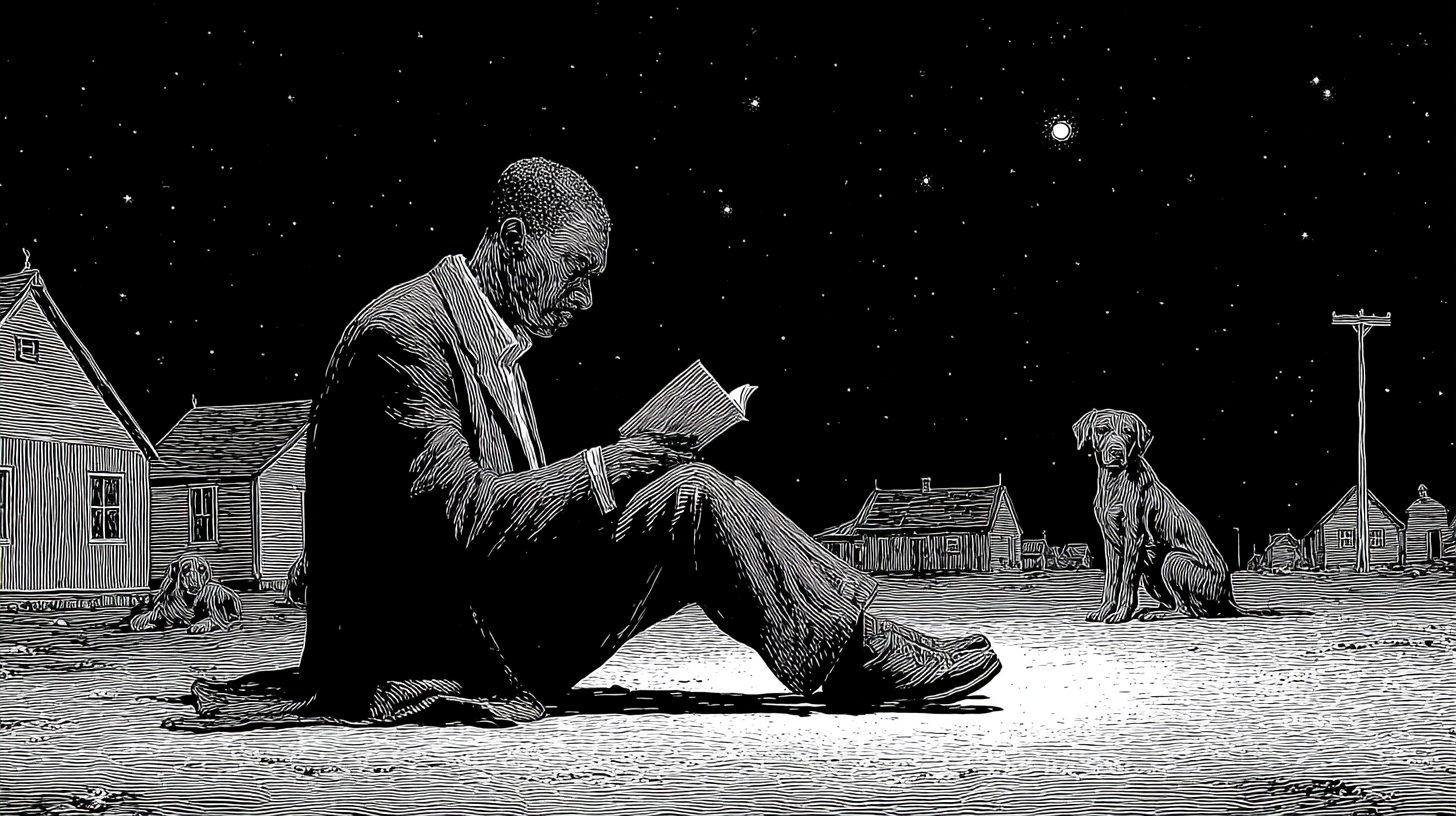
The wind came in low off Table Bay before sunrise, carrying the smell of wet pavement and diesel, and somewhere above the mountain the clouds were stacking themselves into a thundery shape that hung over the city like a held breath. The thermometer on the side of the chemist's window said nineteen degrees, but the air felt heavier than the number, as it always did when the rain was waiting.
Solly Petersen folded his collar up and stepped into the café on the corner of Hanover Street, or what they were still calling Hanover Street even though the old quarter had been hollowed out years ago and the cobbles repaired with the wrong stone. The wireless was on behind the counter, a small black box with one cracked dial, and the woman who poured the coffee did not look up because she had heard the first item of news already and her face had set against it.
A boy of seventeen and another of eighteen had walked into a mosque in San Diego at the hour of prayer and emptied their weapons into the men kneeling there. Three dead. A note in the pocket, the announcer said, full of what the police were calling generalised hate rhetoric, as though hatred were a vagueness, a weather, and not something taught and fed and watered. Solly stirred his coffee with the bent spoon and thought about how the boys had been somebody's sons last Sunday.
"Generalised," he said aloud, to no one.
The woman behind the counter said: "There is nothing general about a bullet."
Outside the wind moved a piece of newspaper down the gutter, and Solly watched it travel, the headlines flickering like dealt cards. The American president had postponed an attack on Iran, the paper said, at the request of certain Gulf states. He had announced this in the manner of a man pulling back a fist already raised, expecting gratitude for not striking. The clock, he warned, was ticking. Tehran, for its part, was reported to be projecting defiance. So the boys in San Diego had their war, and the men in offices had theirs, and between the two there was only a difference of scale and tailoring.
At a table near the window two men were arguing in low voices over a folded copy of the morning's pages. One was reading aloud from a foreign report: in the Democratic Republic of the Congo an outbreak of Ebola had passed one hundred and eighteen dead, and the World Health Organization had declared an international emergency. Weeks before the declaration, the virus had been there, the paper said, waiting for someone to give it its proper name. The other man, who had a brother in Goma, said nothing for a while. Then he said: "It is always weeks before. It is always weeks before, with everything."
He turned the page. In Lebanon the dead from the Israeli strikes had crossed three thousand since March, despite what the foreign offices kept calling a ceasefire. The word lay on the page like a stone in a bowl of soup. The man with the brother in Goma pushed the paper away.
Solly thought of a country he had once visited, in the time before, where the official radio used the word "ceasefire" to mean "the morning's casualties have been counted and we may begin the afternoon's." He had not believed then that the trick would travel so far.
A young woman came in from the street, the wind pulling at her hair, and she had been on the road from Bellville and she was tired. She put down a paper of her own. Across the top, in print large enough for a man with bad eyes to read at a distance: nationwide protests in Kenya over fuel prices. Four dead in Nairobi. The capital empty of buses. The commuters stranded.
"They will not eat the price of petrol forever," the woman said. "Somebody must tell them this. Somebody must keep telling them."
The man with the brother in Goma nodded. "It is the same petrol. Everywhere it is the same petrol."
Solly opened the inner page and read of fathers in Afghanistan selling their children in order to keep the other children from starving, because three out of four people there could no longer meet their basic needs. He had read this kind of sentence many times in his life. He had read it from his own country, from his own city, from the streets that were no longer streets. The arithmetic never improved. It was always the smaller number that was sold, in order that the larger number might live a little longer, in order that someone in a high office could declare an emergency three weeks late and call it leadership.
Outside the rain began in single drops, slow, deliberate, as though it had been told to take its time. The wind off the Cape pushed at the door. The wireless on the counter moved on to other things, smaller things, the kind of news that a city uses to clean its mouth after the rest: a singer in Spain had won back fifty million pounds from the tax office, two American men had jumped a fence at a zoo in Japan to be photographed with a monkey called Punch, in Mexico City the mayor had painted purple amphibians on the streets in preparation for the World Cup and the people were calling it a waste.
Solly almost smiled. There was something terrible and human in the persistence of the small story, the way it ran alongside the slaughter without seeming to notice it. He had once thought this was a kind of cowardice. He had come to suspect it was something nearer to survival.
The young woman at the next table was watching the rain now. "It is going to come hard," she said.
"Yes," said Solly.
"It usually does, this side of the mountain."
He looked at her, at the woman behind the counter, at the two men with the paper between them. The light in the café was the colour of weak tea. Outside, the city of Cape Town went on with its morning, and beyond the city the continent, and beyond the continent the world, and somewhere in the world a boy of seventeen was being booked into a cell for the murder of three strangers at prayer, and somewhere else a man in a suit was deciding whether to begin a war on Thursday or postpone it to the following Tuesday. The clouds over Table Mountain held their thundery shape. Nineteen degrees. The wind moving steadily over the bay.
Solly Petersen finished his coffee and put down a coin on the saucer, and the woman behind the counter said, without looking up: "Come again tomorrow, when it has all stopped."
"It does not stop," Solly said.
"No," she said. "But come anyway."