The frost has come early to the highveld this year. At first light the lawn is white and brittle, the bougainvillea blackened along its edges, the swimming pool ringed with a thin grey skin that the gardener will break with the handle of his rake at seven o'clock. The thermometer beside the kitchen door reads seven degrees. The sky is the empty, perfected blue that one associates with Gauteng in May, a sky so clear it appears to have been washed and ironed. There is no wind. From beyond the wall come the sounds that, having lived here all one's life, one no longer hears: a dog, a starling, the small motor of a delivery scooter labouring up the hill from town.
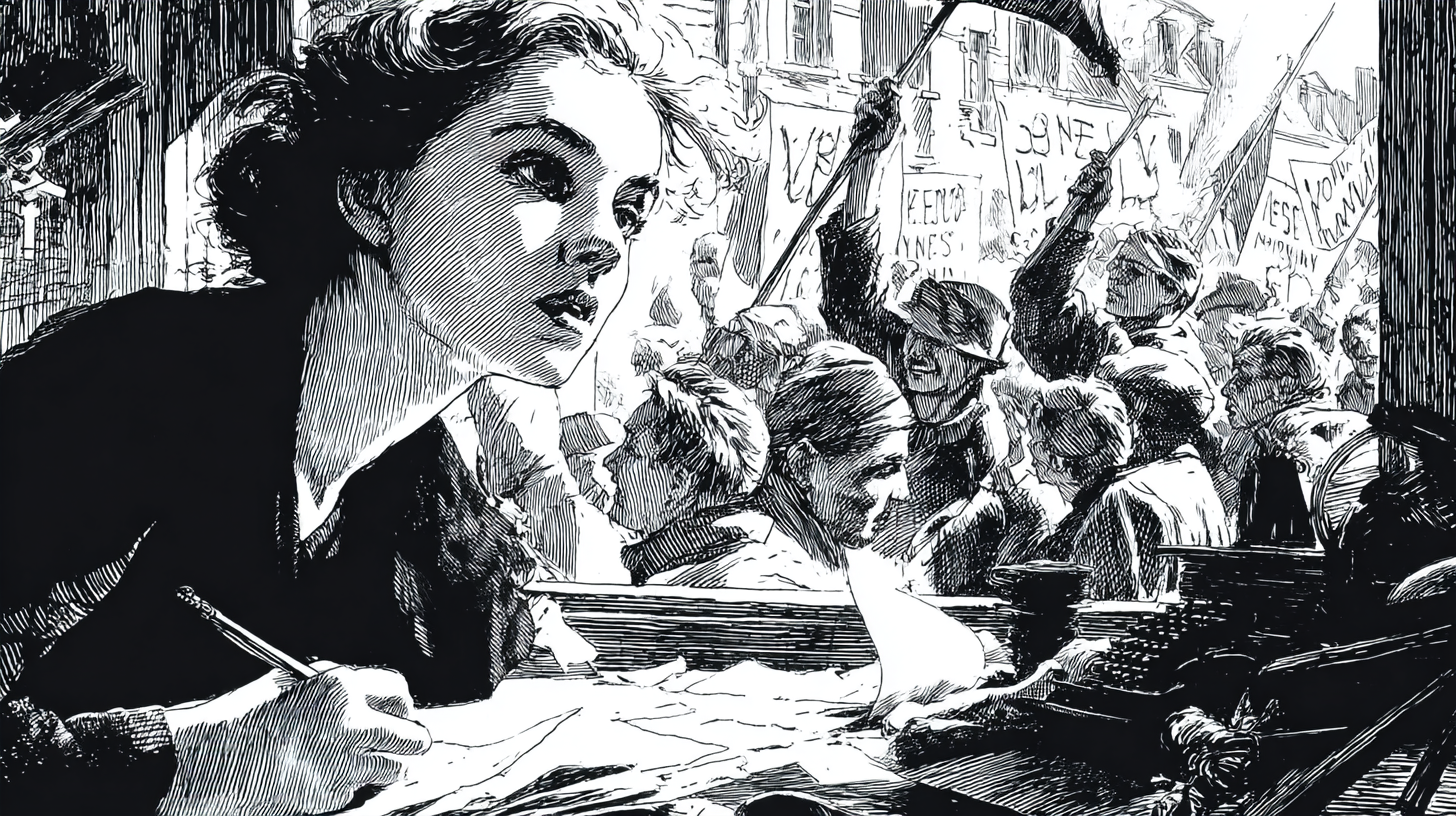
She brings her coffee into the garden and sits with the newspapers folded on her lap. This is the hour for it. Before the telephone. Before the day insists upon its claims. She reads, as her mother once read, with a pencil; not to underline so much as to register, on the body, that a thing has been noticed.
The first item she notices is a sentence in a despatch from Tehran. This may be the last time you hear my voice. The United Nations, the paper reports, has verified the execution of at least thirty-two political prisoners since the war began on the twenty-eighth of February. The sentence is attributed to a man whose name has been withheld. It is a sentence so old, so often spoken, so frequently written on prison walls and smuggled out in the linings of coats, that she finds herself wondering whether what is shocking is the sentence or the fact that it can still shock her. She knew people, once, who left such sentences in drawers for their wives to find. She knew the wives. She has, she supposes, written about both.
On the same page the American President is reported to have warned the Iranian government that there won't be anything left of them should they refuse the terms he has proposed. Five conditions, according to the Iranian press. The dismantling of the nuclear programme. The surrender of the missile stocks. She has heard, in her time, the phrase won't be anything left applied to villages in the Eastern Cape, to townships outside this very town, to men whose names did not appear in any newspaper. The grammar of annihilation is remarkably stable. Only the speakers change, and the costumes of their authority.
She turns the page. A drone has struck somewhere near the perimeter of the nuclear facility at Barakah, in the United Arab Emirates. A fire, the report says, was quickly contained. Quickly contained – the soothing administrative verb that a censor in the old days might have used about a riot. Saudi Arabia, too, reports drone attacks. The world has acquired a new vocabulary while she was sleeping: the swarm, the loitering munition, the autonomous strike. She thinks of the boys she used to see at Wits in the seventies, who could quote Fanon entire and could not change a tyre. The boys now have engineering degrees and write code, somewhere, that decides whom to kill.
The dog has come to lie at her feet. The frost is going off the grass, leaving it darkened and beaded. She turns to the African pages, which are at the back of the paper, as they have always been, even in those years when whole histories were being lost on this continent and reported, if at all, in five centimetres of agate type beneath the racing fixtures.
The World Health Organization has declared the Ebola outbreak in the Democratic Republic of Congo a public health emergency of international concern. Two hundred and forty-six suspected cases. Eighty deaths. International – the word does a great deal of work in that sentence. A thing becomes international when it threatens to leave Africa. Before that it is merely African, which is to say, endurable at a distance. She wonders, not for the first time, what the people of Equateur Province make of being told their suffering has only now become real.
Below this, an account from the Lake Chad Basin: ISWAP, Boko Haram, the slow re-mapping of a region by men with rifles and grievances. Weak governance, the correspondent writes; economic hardship. These are the polite words for the condition in which her own country lived for so long, and in which one half of it lives still. The collapse never announces itself. It is achieved by small subtractions: a clinic that closes, a road that is not repaired, a teacher who is not paid, a family that decides, one morning, not to walk to market.
And in Lebanon, where a ceasefire has been extended, Israeli aircraft have killed at least five people in the south. Elsewhere on the same page the Israeli government has approved the construction of a military museum on the site of the former UNRWA offices in Jerusalem. She reads this twice. A museum, on the ground where the refugee agency stood. There is a violence in the symbol that exceeds the violence of the building itself; one feels it in the chest, the deliberate cruelty of the gesture, the pleasure taken in choosing precisely that site and no other. The architects of October seventh, the Israeli Prime Minister says, have mostly been killed. He does not say what has happened to the architects of everything since.
She closes the paper. The frost is gone now from the grass nearest the house, though it lingers in the shadow of the plumbago. Somewhere along the street a child is being called in to breakfast in Sesotho. A jet, very high and silver, scratches a line across the perfected blue.
Yesterday, she reads, the American President held a prayer rally in Washington to rededicate his nation as one nation under God. Christian preachers spoke; cabinet officials spoke. The critics, the careful, marginalised critics, noted that the Constitution had something to say about the separation of church and state. She has watched, in her lifetime, the marriage of pulpit and presidency in this very country: the Dutch Reformed dominees blessing the architecture of separateness, the prayers offered up over the small coffins. She knows the look of that marriage. She knows what the children of such a marriage become.
A small thing, almost lost between the larger items: the businessman Alex Saab, alleged conduit for the looted billions of a deposed Venezuelan president, has been extradited from Caracas to the United States. Part of a purge, the report says, of powerful figures who helped Maduro stay in power. In her experience, purges of accomplices tend to spare the people who profited most. One should watch, in the coming months, who is not arrested.
She gathers up the papers and goes inside. The kitchen is warming. The kettle has begun to mutter. There will be telephone calls. There will be letters to answer. There is the manuscript on the desk that has been waiting now for three days.
To write at all, in such a season, is to be asked the old question, the one she has been asked since she was a young woman and which she has never satisfactorily answered: what is the use? The answer, she has come to think, is small and unromantic. The use of writing is to insist that the sentence has been heard. This may be the last time you hear my voice. Someone, in another room, in another country, on another morning of perfected blue, must pick up the pencil and write the sentence down.