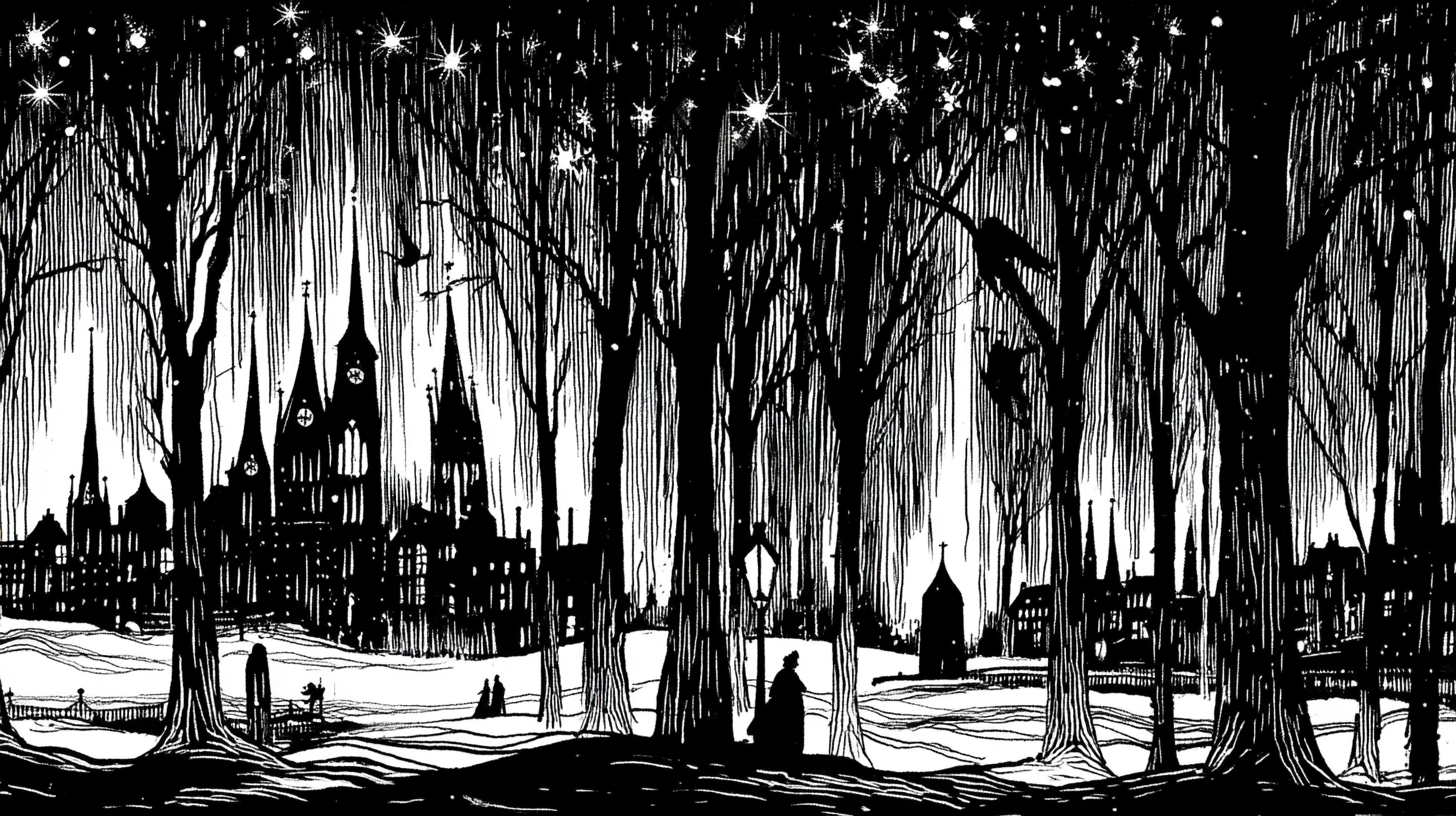
There was once a fog that crept over the old city of Odense, so thick and so grey that even the church steeples could not see their own crosses. The thermometer shivered at two degrees, and the cobblestones were slick and cold, as if the whole earth were holding its breath. And indeed it was – for on this Easter morning, the world had need of a story.
Let us begin, then, as all proper tales must begin, with a king who lost his throne.
In a country not so very far away – you could reach it if you walked east through the forests and over the plains where the Danube runs wide and brown – there lived a ruler who had sat upon his chair of power for sixteen long years. He had built high walls around his kingdom, not of stone, but of words. He told his people that the world outside was wicked, that only he could keep them safe, and for many years they believed him, as people will believe a voice that speaks loudly enough and often enough.
But there was a man, younger, with eyes that had seen the rot from within the palace itself, who went out among the villages and the cities and said, simply: "Look. Look at what has become of us." And the people looked. And on the day of the election, they cast their votes like so many small stones into a river, and the river swelled, and the old ruler was swept away. "You have liberated Hungary," the young man told the crowds, and whether this was true or merely hopeful, only the years ahead would tell. For liberation, as any fairy tale will warn you, is not the end of the story. It is the beginning of the harder one.
Now, far to the south and east, across many seas, there was a strait: a narrow passage of water through which the ships of the world carried their black treasure, the oil that makes the engines turn and the lights burn. A great power from across the ocean declared that it would block this passage, that no vessel should enter or leave the ports of a certain ancient land until that land bent its knee.
The price of oil leapt upward like a startled hare, past one hundred dollars, past one hundred and three, and in the markets of Asia, the numbers fell as numbers do when fear takes hold. The United Nations warned that the war and the blockade could starve not just armies but children, and the diplomats who had gathered in Islamabad to make peace went home with empty hands. The sea, which belongs to no nation and to all nations, was made into a wall.
How strange, thought the fog over Odense, that men who have never wanted for bread should decide who may sail and who may not.
And while kings fell and seas were closed, there came news from a mountaintop fortress in Haiti: a fortress called the Citadelle, built long ago by freed slaves who swore they would never be enslaved again. It stands on a peak in the north, proud and crumbling, a monument to courage. But on this day, a great crowd had gathered there, drawn by some fleeting spectacle, some personality of the glowing screens, and in the pressing and the pushing, dozens of young souls were crushed. Thirty dead, perhaps more, on the steps of a place that was meant to stand for freedom.
The fog wept a little at this, for it knew – as fogs do, having drifted over many centuries – that a crowd is a dangerous creature. It has no single mind, no single heart, and when it surges, it does not pause to ask who is beneath its feet.
In gentler news (though is any news truly gentle?), a voice fell silent in India. Asha Bhosle, who had sung for ninety-two years, who had given her throat to more than twelve thousand songs, whose melodies had poured from radios and cinema halls and wedding tents and rickshaws, died. She was the sound of a nation's joy, its longing, its mischief. She sang the songs that the leading ladies would not, the bold ones, the playful ones, and in doing so she became more beloved than any of them.
There is a tale I once wrote about a nightingale whose song could move even the Emperor of China to tears. But the emperor replaced the bird with a mechanical one, jewelled and precise, until the real nightingale was forgotten. It was only when Death sat upon the emperor's chest that the true nightingale returned, singing so sweetly that Death itself went back to the graveyard. Asha Bhosle was such a nightingale. No mechanical voice will ever replace her. The silence she leaves behind is the shape of twelve thousand songs.
And then, for fairy tales must not neglect the small and the overlooked, there was the matter of a little Dutch village called Moerdijk. It sat quietly in the Netherlands, bothering no one, as villages do. But the authorities had decided that it must be demolished, erased from the map entirely, so that in its place they could build a vast electricity substation. Progress, they called it. The future demands it. And the people of Moerdijk were told that their homes, their gardens, their church, their memories, must make way for cables and transformers.
Is there anything sadder than a village that must die so that distant cities may keep their lights burning? The little mermaid gave up her tail for love and received only pain. The steadfast tin soldier was melted in the fire. And Moerdijk – dear, small, ordinary Moerdijk – must give up everything for electricity.
On a greener note, and I do not wish to end this tale in nothing but shadow, a golfer from Northern Ireland named Rory McIlroy won the great tournament at Augusta for the second year in a row: a feat not accomplished since the days of Tiger Woods, a quarter of a century ago. He swung his club, and the little white ball sailed through the American air and found its home, and the crowd roared. It is a small thing, a ball and a hole and a stretch of impossibly green grass. But there was something in it – the persistence, the steadiness, the refusal to falter – that the world needed on this particular Sunday.
Meanwhile, in the east, Easter had come to Ukraine, and with it a ceasefire, or what was meant to be one. Both sides had agreed to lay down their weapons for the holy days. But even before the church bells had stopped ringing, each accused the other of firing. Hundreds of violations, they said. Hundreds. The ceasefire was a fiction, a paper bird that could not fly. And yet they had agreed to it, which meant that somewhere, buried under the rubble and the anger, there was still the idea of peace, still the memory that once, on this day, something miraculous was supposed to have happened.
The fog began to lift over Odense. The temperature held at two degrees, stubborn and cold, but a pale light pressed through, the way light does when it is determined to arrive. A child walked to school along the canal, dragging a stick along the iron railing, making a sound like a tiny xylophone. The child did not know about blockades or elections or stampedes. The child knew only that it was Monday, and that the fog was thinning, and that the stick made a pleasing sound.
And that, perhaps, is the moral, if fairy tales must have morals: that the world is full of gates (gates of war and gates of power and gates of grief) and most of them are locked. But somewhere, always, there is a child with a stick, making music against the iron bars, and the music passes through.