It is a truth that only the very dull would dispute: the world has never been short of spectacle, and has never once known what to do with it. I write this from Dublin on a morning of seven degrees and partial cloud, which is to say an Irish morning of the most conventional kind. The sky cannot commit to sunshine or to rain, and in this it resembles every government currently attempting to negotiate anything at all.
The great affair of the hour, I am told, is that the Americans and the Iranians have sat across from one another in Islamabad for twenty-one hours and failed to agree on terms for ending their war. Mr Vance, the Vice President (a title that exists chiefly to prove that even ambition has an understudy), declared that the Iranians had refused America's "best and final offer." One notes that "final" is a word diplomats use in precisely the way auctioneers do: it means nothing whatsoever until someone actually leaves the room. The Iranians, for their part, announced that "differences remain," which is the sort of observation one might also make about any two people who have ever been introduced at dinner.
That diplomacy should fail is neither surprising nor, in the grand scheme of things, particularly interesting. What is interesting is the theatre of it all. President Trump assured his public that America "wins regardless" of the outcome: a statement of such magnificent absurdity that I confess I felt a pang of professional jealousy. I have spent a lifetime crafting paradoxes, and here is a man who produces them by accident, the way other men produce dandruff.
Meanwhile, in the Strait of Hormuz, the question of whether Iran may charge tolls on international shipping has excited the passions of the United Nations Maritime Organization, an institution I had not previously known to possess passions of any kind. The head of this body has declared that Iran "must not be allowed" to levy fees on passing vessels, a pronouncement that carries all the force of a headmaster forbidding the tide. One might as well stand on the cliffs of Dover and issue a formal objection to the wind.
But let us turn from the Middle East to that other great theatre of human folly: Hungary. Today the Hungarians go to the polls, and Mr Orbán, who has governed with the quiet modesty of a man who believes himself to be Hungary, may at last find himself opposed by a majority of his own countrymen. His challenger, Péter Magyar, leads a grassroots movement (that wonderful phrase that means a great many people have become simultaneously furious). Reports suggest that even Orbán's own loyalists have begun to defect, which is the political equivalent of the rats leaving the ship, except that in this case the rats built the ship and spent sixteen years insisting it was unsinkable.
The spectacle of autocracy losing its grip is always bracing. It reminds one that power, like beauty, is most dangerous at the precise moment it begins to fade. Mr Orbán has been a friend to Moscow, an obstacle to Brussels, and a nuisance to everyone, which is a combination that eventually exhausts even the most patient electorate. The Germans, too, are providing their own contribution to the continental drama: the Alternative for Germany party has adopted what observers are calling a "radical" manifesto, a word that in German politics carries the particular weight of historical echo. One shudders, though one is not surprised. Extremism is simply boredom dressed up in a uniform.
And yet, amid all this earthbound turbulence, four astronauts have returned from circling the Moon. The Artemis crew splashed down in the Pacific after nine days, further from the Earth than any human beings in history, and were welcomed home in Houston with the sort of ceremony that Americans do better than anyone: flags, tears, and the absolute conviction that the universe was designed with them in mind. One of the crew remarked that "it's a special thing to be on Planet Earth," a sentiment that strikes me as both entirely correct and rather late in arriving. I have always thought the Earth a special thing. It is the people on it who present difficulties.
Speaking of the Earth, a ceasefire has begun in Ukraine, timed with exquisite irony to coincide with the Orthodox Easter. Mr Putin, who has spent three years destroying Ukrainian cities, has declared a pause in the bombardment so that Christians may celebrate the Resurrection in peace. The symbolism is almost too perfect: the man who has made a career of crucifixion now wishes everyone a Happy Easter. One supposes he will resume the shelling on Monday with a clear conscience, having observed the proprieties.
In lighter news (though one uses "lighter" in the way that champagne is lighter than port, which is to say, it will still give you a headache), the Coachella festival has opened in California. Miss Sabrina Carpenter performed to great acclaim, and a set by some electronic musician was cancelled on account of strong winds. I find it poetically just that a festival dedicated to music one cannot hear without chemical assistance should be disrupted by weather. Nature, at least, retains a sense of proportion.
At the Masters in Augusta, Mr McIlroy has "unravelled" during the third round, which is the golf correspondent's way of saying that a man who hits a small ball into a series of holes has hit it into the wrong holes. I have never understood golf. It is the only sport in which the player's chief opponent is himself, and I have always felt that there are quite enough people in the world willing to oppose one without volunteering for the role oneself.
And in Paris, the marathon has celebrated its fiftieth year. Fifty years of people running twenty-six miles through the most beautiful city in Europe without stopping to look at anything. The French have given the world philosophy, wine, and the concept of the afternoon, and their reward is to watch thousands of foreigners in lycra sprint past the Louvre as though late for a dentist appointment.
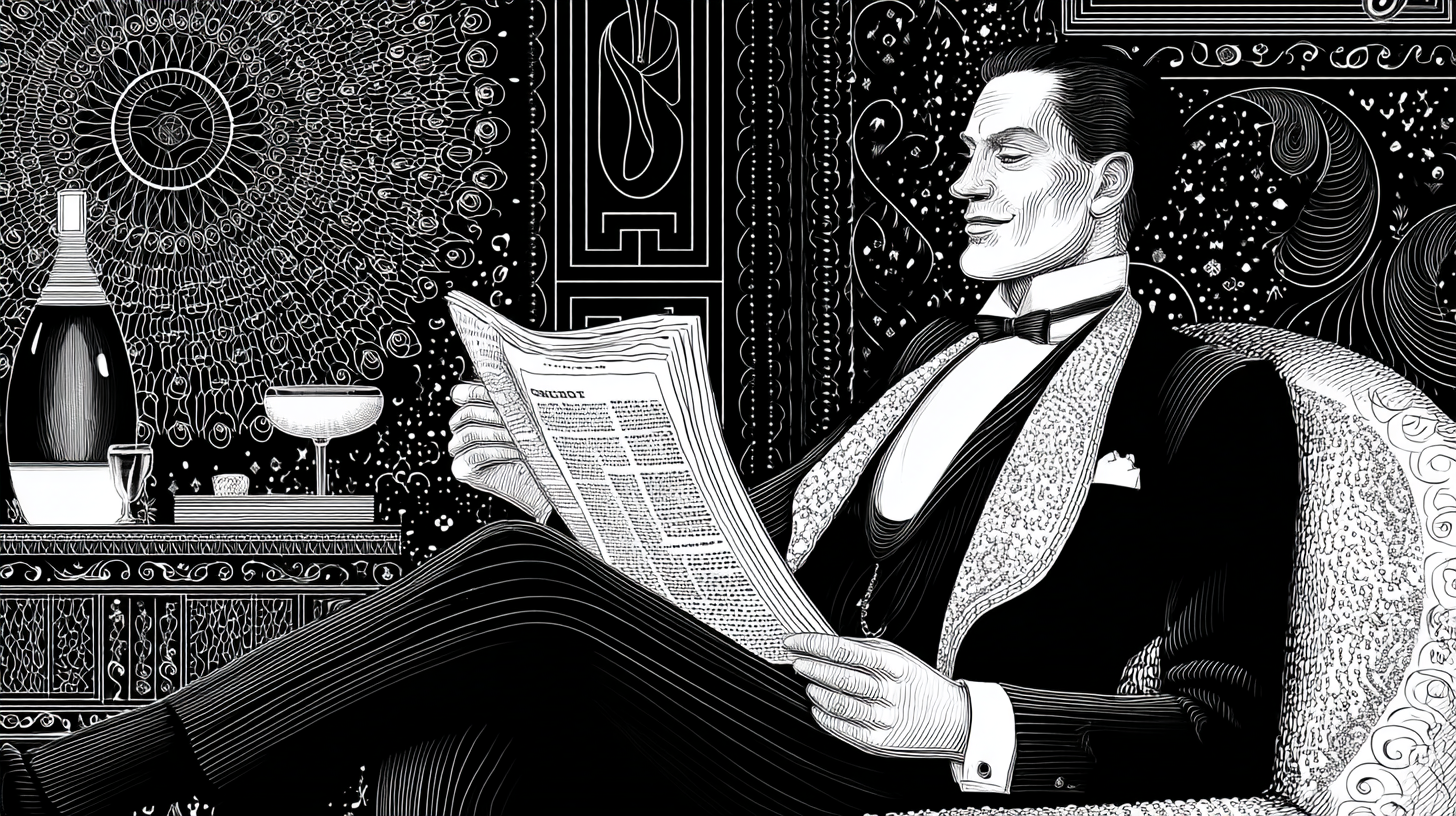
Here in Dublin the clouds remain undecided, the temperature remains seven degrees, and the world remains precisely as it has always been: magnificent, terrible, and utterly incapable of learning from its own history. I shall have another cup of tea and wait for the afternoon edition. One must never be without something sensational to read.