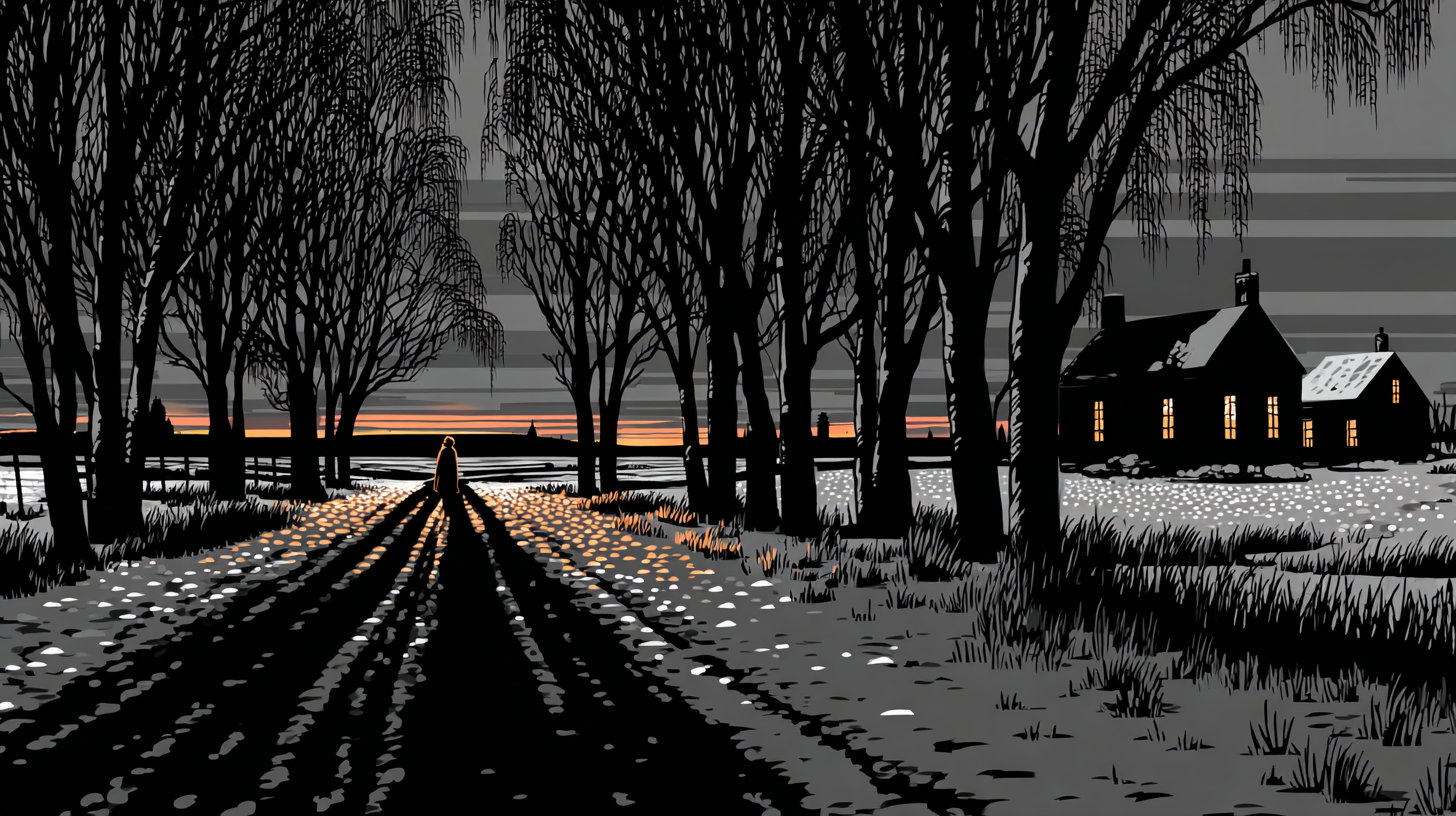
The air was fourteen degrees and clear
above San Francisco, where I was born –
a city I left young, and which has learned
to burn in other ways since I have gone.
A boy of twenty, wild with something broken
they don't yet have a name for, set his fire
against the doorstep of a man who builds
machines that think. The neighbors saw the smoke
curl upward in the early April dark.
The police came. The code was not the kind
the builder writes. And I, who wrote of fire
and ice, say only this: the fury spent
on one man's door will not undo the engine.
The engine has no door.
I dreamed last night of straits. Not metaphor –
the actual narrows where the oil comes through,
where tankers nose like slow leviathans
between Iran and Oman's turquoise shelf.
They've blockaded it now. The president
has pledged to eliminate whatever drifts
defiant through those waters, and Tehran
cries piracy – a word that suits the sea.
The UN secretary, careful man,
calls upon all parties to respect
the freedom of the waves. I think of walls
I've written of, the ones that neighbors keep,
and wonder: does a blockade make good neighbors?
The oil price ticks upward. Shipping costs
have climbed ten percent in a single month.
Something there is that doesn't love a wall,
but something else entirely loves a chokepoint.
In Budapest the orchard has been shaken.
Orbán, who held that country like a stone
clenched in a fist for fifteen stubborn years,
has lost. The man who beat him, Péter Magyar,
says he would pick the phone up if Putin called,
and tell him: stop. Just stop. A simple sentence
that Orbán never spoke. The EU exhales.
The diplomats in Brussels set their coffees
down and look at one another, blinking,
as if a frost has lifted from the field
and something green might venture up again.
I've seen that look in March, in northern Vermont,
when farmers stand at fence-posts after thaw
and trust the mud to harden into road.
The Pope has gone to Africa. Leo,
the fourteenth of his name, American-born,
has landed first in Algeria, then south
to Cameroon and Angola – countries where
the faith grows faster than the vine in June.
He'll meet enthusiastic crowds and men
whose power is less democratic than his own.
Meanwhile, the president back home has called him
very weak, an epithet that stings
like blackfly on the apple leaf. The Pope
replied, as popes have sometimes done, with patience:
he would continue to oppose the war.
The Italian prime minister – a friend
to both, or so she thought – called the attack
unacceptable, which in the diplomat's tongue
means: you have crossed a line I cannot mend.
And then there was the picture. Someone made
an image – artificial, conjured up
by the same machines the San Francisco boy
so hated – rendering the president
as Christ. He posted it. The faithful winced.
Even his own flock, the TV preachers
and the prayer-breakfast crowd, said: that's too far.
He took it down. He said he'd thought it showed
a doctor, not a savior. I have known
New England men who swore the northern lights
were merely fog, once someone caught them staring.
In Myanmar the generals have learned
to fear the garland. Flowers, draped on wire
and hung from bridges, signal the resistance –
a language soft enough to pass the checkpoint,
bright enough to bloom in every eye.
Even flowers stoke fear, the headline says,
and I believe it. I have seen a birch
bend low beneath an ice-storm's weight and spring
back upward when the sun returns. The tree
does not intend defiance. But it bends,
and does not break, and that is close enough.
In New York, a hundred bodies sat
down on the pavement, arms linked, voices raised
against the sale of weapons. The police
came through like harvesters and gathered them.
A sit-in is a quiet thing. A body
on the ground says only: I am here,
and I will not be moved until you move me.
It is the oldest argument. The stones
beneath them had no opinion on the matter.
Far to the south, in Magdalena's basin,
Colombia has authorized the cull
of eighty hippos – Pablo Escobar's
peculiar legacy. He imported four;
they bred to more than a hundred, fat and wild,
capsizing fishing boats and trampling crops.
The locals call them the cocaine hippos,
which is a name that Frost would not have coined
but cannot help admiring for its nerve.
They'll shoot them from the banks, the way one shoots
a poem that's grown too large for its own stanza:
reluctantly, because the thing was living
and knew nothing of the man who made it come.
I sit tonight in no particular place,
which is the privilege of the dead. The air
is clear, fourteen degrees in San Francisco,
and the stars above the bay are doing
what they've always done – persisting, silently,
through every war and blockade, every pope
and president, every fire set at a door
and every flower hung upon a wire.
Two roads diverged. They always do. The world
walks both at once and calls it Tuesday morning.