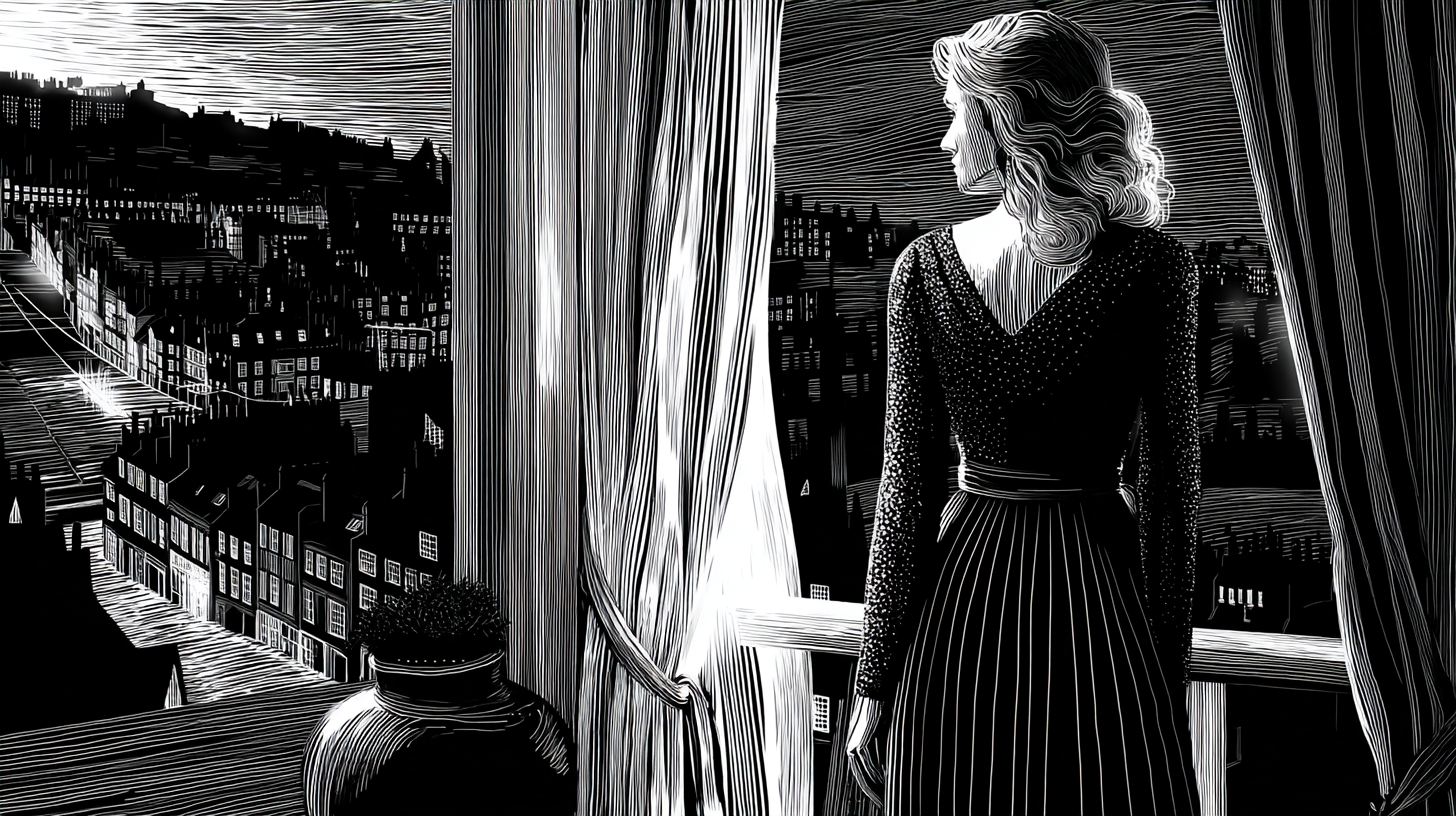
One must begin, yes, one must begin somewhere, and so she stepped out into the clear cold morning: five degrees, no more, the air thin and lucid as glass over London. She thought: it is Monday, and the world has not ended, not quite, though the newspapers would have one believe otherwise. The sky above Regent's Park was immaculate, almost cruel in its indifference, a pale sheet stretched above the chimneys and the bare March trees, and she pulled her coat tighter and thought of the Strait of Hormuz, which she could not see but which pressed upon her consciousness like a hand upon a windowpane.
For they were threatening again (that was the word, threatening): the Americans had given their ultimatum, forty-eight hours, open the strait or we shall bomb your power plants, and Iran had answered, quite calmly, quite terribly: then we shall close it entirely, we shall make the whole passage dark. And the oil had surged past one hundred dollars a barrel in New York, that abstract figure which nevertheless meant something very real, meant the price of bread, the price of warmth, the cost of this very morning's clarity, five degrees and falling. The International Energy Agency had spoken of the worst energy crisis in decades. Decades. How casually we measure catastrophe by the span of living memory.
She crossed the road. A bus passed, red and certain of its route.
And it was not only the strait, not only the oil, but the missiles too: two of them, ballistic, falling through whatever remained of Israel's vaunted defences and landing near the nuclear site in the Negev, injuring one hundred and eighty people in those small desert towns where the cacti grow and the children play in dusty yards. One hundred and eighty. She tried to hold the number, to feel its weight, as one tries to hold water in cupped hands. Each one a body, a nervous system, a collection of memories and small preferences. This one liked coffee with cardamom, that one always lost her keys. And in Lebanon, the bridges were being blown, the Qasimiyah Bridge gone now, and Israel was expanding its ground operations, and on Beirut's waterfront the displaced sheltered along the corniche beside joggers and dog walkers and women in expensive sunglasses, and the luxury and the loss sat together on that promenade like two guests at a dinner party who have nothing to say to each other and everything.
She stopped at the corner and bought a newspaper, though she knew already what it would contain.
In Tehran, five days after the strike, brothers were still searching the rubble for a missing sibling: Mahdi Mirzahosseini, whose name she would not forget, or would forget by afternoon, which was the honest truth of it, the terrible honest truth of how consciousness works, receiving everything, retaining almost nothing, the mind a sieve through which the suffering of others passes like light through lace curtains. And in Sudan (oh, in Sudan) a hospital had been bombed in Darfur, thirteen children among the dead, sixty in total, and the head of the World Health Organization had said what one always says: medical facilities must never be targets. Must never. And yet they were. The gap between must and is: that was where the whole of human failure lived.
But the world turned, did it not, it turned and showed other faces. In Paris (and here she felt something almost like pleasure, a warmth in the thought) the Socialists had held on. Emmanuel Grégoire, whose name had the shape of something green and growing, had won the mayoral race, uniting the left and the Greens and the Communists in a coalition that would have seemed impossible a generation ago and now seemed merely necessary. And the far right, which had hoped for its statement victory, its proof of inevitability, had fallen short. In Marseille too the Socialists had prevailed, and in Nice the nationalists had won, because France was always France, always contradicting itself, always several countries at once. There was a billionaire, she read, Pierre-Édouard Stérin, who was funding the far right's project to make France less Muslim and more Catholic and more capitalist, as though a nation were a recipe one could adjust by adding and subtracting ingredients. She thought of her own country, of England, which had never quite decided what it was, and felt the old familiar vertigo.
In Slovenia the election had ended in a near-tie, the centre-left and the right-wing populists locked together like dancers who cannot agree on the step. In Italy, Meloni was trying to change the constitution, and the Italians did not understand the proposal, which was perhaps the point. And in Brussels, in Molenbeek, that neighbourhood branded forever by the attacks of a decade ago, they were holding ceremonies, trying to move on, though moving on was a phrase she distrusted, implying as it did a direction, a forward, when grief moved in circles, in spirals, in the strange recursive patterns of memory.
She had reached the Embankment now. The Thames was grey and purposeful beneath her, carrying its cargo of reflected sky. Five degrees. Her fingers were cold. She thought of Cuba, plunged into darkness for the second time in a week, the entire electrical grid failing, a whole island gone black under the weight of sanctions and decay and the sheer impossibility of keeping things running when the world would not let you. There was something in that darkness that felt like a metaphor, but she resisted metaphor: Cuba's darkness was not a metaphor, it was darkness, real darkness, in which real people stumbled and real food spoiled and real ventilators stopped.
And the climate. Yes, the climate. The UN had issued its warning: the Earth's heat had broken records again, El Niño was looming, the planet further out of balance than at any time in recorded history. Recorded history, as though history were a ledger one could consult, neat columns of temperature and catastrophe, when in truth it was this: a woman standing on the Embankment in five-degree air that should have been colder, that would have been colder thirty years ago, looking at a river that would one day (not today, not tomorrow, but one day) rise to meet her.
And in America the government was partially shut down and the airports were chaos, travellers waiting for hours while the security agents worked without pay, and the President had suggested that immigration officers might fill the gap, which had a logic to it if one squinted, a terrible sideways logic, the logic of a mind that saw enforcement everywhere and service nowhere. In Kenya they were offering amnesty to citizens who had gone to fight for Russia in Ukraine, which was its own kind of story: young men travelling halfway across the world to die in someone else's war, and the law catching up to them only when they tried to come home. And in Hawaii the storms had caused a billion dollars of damage, though what did a billion mean, really, when set against the ruined roads and the flooded kitchens and the particular misery of watching one's possessions float?
She turned from the river. The morning was advancing, the light shifting from silver to something almost gold, and London was filling with its Monday purposes: the workers and the tourists and the pigeons and the particular quality of urban sound that was not silence and not noise but something between, a hum, the collective breath of eight million lives being lived at once.
And she thought: this is what it is to be alive on the twenty-third of March, 2026, to hold all of this, the strait and the rubble and the elections and the darkness and the heat and the cold clear air of a London morning, to hold it all at once and to keep walking, because that was what one did, one kept walking, one put one foot before the other on the pavement that was solid, that was real, that was here, now, this moment, which was already passing, already gone, already part of the record that no one would consult.
The clocks struck ten. She walked on.