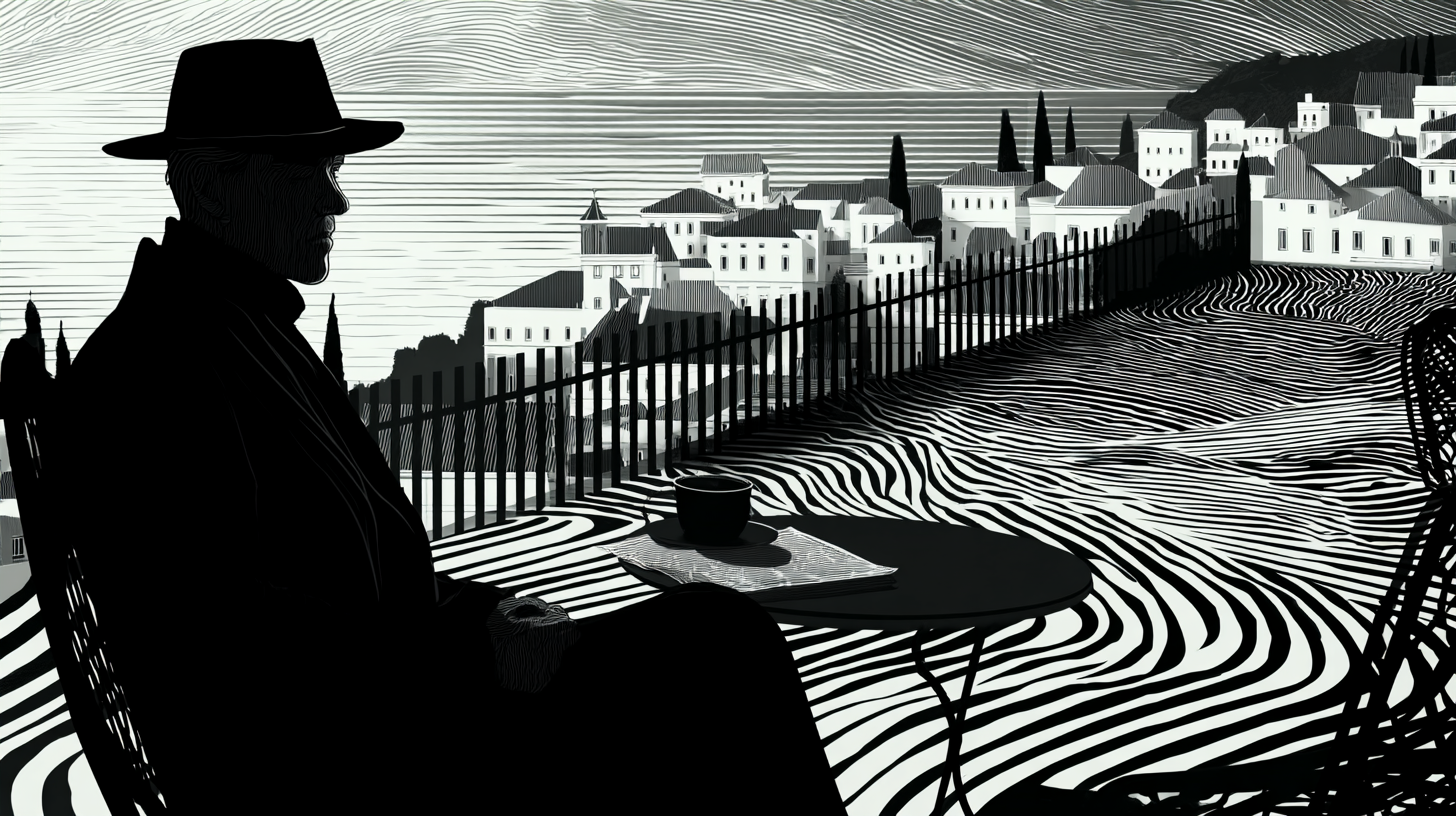
I woke this morning in Algiers to a sky that could not decide what it wanted to be. Partly cloudy, nine degrees: cool for March, the kind of weather that makes you pull your collar up and think about the Mediterranean, about how the sea does not care whether we threaten it or not. And this seemed to me the only honest thought available on a day when a man in Washington had given the Strait of Hormuz forty-eight hours to open itself, as though a body of water were a subordinate who had overslept.
One must imagine this clearly. The president of the United States has threatened to obliterate Iran's power plants if a strait does not comply with his schedule. Iran has responded that all American energy infrastructure in the region will burn in return. Each side speaks as though destruction were a form of management, as though there existed some ledger in which annihilation could be entered on the correct line and the accounts would balance. I have seen this arithmetic before. It does not balance. It never has.
Meanwhile, the missiles have already found their targets. Iranian projectiles struck Dimona and Arad in southern Israel, wounding more than a hundred people, in retaliation for an attack on the Natanz uranium enrichment facility. The International Atomic Energy Agency called for maximum military restraint. Those words, "maximum restraint," mean nothing when the warheads are already in flight. The chief of the agency spoke as men always speak after the fact, asking for what was needed before. Nuclear towns are being struck. Nuclear facilities are being targeted. We have arrived at the place where the unthinkable has become merely the latest headline, and the headline will be replaced by tomorrow's headline, and we will scroll past it as we once turned the page.
I do not pretend to know how wars end. I covered one, once, from the pages of Combat, and what I learned is that they end badly or they do not end at all. Zelensky has sent negotiators to Washington, hoping to revive talks about Ukraine while the world's attention pivots to the Persian Gulf. He has said he has a very bad feeling. I understand this feeling. It is the feeling of a man who watches the doctor leave his room to attend to a louder patient. The drone that killed two people in Zaporizhzhia and wounded two children, aged eleven and fifteen – that drone does not pause because there is a larger war now. The children do not heal faster because their suffering has become secondary.
In Sudan, a strike on a hospital in East Darfur killed sixty-four people and wounded eighty-nine more. Among the dead were children and medical personnel. A hospital. I want to hold this word up to the light and turn it slowly, because a hospital is perhaps the last place where we collectively agree that human life has value, where even enemies are to be treated, where the doctor does not ask which side you serve before he stops your bleeding. To bomb a hospital is to announce that this agreement is void. It is the act of someone who has looked at the social contract and decided it does not apply to him. I have written about plague, and I have written about murder, and what I have always tried to say is that the refusal to be complicit in killing is the beginning of all morality. When a hospital burns, that beginning is erased.
In Havana, the lights went out for the second time in a week. A national blackout, total, the kind that leaves an entire island in darkness, and in this darkness there is a particular cruelty because it is not caused by storm or earthquake but by a fuel blockade – which is to say, by human decision. Someone decided that these millions of people would sit in the dark. And in the dark, a grandson of Fidel Castro posts photographs on Instagram: beer, Nikes, jokes about Trump. He flaunts a life of luxury while using satire to point out the very deterioration his family's leadership helped create. There is an irony here so thick it becomes a kind of honesty. The revolution devours its children, and the children post about it with filters.
A judge in Washington ruled that Pentagon restrictions on the press violate the First Amendment. Reporters had been required to agree to rules about what information they could gather in order to maintain access. I will say this simply: when a government tells journalists what questions they may ask, it is not protecting security. It is protecting itself from being seen clearly. And clarity – the unflinching, cold, Mediterranean clarity that falls on things like noon sunlight – is the only weapon the rest of us possess. Without it we are all in Cuba, sitting in the dark, waiting for someone to decide whether to turn the lights back on.
Robert Mueller died at eighty-one. He was the former FBI director who led the investigation into Russian interference in the 2016 election. The president of the United States wrote that he was glad Mueller was dead. I will not moralize about this. I will only note that to celebrate a man's death publicly, from a position of power, is to cross a line that most civilizations have marked with silence. The Romans did it. The revolutionaries did it. It has never been the sign of a healthy republic.
And then there is the small, strange, beautiful news that arrives like light through a crack. In Washington, the cherry blossom festival opened, and Japan announced it would send two hundred and fifty new cherry trees to mark America's two hundred and fiftieth birthday. Cherry blossoms, which bloom for a week and then fall, which are loved precisely because they do not last. The Japanese understand something about impermanence that the men with their forty-eight-hour ultimatums do not. A blossom does not negotiate. It opens, it is beautiful, it falls. This is not weakness. This is the truth about all living things, including nations, including empires, including us.
In Seoul, forty thousand people gathered for a free concert as the members of BTS performed together for the first time since 2022. I know nothing about this music. But I know what it means when forty thousand people stand in a city and sing together at a time when cities are being bombed elsewhere, when hospitals burn and straits are blockaded and presidents celebrate death. It means that the human desire to gather, to hear, to feel something together in the dark – this desire is unkillable. It persists like the nine-degree wind off the Mediterranean this morning, insistent and without purpose, carrying the salt of a sea that has witnessed everything and forgotten nothing.
The clouds over Algiers have not made up their minds. Neither have we. But the afternoon will come, as it always does, and with it perhaps a little sun, and the question that has always been the only question: what will we do with this one unrepeatable day?