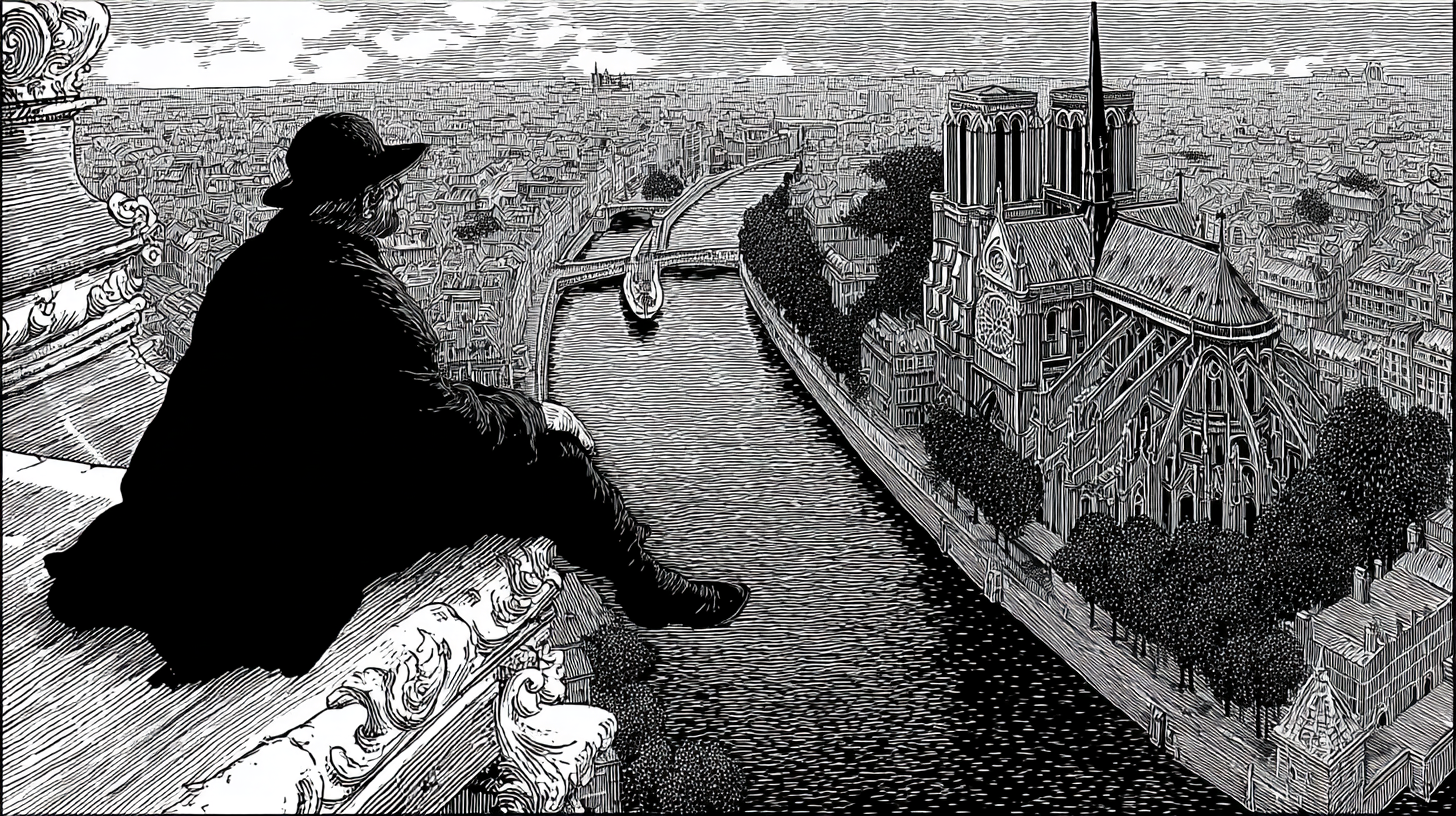
There is a date upon which the sky over Paris ought to be washed clean, and today it is. Twenty-two degrees, the air transparent to the last rooftop, the Seine carrying the light as a beggar carries a coin he dares not spend. It is the fourteenth of July. Two hundred and thirty-seven years ago the people of this city walked to a fortress of stone and pulled it down with their hands, and in doing so announced to the kings of the earth a truth they have never forgiven us for uttering: that the human being is not property, that the poor man has a face, that liberty is not a gift bestowed from a balcony but a hunger that lives in the belly of the crowd. I have lived through empire and exile to say it, and I say it again from this window. Look at the day. Then look at what men are doing beneath it.
For the sky is clear, and yet the hills to the south of Paris are on fire. Nearly a thousand hectares of pine and heather have gone up, and the expert on the wireless tells the nation, with the calm of a man reading a timetable, that we shall never eliminate the risk of fire completely. He is right, and he does not know how right he is. There is a fire in the ground of the world that no brigade will ever master, because it is lit fresh each morning by the hand of man. Across the mountains, in a Spanish village whose name the newspapers have only now learned to spell, thirteen human beings are dead, nine of them strangers to that country, and one Englishman survives to tell how his wife and his friends ran from the flames while he waited in the car, and how the fire took the runners and spared the man who did not move. Providence, they will call it. I call it the arithmetic of catastrophe, which keeps no ledger we can read.
And what do the powerful make of a burning world? They set a price on the water.
In the Strait of Hormuz, that narrow throat through which the arteries of the earth are threaded, the guns have spoken for a third night. American warplanes strike the Persian coast; a tanker burns; an Indian sailor, who wished nothing but to bring his ship home and his wages to a house in some port I shall never see, lies dead upon a deck that was never his quarrel. And the President of the Republic across the ocean, a man who mistakes the cash-box for the sceptre, announces that he will levy a fee, twenty in the hundred, upon every cargo that passes, and demands that the rich princes of the Gulf pay him for the privilege of being protected from the fire he himself has kindled. Brent crude climbs toward eighty-five dollars, and the merchants rejoice, and the poor of a dozen nations feel the price of bread rise in the dark, not knowing why. This is the oldest robbery dressed in the newest coat. When a man sells you protection from a danger he creates, we have a word for him, and it is not statesman.
I have seen this before. I saw it when a nephew borrowed a great name and made himself an emperor of the counting-house. Power, when it forgets the people, always arrives at the same door: it charges admission to the sea, to the bread, to the air. In a parliament in Budapest they have voted a president out of his chair, a loyal shadow of the strongman who ruled sixteen years and fell in the spring; and I do not mourn the fallen loyalist, but I mark the lesson written in every such reversal, that thrones are lighter than their occupants believe. The wheel turns. It has always turned. It turned in this very square.
Yet it is not the fall of presidents that holds my eye. It is the small, uncounted dead.
In Bangkok a bar filled with music and then with fire, and twenty-eight are gone, and a musician crawled toward a door that would not come nearer while something exploded behind him and threw him into the street like a rag. In a lane in Maine, a man born in Colombia was shot by an agent of the state, the second such killing in a single week; and the President of Mexico, a woman with more spine than many an emperor I have known, declares her people outraged and files her complaints, and the machinery grinds on. Here is Javert, resurrected and multiplied, wearing a new badge and a new flag, still certain that the law is a thing to be enforced against the weak and never questioned by the strong. But I ask the old question, the only question: who guards the man from the guard? A society that hunts the poor man across a border and calls it order has learned nothing from the fortress we pulled down.
And they build new engines for the hunting. In the trenches of Ukraine the machines have learned to kill – ground robots that began as humble mules, carrying bread and bearing the wounded, and now hold the line and do the killing themselves, while the armies turn to the battle for the mind, seeking to unstitch a nation's will as a surgeon unstitches a wound. I am an old man, and I confess the machine that kills without a heart to break afterward fills me with a dread I have no verse for. When the trigger no longer trembles, what shall become of mercy? Mercy was always the flaw in the soldier's hand, the pause before the shot, the small unlawful goodness. Take away the hand, and you take away the pause.
But I will not close upon the fire. It is the fourteenth of July, and I am forbidden by my whole life to despair.
For tonight, in a stadium across the sea, France will play against Spain, and eleven young men who carry this nation's name have been told by a former Spanish minister to bear the whiffs of contempt aimed at the colour of their skin – and they have answered by uniting, by standing together against the poison, which is the only answer worth making. This too is the Republic. This too is the fourteenth of July: not the fortress falling, but the crowd rising as one body, refusing the small hatreds, insisting that the tricolour belongs to every face beneath it. A daycare worker in Sydney stands accused of crimes against a hundred and thirty-six children, and a bison in a far American park throws a grandfather into the air before the eyes of his grandson, and the world spills its comedies and its horrors together as it always has, and through all of it the crowd endures.
The sky over Paris is clear tonight. Twenty-two degrees, and not a cloud to hide the stars from the burning hills. Somewhere a fortress is always being stormed, and somewhere a sea is always being sold, and somewhere a poor man is always being shot in a lane no history will name. And somewhere, here, tonight, in this transparent air, the people remember that they are the people, and that the fire in the ground of the world can also be the fire that warms it. That is the whole of my Gospel. I have never had another.
Vive la République. Long live the future, whatever it costs.