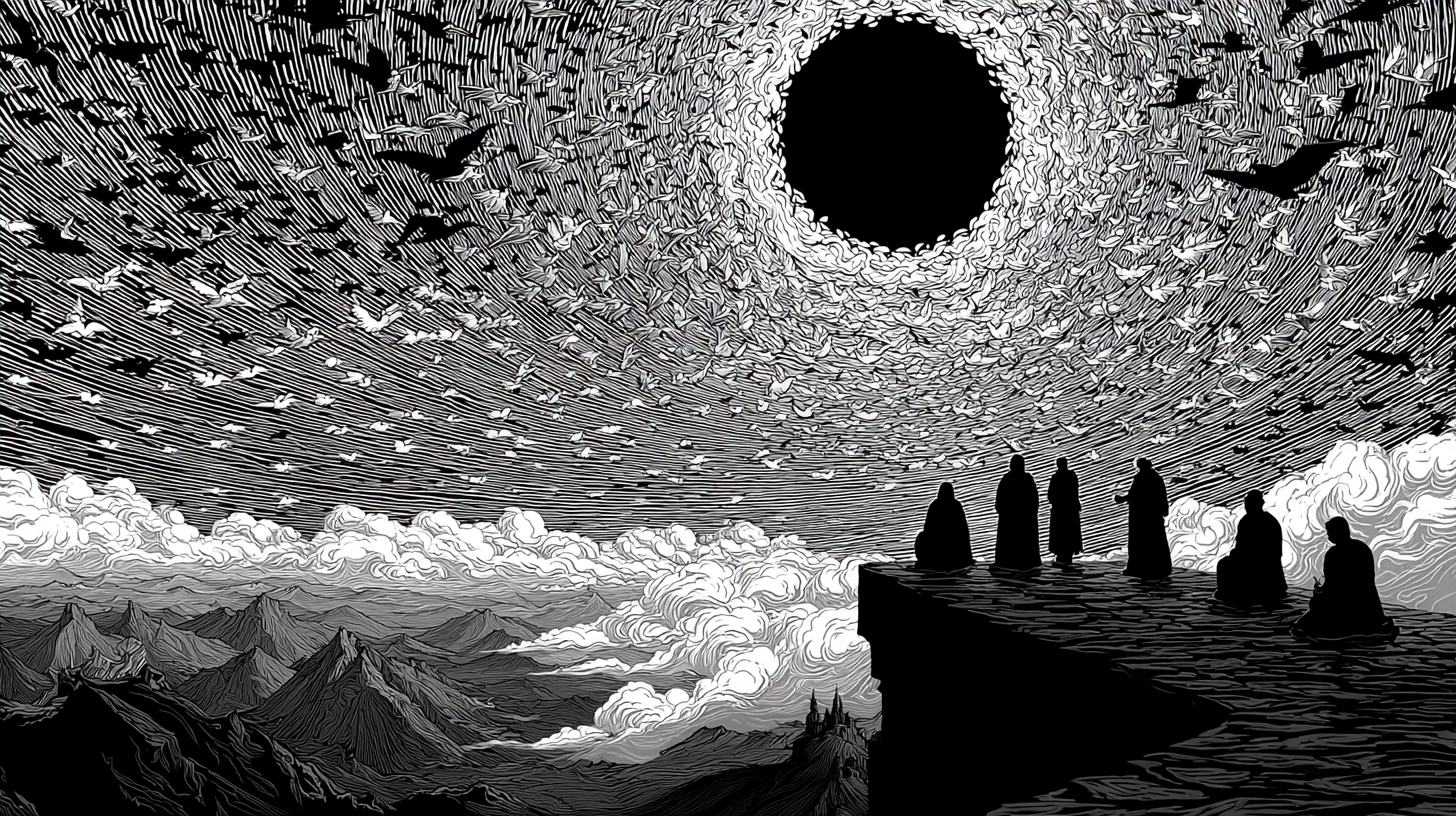
Midway upon the journey of our years
I stood where Arno's water ran serene,
beneath a heaven innocent of tears.
The twentieth degree of warmth, washed clean,
lay over Florence like a lifted hand;
no clearer dusk these aging eyes had seen.
Then fell a light I could not understand,
that took my wrist as Virgil took it once,
and drew me outward from my native land.
"Come," said the shade, "and answer, for the nonce,
what poets must: to look and not to flee.
The earth has cracked. Go down, and bear response."
The First Descent: The Broken Coast
We crossed to shores I never thought to find,
where La Guaira rose in tiers of stone
above an under-country, deaf and blind,
that drew two hundred thirty-five alone
beneath their fallen floors, then shook again
before the dust of the first blow had flown.
Four thousand more lay wounded; weeping men
clawed at the concrete where their children slept,
to lift one living body up again.
"These are not of the damned," my master said.
"Mark how they dig for strangers through the night,
how Cuba, Iran, the States, with one accord,
send ships and surgeons toward the fractured light.
Even in ruin, mercy keeps its post,
and pity is the last to lose its sight."
I looked, and could not tell the saved from lost,
so mingled were the rescued and the gone;
I learned what trembling earth exacts as cost.
The Second Circle: The Furnace of the North
We turned, and now no earthquake but a flame
poured down on Paris and the German plain,
where forty fevered degrees became
a second furnace in a single reign
of summer, and the city, to protect
its sweltering flesh from wine's unsteady strain,
forbade the cup in public. I reflect:
how strange, that men who built the vine its trellis
should bid the bottle wait, the throat be checked.
Down to the old canal of Saint-Martin
the crowds had thrown their bodies in the cool,
where forty drowned who only sought to swim.
So thirst itself becomes a kind of school,
and water, which we beg of the dry sky,
turns executioner, and breaks the rule.
The Strait Where the Black Waters Lie
He led me where the narrow waters run
at Hormuz, and a cargo vessel reeled,
struck by a projectile none would own,
so that the fleeing sailors, half-concealed,
were left to wait, their rescue plan undone,
while merchants watched the price of oil revealed,
climbing like smoke against the morning sun.
"Behold," he said, "how greed and fear conspire
to make a chokepoint of the world, and shun
the very ships they need." The whole desire
of nations narrowed to that thread of sea,
where one stray spark could set the globe afire.
The Circle of the Crooked Crown
Then to a chamber, panelled, cold, and grand,
where an old man of eighty-three contrived
to stretch his term beyond the law's command,
and called it stability; and so survived
by bending what the people meant to bind,
a constitution gutted, not revived.
I, who was exiled, banished, and resigned
to die far from the city of my birth,
know well the taste of justice redefined.
For elsewhere, by a court of high repute,
the wandering people, settled years and years,
were stripped of shelter, branded transient, mute,
and bidden to the road of exile's tears,
the Haitian and the Syrian alike.
I wept, who carried exile through my years.
The Women Who Demand the Hour
But there, against the wall of fixed decree,
stood fifty women, more, who would not let
the clock dismiss their wound to history.
"Abolish," cried they, "the appointed debt
of silence, this short season law allows;
let no man's crime be canceled by forget."
And I, who set my Beatrice in the house
of highest light, bowed low before that band,
who turn their suffering into vows,
and ask of time what time will not command:
that justice keep no calendar, no gate,
but answer late as gladly as it planned.
The Terrace of the Singing Crowds
At last my guide unveiled a stranger ground,
a Purgatorio of green-lit fields,
where flags and anthems made a joyful sound:
the nations playing, while the planet yields
to fire and fracture, kept their festival,
and Japan and Sweden, neither one that kneels,
drew even; Ecuador stood proud and tall
as Germany went down; the crowds still sang.
"Is this not blindness?" I began to call,
but he replied: "No. Hear how the cheers rang
not in contempt of grief, but to declare
that beauty, even now, outlasts the pang.
These are the souls who climb, who still repair
toward the light by loving what is fair.
Let them have their hour beneath the open air."
And so he brought me back, the vision spent,
to Florence and her twenty cloudless degrees,
the clear sky over Tuscany unbent.
I sat among my cypress and my bees,
and understood the day as one great song:
the earth that opens, and the heart that frees;
the furnace and the flood, the right, the wrong,
the crooked crown, the women at the gate,
the crowds that sing because the night is long.
Write it, the light had said. I do not state
who falls, who rises. That I leave above.
I only mark the trembling, and the weight,
and that the last word, even here, is love.