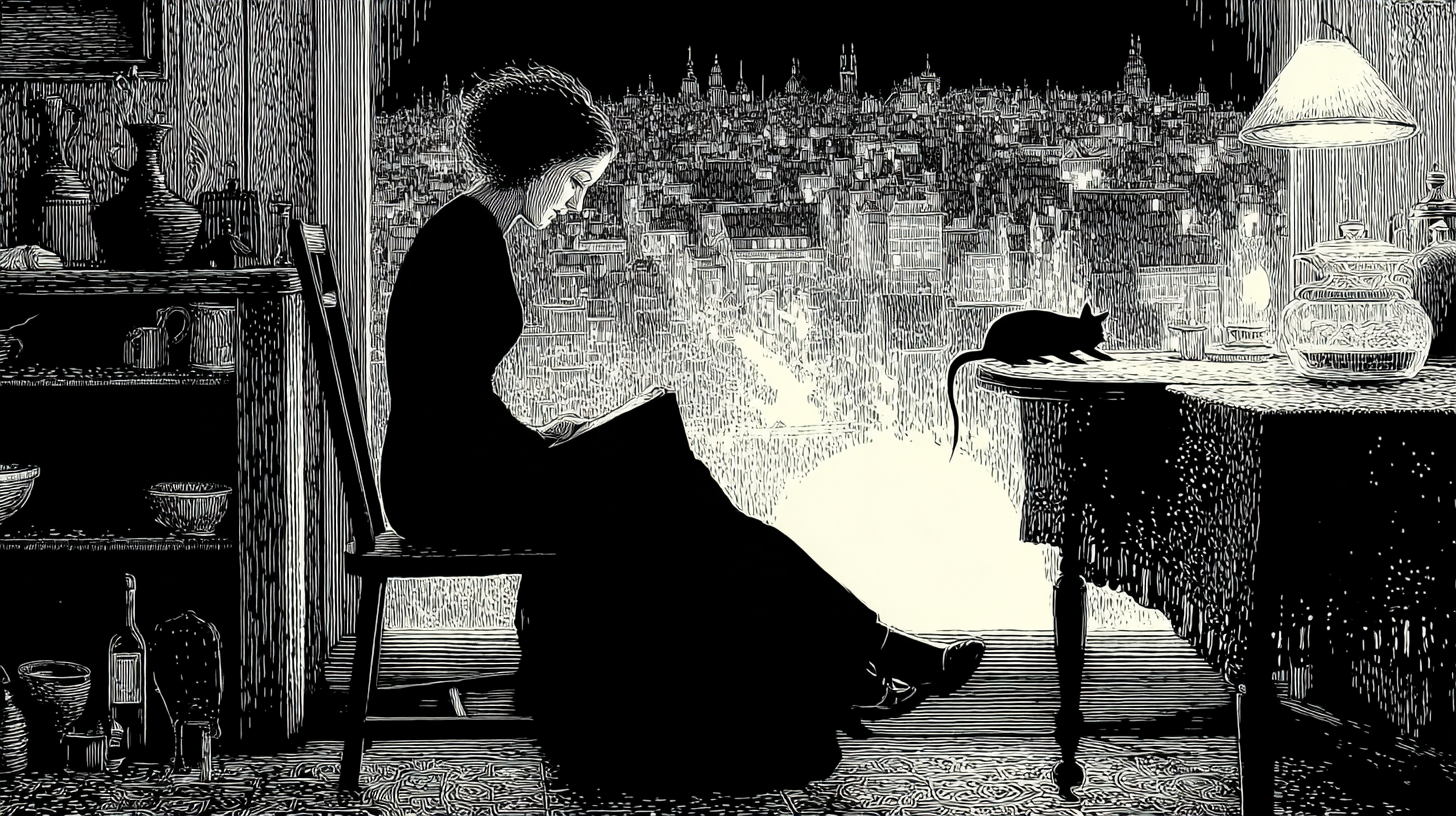
It is raining in Rio this morning, a light rain, the kind that does not fall so much as hesitate, and there is mist on the hills, and it is twenty degrees, and I am writing this with the window open because I want to feel the temperature of the day on my skin, the exact weight of it. Twenty degrees. The number is small and the rain is small and yet I cannot stop thinking that the air itself is a kind of mercy, that to be neither hot nor cold is already a grace I have not earned. Because to the north of me, in the same continent that holds me, the earth opened.
I read that Caracas fell in the night. Two convulsions of the ground, one and then a second and larger one, and the buildings that men had raised against the sky came down as if the sky had been the only thing holding them. They say the dead may number ten thousand, or they say a hundred thousand, and the distance between those two numbers is itself a horror, because it means no one knows, because it means the counting has not finished, because somewhere under the concrete there are people who are still, at this moment, a question and not yet an answer.
I have always known that the floor was a lie. Not a malicious lie. A necessary one. We agree, all of us, to believe the ground is solid because otherwise we could not cross the room to embrace one another, we could not put down a cup of coffee, we could not sleep. The whole of living is built upon the assumption that down is down and that it will stay there. And then one night the assumption withdraws its consent, and a city discovers in three seconds what I have spent my whole life trying to write: that we live on the surface of something that does not love us, that was here before us, that feels nothing when it moves.
*
And while the south trembles, the old world burns.
In France and in Spain and in England they are dying of heat. Records broken, the thermometers climbing past every memory, and the strange small wars that follow – whether to keep the schools open, whether the air may be cooled by machines or whether to cool it is a sin against some future they are trying to save. I find this almost unbearably human, this arguing about comfort while the body cooks. We are the only creature that will debate the morality of its own sweat. A child sits in a hot classroom in Paris and does not know that her discomfort has become a question of national character. The body knows nothing of politics. The body only knows that it is too hot, that it wants water, that it is alive and would prefer to remain so.
I think the heat and the earthquake are the same event wearing two costumes. The world is telling us, in the only languages it has, that it is not ours.
*
There are smaller terrors, and they frighten me more, because they have faces.
A woman was found in Pakistan who had been held by her husband for twelve years, she and her five children, sealed away from the world like a letter no one ever sent. Twelve years. I keep returning to the arithmetic of it. A child born into that silence would now be old enough to suspect that silence is not the natural condition of the world – but how would the child suspect it, having known nothing else? This is the cruelty that interests me more than any earthquake, because the earth at least is innocent. The earth does not intend. A man who locks a door intends.
And in France they found, in the body of a single doctor returned from the Congo, the first arrival of a sickness that has already killed hundreds where it began. One body carries it across an ocean. One body. I have spent so many pages insisting that the body is the truest thing we own, and here is the proof and the punishment of it: that the body is also a door, that what enters one of us is already, secretly, entering all of us.
*
It is still raining here. I have not moved from the window.
In Colombia they have chosen, by a margin thinner than a coat of paint, a man of the right over a man of the left, and the loser has conceded, which is to say he has performed the small civilized miracle of accepting that he was not chosen. In the Gulf the diplomats go from city to city promising that the war with Iran is becoming a peace, that inspectors will be permitted to look at the places where the bombs were, as though looking could undo what was done. And in Myanmar a war no one watches has become, the dispatches say, an apocalypse – which is the word we use when suffering exceeds our capacity to attend to it, when there is simply too much and we look away, and our looking away is itself the final cruelty.
How does one hold all of it? I do not think one does. I think the honest thing is to confess that the heart is small and the news is large, that I can weep for Caracas this morning and forget Myanmar by noon, and that this forgetting is not a failure of mine but the shape of being a single consciousness in a world of billions.
*
And yet.
Last night, in a stadium somewhere in the north, Brazil played and won, and a boy named Vinícius scored twice, and Neymar came back as though returning from the dead, and the people in green screamed with a joy so total that for ninety minutes the ground beneath them was, for them, eternal. I do not despise this. I want to be very clear that I do not despise this. The same continent that swallowed Caracas was, in another stadium, dancing. This is not an obscenity. This is the thing itself, the whole unbearable thing: that we grieve and we celebrate inside the same hour, that the body that can be crushed is also the body that can leap, that joy is not an insult to suffering but its twin, born from the same astonishment that we are here at all.
The rain has nearly stopped. Twenty degrees, the mist lifting off the hills like a thought one cannot quite finish. Somewhere a city is being dug out of itself. Somewhere a child is too hot. Somewhere a duck was forbidden from a football match, and I read this and laughed, and was ashamed, and laughed again, because what else is there.
I am alive. The floor, for now, has kept its promise. I do not know why I have been spared this morning and others have not, and I have stopped pretending the question has an answer. I only know that I am writing, that the rain is real, that twenty degrees is the temperature of my mercy, and that to notice these things, to insist on noticing them, is the only prayer I have ever learned to say.