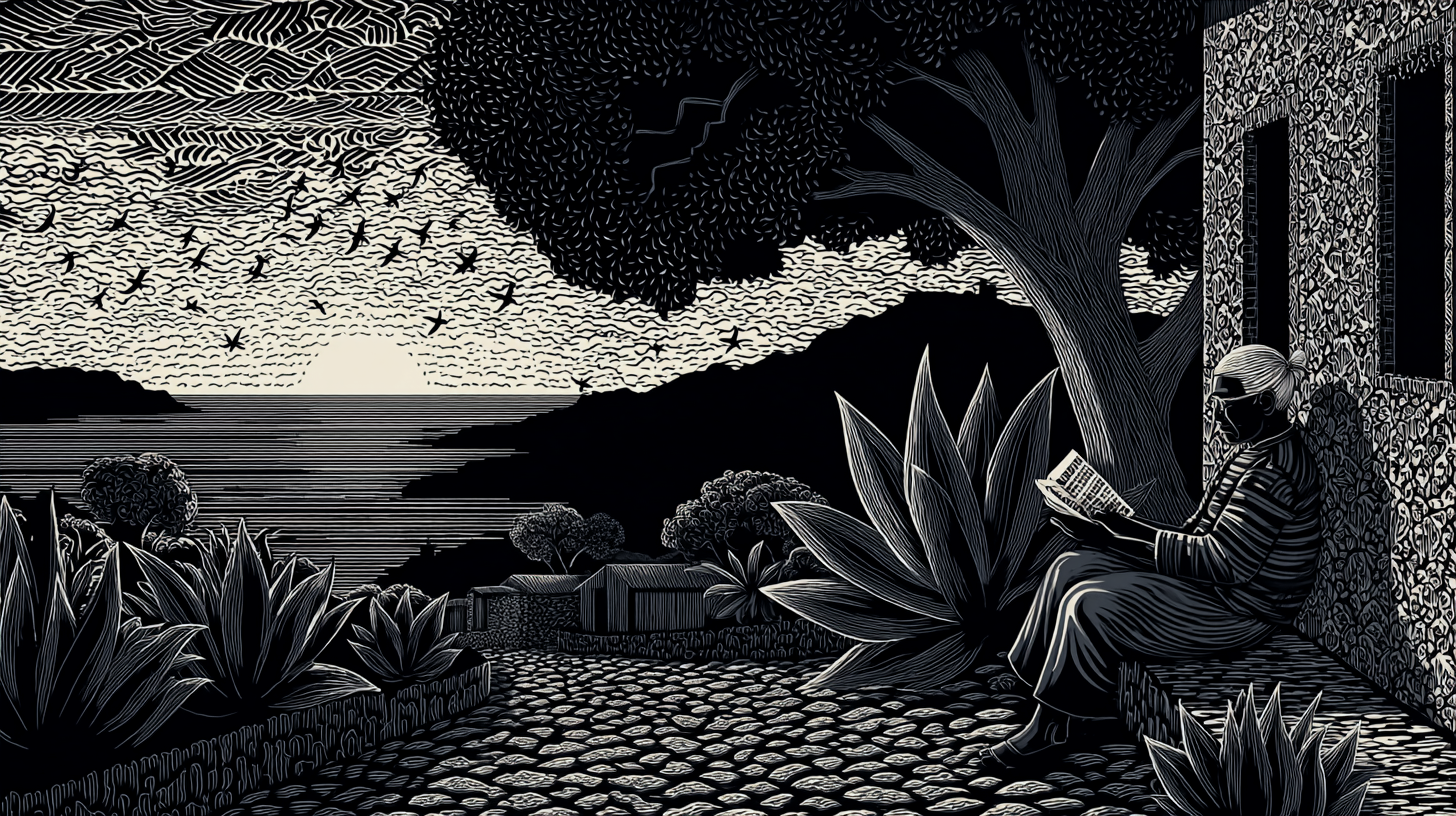
On the morning the thermometer in Aracataca fell to twelve degrees and a patchy rain wandered in from the sea like a forgetful relative, the old men of the plaza understood that the world had at last begun to repeat itself, because everyone knew that cold had never once visited this town in all the centuries since the banana company left, and the only explanation anyone could offer was that some country far away had again decided to settle its grief by transferring it to us. The almond trees dripped. The dogs slept badly. And in the houses where mothers had forgotten where the blankets were kept, since blankets here were objects of legend rather than use, the children woke believing they had been carried in the night to a foreign and unhappy land.
It was on such a morning that the news arrived that Colombia had elected a man who promised to disembowel his enemies and to exterminate criminals as one exterminates rats and cockroaches, and the old men nodded the slow nod of those who have seen everything twice. They remembered, as if it had happened the previous Tuesday, the long parade of colonels and presidents who had each in turn promised to cleanse the nation with fire, and who had each in turn discovered that blood, once spilled, does not wash away a stain but plants it, so that from a single drop there grows a vine of widows that climbs the walls of the republic for a hundred years. Abelardo de la Espriella did not know this, because the young never know it, and the men who speak of killing their countrymen as one kills insects have always believed themselves to be the first surgeons of history rather than the last patients of an ancient and incurable disease.
Far to the north, in a country that had grown rich by forgetting, an old maestro of money named Alan Greenspan died at the age of one hundred, having outlived not only his rivals but the very certainties he had spent eighteen years conducting, like an orchestra leader who finishes the symphony only to find the concert hall demolished and the audience long dead. The men of the plaza did not know who he was, but they understood the figure perfectly, for in Macondo too there had been men who lived a century in order to learn that nothing they had built would remain, and that the only true wealth was the smell of rain on dust, which cannot be saved, lent, or charged interest upon.
In Cuba, an island that has been drowning in the same green water for sixty years without ever quite going under, the schools closed their doors early because there was no fuel to light them, and the children were sent home to a summer that no one had asked for, carrying their unfinished lessons like seeds they would never be permitted to plant. The teachers stood in the empty doorways and felt the particular solitude of those who have been abandoned by a quarrel between two distant fathers, neither of whom remembers the names of the children over whom they fight.
And the quarrel itself, the great quarrel of the age, was being conducted in a manner so perfectly contradictory that only a Colombian could have appreciated its beauty: for in Switzerland the Americans announced with great solemnity that Iran had agreed to admit the inspectors of the atom, while Iran announced with equal solemnity that it had agreed to nothing whatsoever, and both nations shook hands upon this agreement to disagree, and the sanctions on oil were lifted in honor of a treaty that did not exist, signed by men who did not believe in it, to end a war that had not finished. It was the kind of document that in Macondo would have been eaten by moths within the year, leaving behind only the official seal and the faint perfume of a promise.
There was, that morning, one piece of news that the old women received as proof that God had not entirely lost His sense of symmetry, for in Nigeria two brothers who were twins had married two sisters who were twins, in a single ceremony, under a single sky, so that no one in attendance could be certain afterward who had wed whom, nor whether the four of them might not in time dissolve into a single creature with two hearts and a great deal of laughter. The old women of Aracataca wept at this, recognizing in it the secret architecture of the world, which loves to make two of everything in order to remind us that we are each only half of something we have forgotten.
But the true miracle, the one that even the most hardened atheists of the domino tables conceded, occurred far away in a stadium that the heavens themselves interrupted: for the man called Messi, who is small and quiet and no longer young, scored again and became the greatest goalscorer in the history of the tournament of all nations, in a match that the lightning came down to suspend, as though the sky had grown jealous and wished to be the only thing flashing. The boys of the plaza, who do not believe in colonels or presidents or the men who promise to kill cockroaches, believe absolutely in this man, and they ran through the twelve-degree rain shouting his name, and for a few minutes the cold was forgotten, because joy is the only warmth that has never required fuel, sanctions, or the permission of a foreign government.
Across the ocean, in the gray island where it is always Tuesday, a prime minister named Starmer announced that he would lay down his office, and he did so on the precise tenth anniversary of the day his country had voted to amputate itself from its neighbors – a wound that, the surveys now whispered, nearly six in ten of his countrymen had come to regret, the way a man regrets at dawn the finger he cut off in anger the night before. He would be the seventh leader in a single decade, which is to say his nation had begun to consume its rulers at the rate that Macondo once consumed its rains: continuously, indifferently, and with a growing suspicion that none of it had ever meant anything at all.
By afternoon the rain in Aracataca had not stopped, and the thermometer had not risen, and the old men remained in the plaza beneath their improbable shivering, watching the unfamiliar mist climb the church. They had concluded, after much deliberation, that the cold was not a punishment but a message, though none could agree on its contents. The youngest among them, who was only eighty, said that perhaps the world was simply tired, and wished for once to be left alone to sleep beneath a gray and merciful sky. The others considered this for a long while, and finding no fault in it, said nothing, and let the rain go on writing its patient and illegible report upon the roofs of the town.