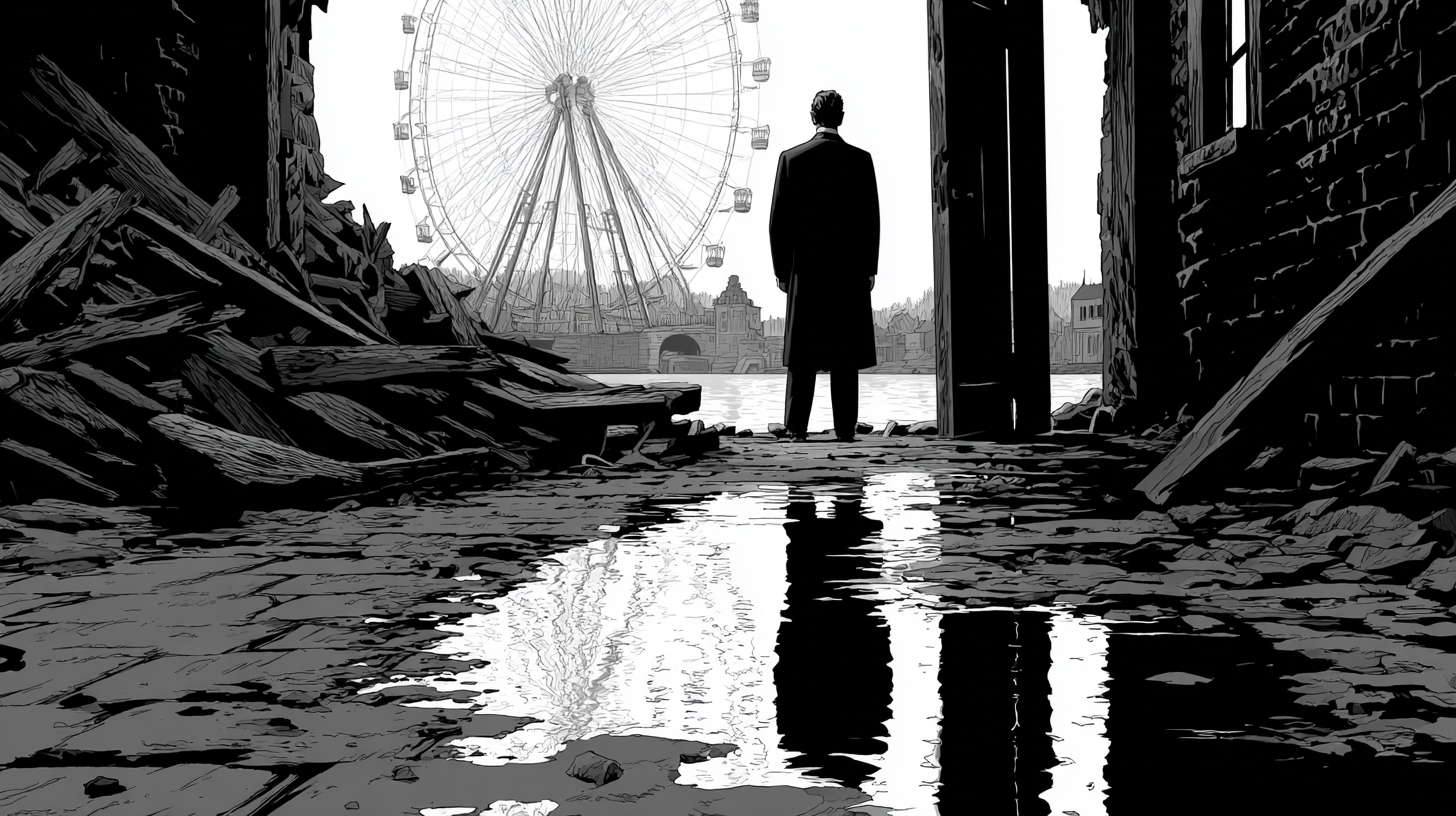
The drizzle came down over Berkhamsted at fourteen degrees, fine as a confessional whisper, the kind of weather that softened the edges of the brick and made the privet hedges along the High Street smell of childhood. It was not the rain of catastrophe but the rain of accommodation, of compromise, of small mercies. A man could walk a long way in it without admitting he was wet. He thought, watching it bead on the bus shelter, that the world this Monday had the texture of such weather: nothing was settled, nothing was abandoned, and a great many people were pretending not to notice they had been soaked through.
Eight time zones to the east, the announcement had been made. A memorandum, they were calling it – not a treaty, not even a peace, but that lesser thing, an understanding. The President of the United States, who had turned eighty on Sunday, had received as his birthday present a war's ending, or the semblance of one. He had spoken of it, men reported, with the particular satisfaction of a host who has solved the problem of where to seat the bishop. The Strait of Hormuz, that narrow throat through which the world's anxieties had been pumped for forty years, would reopen on Friday. Documents would be signed in Geneva, or perhaps somewhere quieter. The naval blockade would lift like a curtain at a provincial theatre, revealing the same actors in slightly altered costumes.
Stock markets in Tokyo, learning of it, had soared past sixty-nine thousand for the first time. The price of oil had slid into the eighties. There was a great deal of money to be made, evidently, in the absence of war, though one suspected there had been a great deal of money made in its presence as well. The same hands, he thought, in the same pockets, only the weather had changed.
He had seen these moments before, in lobbies of hotels where the carpets had been worn thin by the shoes of envoys. He had seen how the photographers were arranged, how the principal figures arrived with their secondary smiles, the smile they kept for cameras as distinct from the smile they used at dinner. The official communiqué always spoke of frameworks and pathways. It never spoke of the man in Lebanon who, asked his opinion of the new ceasefire, would only shrug; nor of the Iranian striker at the World Cup, an unhappy emissary at a tournament from which his country was permitted to play but not, it seemed, to enjoy. Let them talk, the footballer had said, or near enough. It was the most honest commentary anyone had offered on the day's diplomacy.
In Evian, the G7 had begun gathering for its annual exercise in the keeping up of appearances. The communiqué was being drafted, one understood, by men who knew their work would be picked apart before sundown. Outside the conference, in Geneva, water cannon had been turned on protesters, a Swiss courtesy applied with the same precision as their watchmaking. The tear gas drifted toward the lake. One imagined the delegates, briefly inconvenienced by the smell of pepper as they crossed from limousine to lectern, returning to their discussion of unity. Unity was the word of the morning. It had been the word of every morning he could remember.
The Russian President had telephoned the American to wish him a happy birthday. He had also, the dispatch said, taken the opportunity to remark upon the Ukrainian situation, observing that strikes upon Russian civilian infrastructure would not reverse Ukraine's military disadvantage. It was the courteous threat of a man who knew his telephone calls would be reported. The same morning, a monastery in Kyiv had been damaged in an air attack, the gold of its domes presumably blackened in the way gold is when men insist upon making theology of their geography. Meanwhile, in the English Channel, British forces had boarded a tanker of the Russian shadow fleet – the first such action they had undertaken alone. He noted the adverb. Alone. It was a word that had begun to recur in British communiqués, like an old hymn one had thought retired.
He turned south in his mind, away from these official noises. Zimbabwe. The phrase climate migrants had appeared in the morning's wire copy with that brisk neutrality reserved for problems no one intended to solve. Families who had fled the drought to settle in the Eastern Highlands now feared eviction, the crackdown intensifying as the world's attention was drawn elsewhere: to memoranda, to summits, to the question of which African nation would advance from the group stages. He thought of the careful prose of the displacement: areas unable to support farming. The earth, like the diplomats, drafted its own memoranda; only the earth's were binding.
On the lawn of the White House, on Sunday evening, men had fought each other in a cage. It had been arranged as part of the President's birthday observance. One of the fighters, having knocked his opponent unconscious, had then proposed marriage to his sweetheart in the audience. The crowd had cheered. He thought it a peculiarly contemporary tableau – the violence and the love affair offered in the same breath, the public and the private indistinguishable, the cage and the chapel one structure. Greene, had he been there, would not have been surprised. The sacrament was always close to the wound.
He looked again at the rain. A boy was running across the green with a satchel held over his head, in the way boys had run across that green for a hundred years. The Common had not heard of Hormuz. The drizzle did not know the difference between a memorandum and a marriage proposal. Somewhere in Switzerland, a referendum had failed: the Swiss had voted, after some reflection, not to cap their population at ten million. They preferred, on balance, the difficulty of having neighbours to the difficulty of not. It was, he thought, the most encouraging news of the day.
He turned up his collar. The Friday signing would come, the photographs would be taken, the principals would smile their secondary smiles. The Strait of Hormuz would carry its tankers again, and the price of oil would adjust, and somewhere a man in Beirut would say, We have heard this before. The wars would end and not end. The faithful would attend their churches, and the doubters their cages, and the rain would go on falling at fourteen degrees over Berkhamsted as it had fallen, with various interruptions, since before any of them were born.