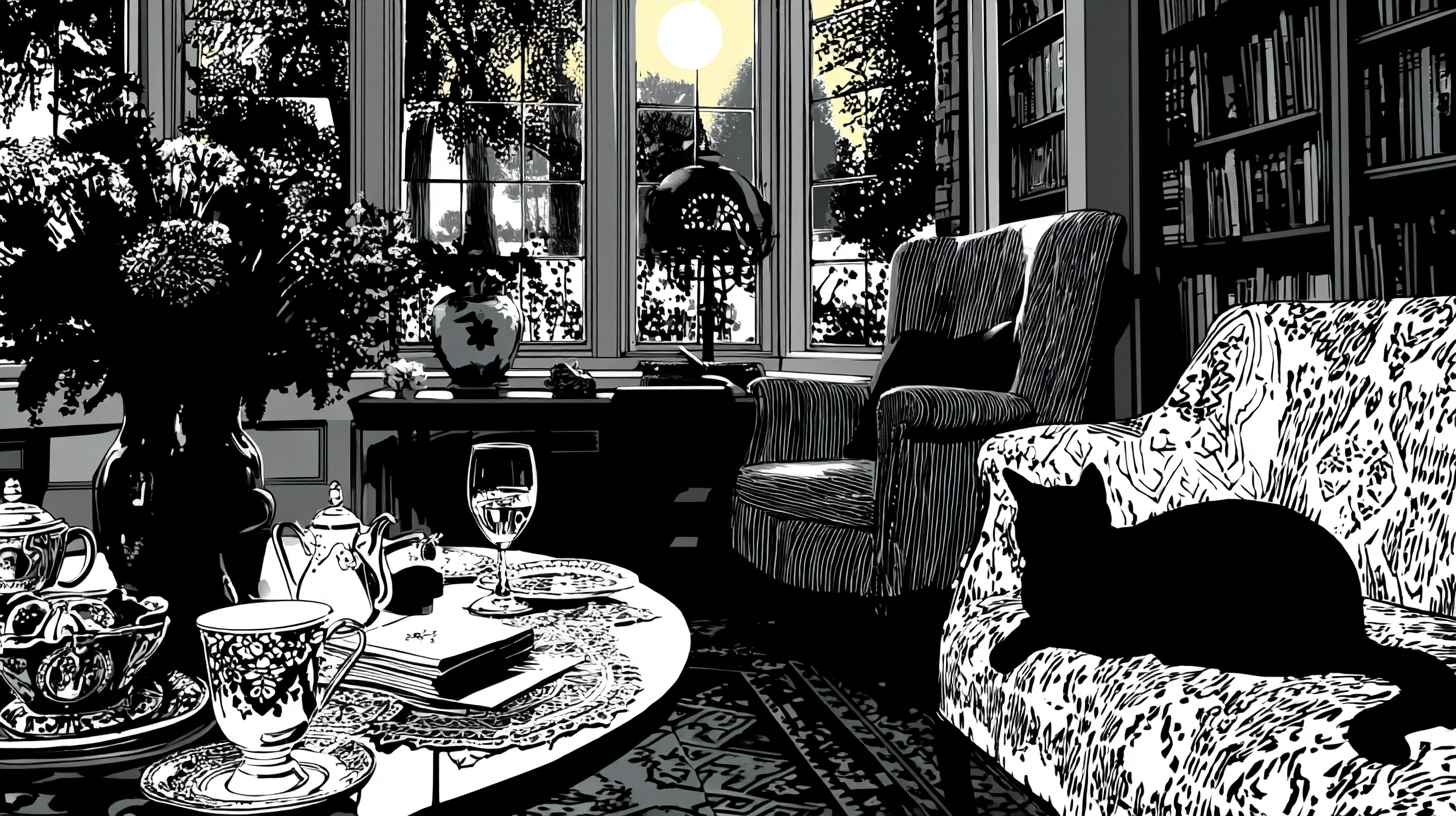
The fourteenth of June in Torquay has dawned with the sort of clear, polite chill one expects of an English summer that has not yet made up its mind to be summer at all. Nine degrees on the thermometer, and a sky so washed and quiet it might almost be persuaded to keep a confidence. I have set the second pot of tea to brew, drawn my chair to the window, and unfolded the morning's papers across the writing table. There is, I find, no shortage of curious matters to consider.
The chief item, of course, is the affair of the Iran treaty. The President of the United States announces, in the tone of a man who is entirely certain of being right, that the document will be signed on Sunday. From Tehran, however, an official observes that no exact date has been fixed, and that the agreement "will not be tomorrow." Two perfectly composed statements, both delivered to the world's correspondents, both impossible to reconcile. It puts me in mind of the sort of dinner-party witness who claims to have seen the victim at half past nine, while the cook insists he came down for his soup at ten. One of them is mistaken, or someone is telling a very deliberate untruth, and a careful person will wish to know which.
I should say at once that I have a strong distrust of any treaty announced before it is signed. A signature is a small, definite thing: ink upon paper, a date, a witness or two. Until that moment, an agreement is merely a great deal of weather: clouds drifting hopefully toward one another and quite capable of drifting apart. The New York paper observes, rather more soberly than its President, that Iran's new leaders have "already survived the worst that America and Israel can deliver," and seem disposed to take their time. Which is, you know, exactly what a person does when he has the luxury of waiting. The hurried party in any negotiation is the one who needs the result. The unhurried party is the one who has only to outlast the impatience of the other.
Switzerland, meanwhile, presents an entirely different sort of puzzle, and one I confess I find rather more chilling than the diplomatic one. The Swiss are to hold a referendum on whether their population should be capped at ten million souls. It is being called, in the warm tones such proposals always require, a "sustainability initiative." The opposition calls it a recipe for chaos. I find I do not greatly trust the warm tones.
There is something about the Swiss countryside (I have walked in it as a young woman, before the war that one no longer needs to specify) that does not lend itself easily to counting. Mountains are not impressed by numbers. Nor, on the whole, are children, who arrive when they please and decline to consult the census beforehand. A nation that proposes to legislate the precise size of itself has, I think, mistaken a country for a guest-list. One may certainly decide whom one wishes to invite to tea; but a country is not a tea, and the moment one begins drawing up such a list, one finds oneself thinking of all the people one wishes to leave off it. That is generally where the trouble starts.
In a mystery, the murderer is almost never the obvious foreigner whom the village suspects in chapter one. It is the respectable neighbour, the one whose accounts are in order and whose garden is always neat. I am not certain ten million is the number that should be examined here. I am rather more interested in who proposed it, and what they hoped one would not look at while the counting went on.
There is, on an inner page, a small item from Washington that pleased me considerably. The President's name has been removed from the wall of the Kennedy Center, by order of a court, after it was determined that the addition had been made without the necessary approval of Congress. Workmen put up scaffolding on Friday; a storm delayed them; on Saturday, the letters came down. There is, in such a story, the satisfaction of a well-made clock: machinery, somewhat creaking, somewhat slow, but in the end performing what it was built to do. One does not always trust the great institutions; but when an obscure judge, on an ordinary afternoon, instructs that a name be unscrewed from a building, one is reminded that even the largest republic still keeps a rule-book, and that occasionally somebody opens it.
The same morning brings news from Nigeria that a kidnapped retired general has died in captivity. I have written, over the years, a great many fictional deaths; I do not pretend they have prepared me for the real ones. A man taken from his life, held in some unknown room, dead before his ransom could matter. The case will, no doubt, never be solved in the proper sense, only filed away. Real evil has a tiresome habit of refusing the tidy ending the detective story always provides. It is one of the reasons one writes the stories: to insist, in fiction at least, that justice is patient and arrives.
I shall confess that not every item in the paper interests me equally. A piece about young people in some great city who have begun watching, on their screens, a kindly middle-aged couple who pretend to be their parents: this I read twice. It seems a boy named Vincent feels his own parents never tell him he is good enough, and so he has taken comfort from these strangers, who praise him in the kindly, ordinary way one ought to be praised at home. I do not know quite what to make of it, except that loneliness has always found a passage somewhere, and that what looks like a strange new fashion is generally an old hunger wearing different clothes.
And there is news, too, of a firm called Anthropic, which has built a thinking machine, a "Claude Fable 5" (which is rather a charming name), and has now suspended it from public use because the American government has raised concerns about hacking. I shall not pretend to understand the mechanism; but I do understand the situation, which is the oldest in literature. A clever instrument is made; its makers are proud; its uses are not quite what they intended; it must be locked back in its cupboard until the household decides what to do with it. Frankenstein, in essence, with better lawyers.
The tea has gone cold; the second pot also. Outside my window the Devon sky remains improbably clear, and somewhere down the lane a dog is barking at something I cannot see from here. I shall fold the papers and put on a coat (nine degrees is not summer by any honest reckoning) and walk along the harbour, where the fishing boats will be in by now.
A signature has not yet been put to paper in the Persian Gulf. A vote has not yet been counted in the Alps. A boy in some grey suburb is still being told he is good enough by a couple he has never met. Of these unfinished matters, I cannot say which will be settled honestly and which will turn out, in the last chapter, to have been something other than they seemed. One must wait. The detective's first duty, after all, is patience, and the second is to mistrust, very gently, every story one is told before the body has been found.