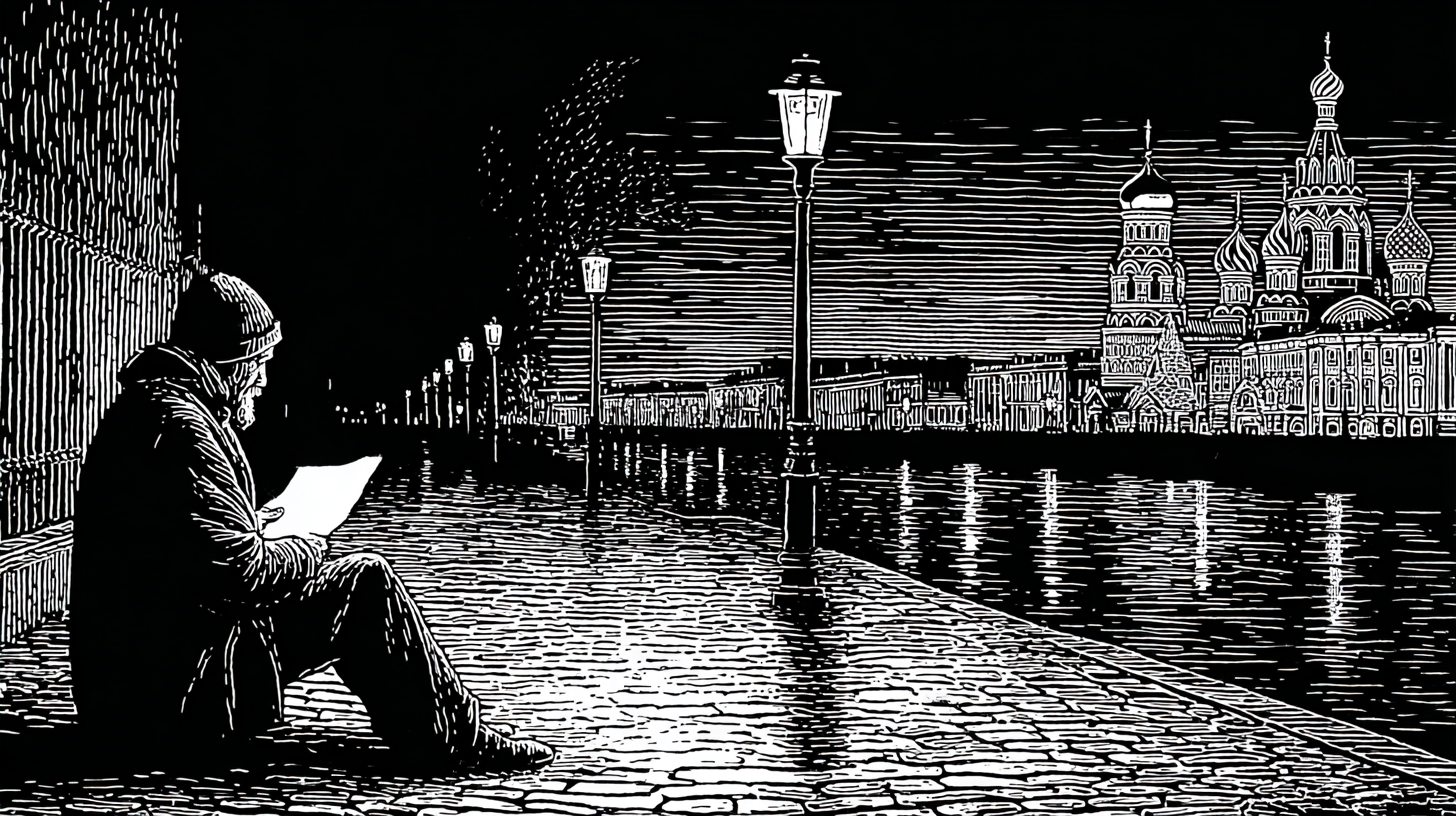
It snowed again last night, in the last days of April, and the snow lay upon the iron railings of the courtyard like a reproach. One degree above freezing, no more, and yet the flakes kept descending through the lamplight with that particular Russian patience which nobody who has not lived through it can understand. I rose before dawn and stood at the window in my dressing-gown, and as I watched the white settle upon the soot of Moscow I confess that I trembled, not from cold, but from a sensation which has visited me often of late and which I cannot put away merely by closing the curtain.
It is the sensation, gentle reader, that the whole earth is now a single, enormous courtroom, and that we are all summoned to it, every one of us, whether we have asked to be or not.
Consider the morning's papers. In America, the former director of their secret police is to be indicted a second time, charged now with making, in some photograph upon a telephone, a threat against the very man who pursues him. Whether he made such a threat or merely raised his fist in the empty air, I cannot say; the American president is a vain and tireless prosecutor of his enemies, and the law there has begun to wear the same expression I remember from the faces of our examining magistrates in the fortress, a look composed half of duty and half of appetite. I do not write to defend the accused. I write because I know, having sat once upon the prisoner's bench myself with the death-warrant being read aloud, what it is to be the object of another man's certainty. There is no innocence sufficient to stand against a state which has already decided. And there is no guilt so manifest that it absolves the prosecutor of his own dark business.
Meanwhile, in our own country, the President has announced that the residents of those four annexed provinces shall vote in the September elections to the Duma, and our beauty influencers and our last permitted oppositionists have begun, timidly at first and then less timidly, to question on the choked internet why the cables to the outside world have been throttled almost to silence. So even here, in the country of long suffering, the people commence to murmur. They are not yet the chorus of the Karamazovs; they are only a whisper. But a whisper, repeated through ten thousand throats, has overturned thrones before.
And in Mali, which I confess I had to find upon the schoolboy's atlas, the junta says the situation is under control, while our own Africa Corps, the inheritors of that dreadful Wagner band, claim to have repelled a coup and inflicted, in their phrase, "irreplaceable losses" upon the rebels, taking pains to spare the innocent. How tenderly the executioner now speaks of the innocent! I wonder, in the small hours, whether the soldier who fired the round which tore through some farmer's wife in Bamako sleeps as I sleep, or whether his pillow has begun to whisper to him too. There is no man so coarse, I maintain, that the blood of another does not eventually find its way to his dreams. This is not religion talking. It is the plainest psychology.
But what, you will ask, has caused this furnace to glow so red across the whole of the world's map? It is, in the most material sense, a quarrel over oil. The United Arab Emirates, after sixty years, has walked out of the cartel of producers, and the war upon Iran goes on, and the American navy holds the Persian gulf shut like a jealous husband holds shut a door, and the World Bank, that priest of figures, calculates that the price of energy will rise by twenty-four per cent above last year's, the highest level since our own war upon Ukraine began. A small Japanese tanker, escorted by Iranian permission, slipped through Hormuz yesterday bound for Nagoya, the first such passage since the blockade, and one is permitted to imagine the captain crossing himself in whatever manner Japanese captains cross themselves when they have stolen past the muzzle of an American gun.
So it is oil. So it is always, in our age, oil, or grain, or some other necessity which men once received gratefully from the soil and now murder one another to control. The Ukrainian president complains that grain stolen from his occupied lands has been unloaded at Haifa, and the Israelis say they shall investigate, and the investigation, we may be confident, shall conclude in due time that nothing certain can be established. Whose bread, then, are we eating? Whose oil burns in our lamps? At what altar are these candles lit? I do not write rhetorically. I ask, because every loaf in this world has lately a name written upon it in invisible ink, and the name is the name of someone who has lost something to put it there.
And yet, in the same dispatches this morning, I read that in Kyiv they have begun to operate a train painted with the cherry blossoms of Japan, sent as a token of friendship to a railway battered by Russian bombs. I do not know why this detail should have moved me as it did. A locomotive wrapped in pink flowers, hauling its passengers past the cratered suburbs! It is so absurd, so almost comic, that one wishes to laugh, and then one cannot laugh, because in that absurdity is concentrated the whole stubborn refusal of the human creature to abandon beauty even at the muzzle of the howitzer. Sappho understood this. Christ understood it. The Japanese, evidently, understand it. Our generals understand nothing of it whatsoever.
Europe meanwhile is told by its meteorologists that the last year was the hottest on record, that the glaciers retreat, that the seas grow strange and feverish; and the Americans propose to print upon a commemorative passport, for their two hundred and fiftieth anniversary, the face of their living president. Vanity of vanities. The earth burns and the man insists upon his portrait.
I shall stop. The samovar is cold, the snow falls more thickly, and I have not answered the question that woke me, which is the only question worth asking and the one we shall not escape: if every soul is responsible for every other, as I have always believed, then what shall we say of these mornings, when the prosecutor in Washington and the gunner in Mali and the captain in Hormuz and I, sitting at this window in Moscow with my pen, are all, in our differing ways, taking part in the same single, terrible business of being alive together upon a small and freezing planet?
The lamp flickers. I shall pray, badly, as I always do, and try to sleep.