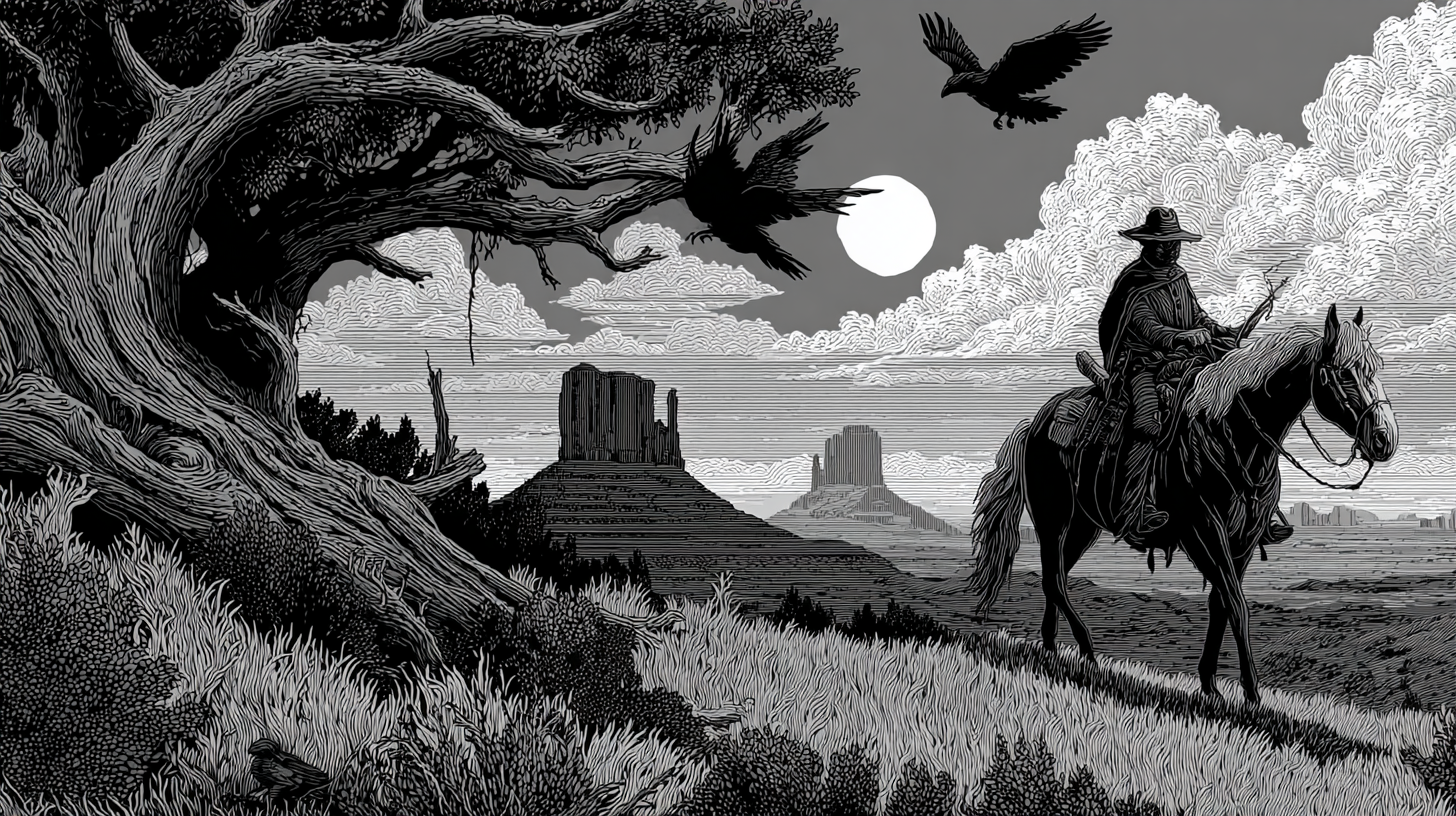
The morning came clear over the Sangre de Cristo and the cold lay on the chamisa like a thin tin sheeting and the thermometer said nine degrees and no more. A coyote called once from the arroyo and was not answered. He stood at the door with the coffee in his hands and watched the light come up over the country and he thought how the world was made each day from the same elements as the day before and how men daily refused this gift and chose another thing.
He had the radio low. The voices spoke of distant places as if they were near and of nearness as if it were strange. They spoke of Mali. They said the defense minister had been killed in his own house by a bomb set in the path of his coming and that men called jihadists had ridden into towns at dawn and that other men called Tuareg had taken the city of Kidal and held it and that the Russian fighters who had stood for the junta had withdrawn into the deeper country and would not be heard from for a season. He thought of those towns. He had never seen them. He saw them anyway. Mud walls and a single road and the wind off the Sahel coming in the evenings carrying the iron smell of what men do to one another.
A boy he had known long ago said to him once that history was a book written in lampblack and blood and that the lampblack faded but the blood did not. The boy was dead now. He thought of him often.
The radio said Nigeria. It said gunmen had come upon a football pitch in Adamawa and killed twenty-nine and that in Kogi twenty-three children had been taken from an orphanage in the night and the proprietress with them. The names of the children were not given. They would not be given. The names of children seldom are. He set the cup down and watched a small bird at the feeder and thought that whatever god accounted these things must keep his ledger in some country no man had walked.
He went out into the yard. The piñon was pale in the new light and the sky was that high desert blue which is the blue of nothing else on earth. He walked to the gate and back. The cold came through his shirt and he did not mind it. A truck went by on the road below and the dust hung a long while in the still air and then settled.
In Colombia the dead were twenty-one and the wounded fifty-six and the bomb had been laid along the Pan-American where the buses run and the men who set it were called rebels and dealt cocaine and the government had put a price on the head of the one called Marlon and the price was a million and four hundred thousand dollars. He thought of the road. He had crossed it once in another life when he was younger and the country was younger too. He thought of buses. He thought of the people who ride them at first light with their bundles and their children and their small dignities and how cheaply such things are weighed by men with explosives and a grievance.
In Chad the count was forty-two and the quarrel had been over a water well. Two families. A well in a dry place. He thought how thirst was the oldest argument and how a man who had drunk that morning still believed the next morning would come and bring water and how this faith was the only kind some men had and yet they killed for it. The well was likely still there. The dead were under the ground. The water did not know the difference.
The men on the radio spoke of the capital. They said a man named Cole Tomas Allen had walked toward the dinner where the president sat among the press and had drawn a weapon and fired and was now charged with attempted assassination and two other counts beside. They said the king was coming nonetheless. They said he would be safe. He thought how every age believed itself the worst age and how every age was right and wrong in equal measure. The king would walk the marble halls and shake the hands and the cameras would record it and somewhere a man with an old grudge would sit and clean a rifle and the world would turn.
He thought of Indonesia where two trains had met one another in the dark on the rails outside Jakarta and fourteen lay dead and rescuers were still pulling the living from the steel. He thought of how a train was a thing built to be on rails and how when it left the rails it became something else. He thought of the men working in the wreckage and how it was perhaps the only honest labor left in the world, the labor of pulling the living out from under the dead.
In the West Bank settlers had set a Palestinian house on fire in the village of Jalud and the smoke had risen above the olive trees and the olive trees were old and the smoke was new and that was all there was to say of it. In Pakistan the planes had crossed the line and bombed a university in Kunar in Afghanistan and seven were dead and seventy-five wounded and among them surely some who had not yet learned what they had been studying for.
He thought of his father. His father had said once that there are two kinds of men, those who keep an account and those who do not, and that the second kind always come to grief in the end though the grief was sometimes a long time arriving. He had not understood it then. He understood it now.
The sun was full up over the mountain. Nine degrees and clear and the day was opening like a book whose pages had been written before any reader came. He thought there ought to be a way to mark each death so that the marking would mean something. There was not. There never had been. The names went into the air and the air went on about its business and the survivors did what survivors do, which was to wake and to eat and to bury and to wake again.
He emptied the cup into the dust. He stood a while longer. Somewhere a dog began to bark and then stopped. The day moved on into itself and would not be called back.
He went inside.