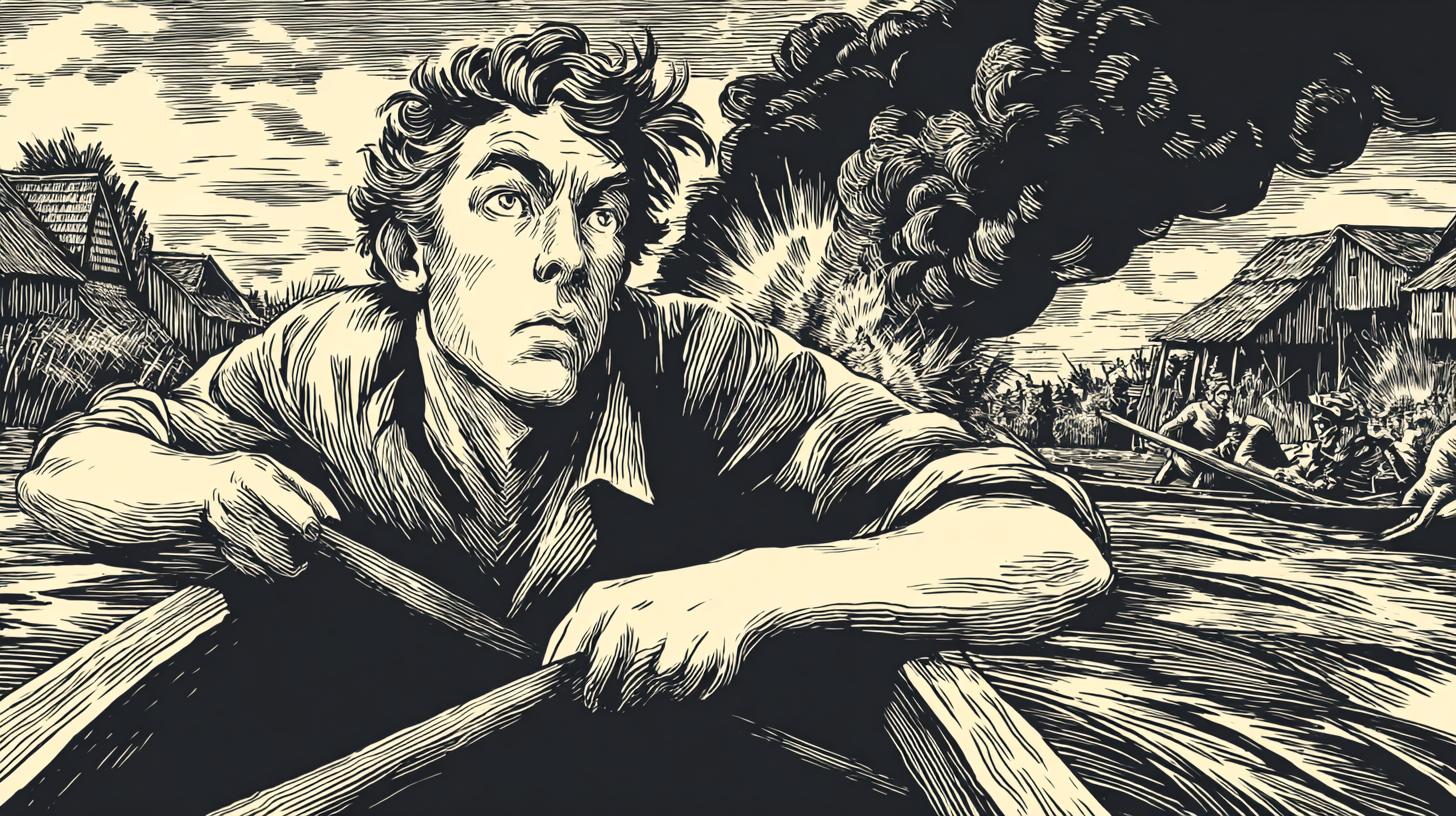
Yossarian was forty-one years and eleven months old when the Army announced it was raising the enlistment age to forty-two, which meant that for the first time in his adult life he was eligible to be killed by his own government legally, and on a salary.
He read the news on his stoop in Brooklyn. The morning was clear and very cold, six degrees by the thermometer nailed to the brownstone, and the sky over the avenue had the pale, exhausted look of a sky that had been awake all night listening to the radio.
"You can still enlist," said his neighbor Mrs. Daneeka, who was sweeping the sidewalk because her husband had told her that sweeping calmed the nerves and her nerves required calming because her husband was now reading the same newspaper over her shoulder.
"I'm forty-one and eleven months."
"They raised it to forty-two."
"That's what I just told you."
"Then you're not old enough yet to be too old, but you're not young enough anymore to be young. You're in the middle. The middle is the worst place to be when there's a war on, because the middle is where they always look first."
"There isn't a war on," Yossarian said.
"There is and there isn't," Mrs. Daneeka said. "That's the genius of it."
The genius of it was this. The President had announced that a high-level delegation, including the Vice President himself, was flying to Islamabad for a second round of talks with Iran. Several hours before this announcement, a Navy destroyer had fired on an Iranian-flagged cargo ship in the Gulf of Oman and seized it. Several hours after the announcement, Iran said it would not be coming to the talks. Several hours after that, the price of oil rose seven percent, which was attributed to "mixed signals," although the signals were not mixed at all. The signals were perfectly clear. They were saying two opposite things at the same time, and they were saying them on purpose.
"It's not a war," explained a man on the radio who had been hired to explain that it was not a war. "It's a maritime interdiction conducted in the context of an ongoing diplomatic engagement."
"What's a maritime interdiction?"
"It's when you fire at a ship."
"And what's a diplomatic engagement?"
"It's when you talk to the people whose ship you fired at."
"What if they don't want to talk?"
"Then we conduct another interdiction so that they will want to."
"And if they still don't want to?"
"Then there's clearly no point in talking, and we can stop pretending."
"That sounds reasonable."
"It is reasonable. That's the worst part."
Yossarian considered enlisting. The advantage of enlisting at forty-two, he thought, was that you went into the war already disappointed, which spared the Army the trouble of disappointing you. The disadvantage was that they would still try.
He thought of the eight children in Louisiana, aged one to fourteen, killed in a single house by a single man with a single gun, and the police calling it a "domestic disturbance," which was a phrase chosen carefully so that the word war would be saved for foreign use, where it could be denied. At home there were never wars. At home there were only disturbances. The disturbances killed more children than the wars did, but the disturbances did not require talks in Islamabad, and so they were considered manageable.
He thought of the people in Paris being evacuated within a 450-meter radius of an unexploded bomb from the last great war but one, a bomb that had lain patiently in the soil for eighty years waiting for a Sunday morning to be detonated by sappers in protective suits. He admired the bomb's patience. He admired the sappers' faith. He did not admire the war, which had ended long ago and yet was still finding ways to interrupt brunch.
"There is something to be said," Yossarian announced to no one, "for a bomb that knows when to wait."
Mrs. Daneeka swept on. The cold was getting into his fingers. He looked at his hands, which were the hands of a man who was now eligible.
A boy on a bicycle delivered the rest of the news, which was the news that Iran would never cede control of the Strait of Hormuz, that a jar of baby food in Austria had been found to contain rat poison, that a senior Iranian politician had said his country would "decide the right of passage," that thousands had marched in Berlin in the rain to call for an end to global wars, that protests in Madagascar were being arrested by the same army the protesters had recently installed, and that in a coastal village in Borneo every house built on stilts above the water had burned to ash overnight.
Yossarian tried to put these things in order. He could not. There was no order. There was only the sequence in which the news had arrived, and the sequence in which the news had arrived was determined by editors, and the editors were determined by markets, and the markets were determined by oil, and the oil was determined by whether or not a Navy destroyer had fired on a cargo ship in the Gulf of Oman that morning. The morning was always.
"Mrs. Daneeka," he said. "If I enlist and they send me to the Strait of Hormuz, am I in a war?"
"No," she said. "You're in a maritime interdiction."
"And if a missile hits my ship?"
"Then you're in an incident."
"And if I die?"
"Then you're in a statistic."
"And if I live?"
She paused. She paused for a long time, leaning on her broom. The pale sun came over the rooftops and laid itself across the street like a thin cold sheet.
"If you live," she said, "then they will say there was never any real danger, and they will not give you a parade, because parades are for wars, and there was no war. They will give you a small adjustment to your pension. You will be expected to be grateful."
"I won't be grateful."
"Then they will say you have a personality disorder."
"I do have a personality disorder. I object to being killed."
"That's the disorder."
Yossarian sat for a long time on the stoop after Mrs. Daneeka had gone in. The thermometer still said six degrees. The sky was still clear. Somewhere over the ocean a destroyer was reloading. Somewhere in Pakistan a delegation was unpacking. Somewhere in Louisiana eight small coffins were being measured. Somewhere in Paris a bomb that had waited eighty years was being told, finally, that its time had come, and the bomb was complying because bombs always comply, and people, on the whole, do not.
He decided not to enlist. He decided not to do anything. He decided that the most radical act available to a forty-one-year-and-eleven-month-old man on a Brooklyn stoop on a clear cold Monday morning was to remain alive on purpose, which was, he knew, also a catch. It was a catch because the longer he remained alive on purpose, the more eligible he became, and the more eligible he became, the more they would want him, and the more they would want him, the harder it would be to remain alive on purpose, until at last, inevitably, he would either enlist or be drafted or be shot in a domestic disturbance, all of which were, when you looked at them carefully, the same thing in slightly different uniforms.
He went inside. He locked the door. He turned off the radio. The radio kept playing.