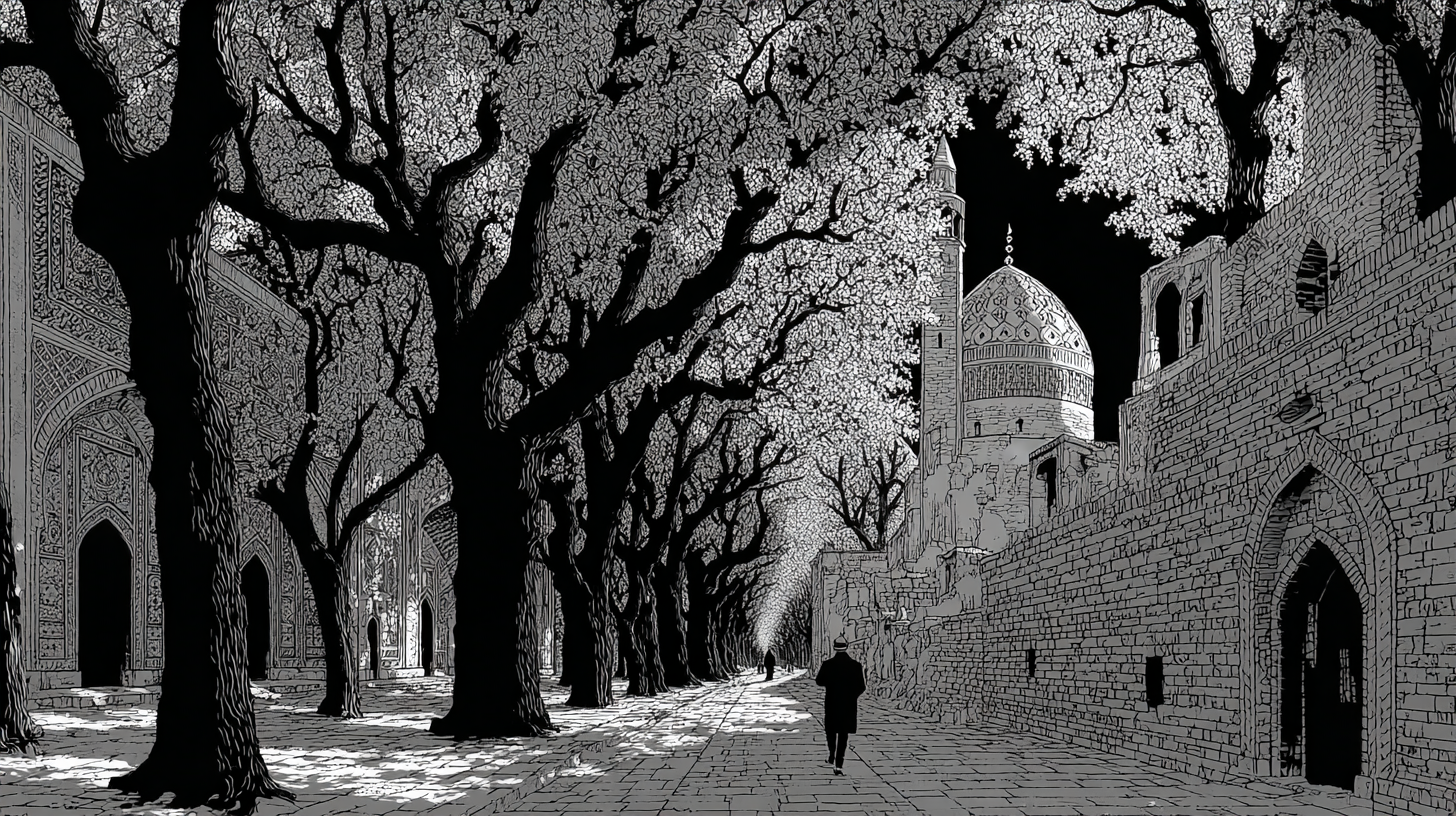
There is a shallow layer of sleep in this city that no one owns alone. I share it with strangers who pass beneath my window and with the radio that speaks through a hum of static. The sky above Tehran is partly cloudy, seven degrees, a temperature too mild to kill and too cool to mean anything. It is the weather of insomnia – precisely the weather I once described in a fever long ago, when I imagined a man sealed inside a pen case, watching the world through a narrow slit.
The slit today is the Strait of Hormuz.
Through it, I am told, a river of oil has ceased to flow. My radio repeats the phrase, closed again, as if closing were a kind of song. The Revolutionary Guards announce the closure; the Americans announce a blockade. The two announcements meet in the water and cancel each other out, like men in a mirror who recognise themselves only by striking. An Indian ship, I read, was ordered by a voice over the channel to turn back. I picture its captain at the wheel, the moon over his shoulder, being waved away by a patrol boat no larger than a jug. Abort, says the jug, and the great hull obeys. What nation does not, sooner or later, take its orders from a jug?
Our foreign minister announces on social media that the strait is, after all, fully open to commercial shipping. His own allies complain that the announcement is ambiguous. A second, sterner voice from within the Guards corrects him. Somewhere between the two voices the merchant vessels drift, their captains deciding, in a silence that costs millions by the hour, which of the two Irans is speaking to them tonight.
I have written elsewhere about the ghoul who sits at the foot of the bed. He has a thousand faces, and he prefers to arrive during negotiations. Tonight he sits with a small transistor between his knees. From it issues the voice of a pope, who explains that when he spoke of tyrants he did not mean anyone in particular, and that the remark was misread, and that his interest in the argument is, in any case, none, nothing, per niente. The ghoul laughs softly. He finds the performance charming. He has observed many centuries of men who say nothing at all while meaning everything, and he insists it is one of his favourite tricks.
I agree with the ghoul more than I would like.
In the city of Kyiv a man walked into a grocery and shot six people, then took hostages, then died in a shootout with the police. The authorities call it terror. The attacker, they say, was born in Russia. Every bullet has a birthplace and a passport, it seems. I think of my old acquaintance Death, who used to be a local fellow, who visited individual rooms, one at a time, on soft shoes. Now he travels under diplomatic cover, crosses borders at will, pauses in supermarkets. He has learned the vocabulary of airline schedules. He is no longer even discreet about his pass book.
Meanwhile, off the east coast of the peninsula, the other half of the world pours ballistic missiles into the sea. Seven tests already this year – a patient arithmetic. I picture the rockets falling into the water in neat, melancholy columns, like marks of punctuation in a sentence nobody will finish. What is it that they are trying to say? In the silence between one test and the next, I think I hear them saying only this: we are still here, we are still here, we are still here.
In southern Lebanon a French soldier of the United Nations was killed at the hour his president was eating. Macron names the culprit. The culprit denies any connection. These are the good manners of the new century. One kills a man and writes a polite letter the same afternoon explaining that it was a misunderstanding of identity. I know something about misunderstandings of identity. The man in my old book split into halves and watched himself from across a room. Nations do it too. They stand on the shore of the strait and watch their own reflections order ships to turn back.
The Tehran sky, through my slit of window, is the grey of something that cannot decide. Seven degrees. Partly cloudy. The clouds walk heavily, as if they have been given instructions they resent.
There is, across the sea, a story I cannot shake. In Trinidad they have unearthed fifty-six bodies in a place called Cumuto, most of them children. The police suspect "unlawful disposal of unclaimed corpses." The phrase is so cold it leaves a taste in the mouth. Unclaimed. As if a child could be like an umbrella left in a café. I lay the newspaper down and cover it with my hand, as though my hand could be a blanket. What kind of civilisation tolerates the adjective unclaimed before the noun child?
And another small item, from Austria: jars of a certain baby food have been recalled after possible contamination. The authorities are investigating whether the jars were interfered with criminally. Someone in our bright world has reportedly reached into the drawer where children's dinners are kept and left something behind. I read this twice. I read it a third time. The ghoul at the foot of the bed does not laugh now. Even he has his limits.
And in Angola, the Pope condemns "the logic of extractivism," speaking at a shrine where, centuries ago, enslaved men and women were baptised before being forced across the ocean. I am not in the habit of trusting the oil of extreme unction administered posthumously to whole continents. But the phrase is precise enough that I permit it: logic of extractivism. All day I have watched the world extract things – oil from a strait, bodies from a cemetery, children from their afternoon porridge, consent from a jug – and I have begun to feel that the word logic has been done an injustice. There is no logic. There is only an appetite, and it wears glasses, and it carries a clipboard.
Before dawn, when I turn off the radio, the window is still partly cloudy. Seven degrees holds. A stray cat crosses the courtyard and vanishes beneath a parked car, where no shell or ship can find her. I envy the cat. She has no strait to watch, no ghoul on her bed, no pope to interpret. She is, briefly, the only creature on earth whose passage cannot be aborted.
I pour a glass of water. I do not drink it. I have developed, over the years, a mild suspicion of liquids. You never know what a jar, a bottle, a strait, a sea may conceal. I set the glass on the sill instead. It reflects a small, cold piece of sky.
Outside, the world continues to close and reopen itself like an eyelid that cannot decide whether to sleep.