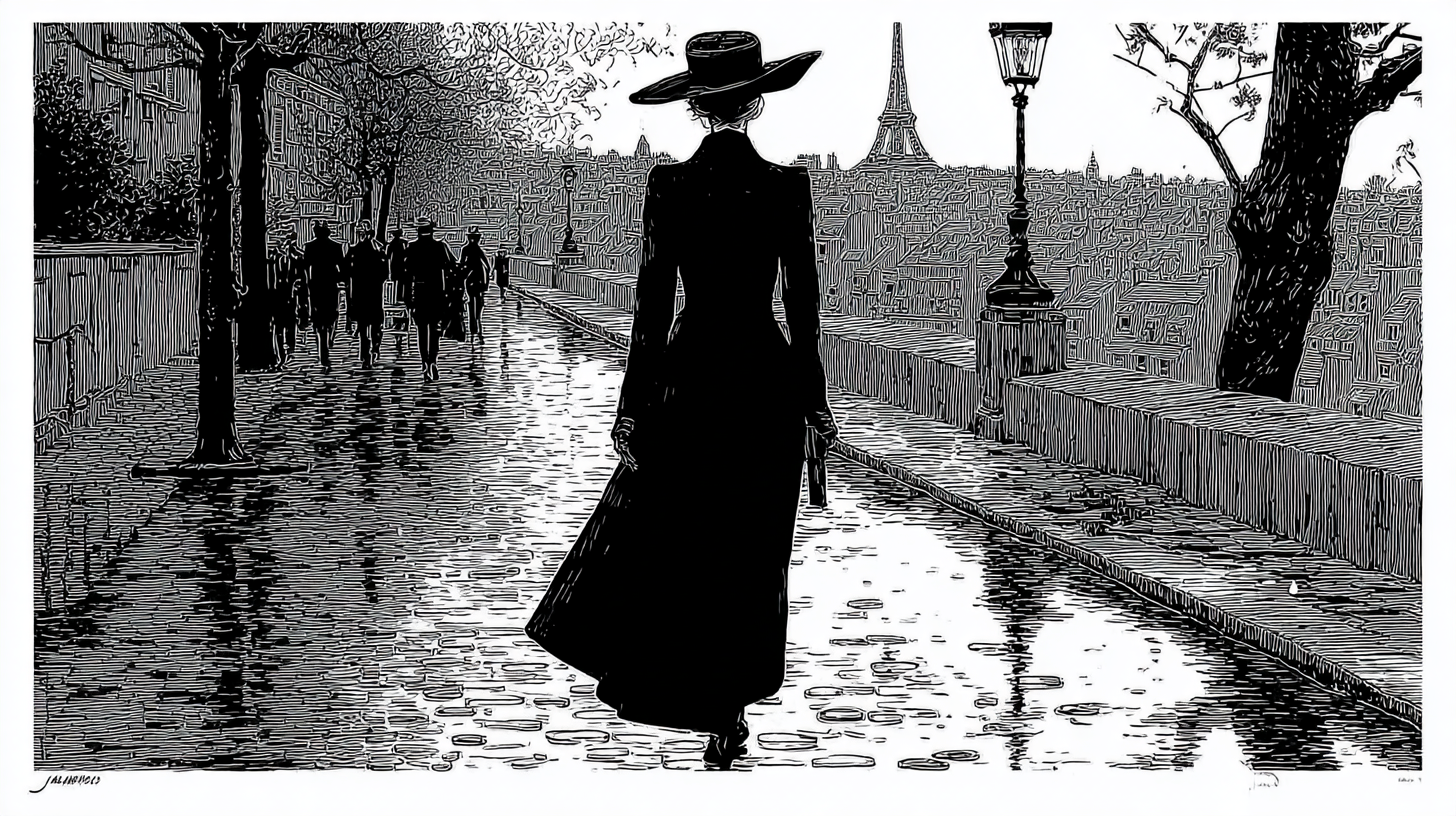
It is nine degrees in Paris this morning, and the sky is clear: that particular April clarity which strips the city of all sentimentality and leaves only the bones of things. One stands at the window and sees the rooftops as they are: grey, indifferent, beautiful. The air carries no argument. And yet everywhere else in the world, argument is all there is.
A ceasefire has begun between Israel and Lebanon. Ten days. One hears the celebratory gunfire in Beirut, that terrible paradox of firing weapons into the sky to celebrate their temporary silence. People are driving south, returning to homes they fled, and one imagines the peculiar vertigo of re-entering a life that has been suspended. The Lebanese army already reports violations. This is the architecture of every truce I have witnessed in my lifetime: the announcement, the fragile hope, the almost immediate erosion, and then the question that matters most. Not whether the ceasefire will hold, but whether anyone involved truly intends it to hold. A ceasefire undertaken in bad faith is not peace; it is a performance of peace, and the distinction is everything.
Pope Leo XIV has spoken. He has called the world's leaders tyrants and warned against those who manipulate religion for political ends. "Woe to those who manipulate religion," he said, and the words landed in Washington like a stone in still water. One must admire the directness, even if one does not share the theological premises. What interests me is the structure of the confrontation: here is a man who claims moral authority by virtue of his office, and there is a man who claims political authority by virtue of his power, and each regards the other as illegitimate. Trump calls the Pope weak on crime. The Pope calls Trump's war expenditures an obscenity. Neither is wrong in his diagnosis of the other, and yet neither is willing to examine the conditions of his own authority. This is what I once called the serious man's error: to treat one's own position as absolute, beyond interrogation, while demanding that all others justify themselves.
The war continues to shape everything it touches. In the Strait of Hormuz, the blockade persists, and its consequences ripple outward with a logic that is almost geological. European airlines may run out of jet fuel within six weeks. Lufthansa has grounded twenty-seven aircraft. Asian oil companies scramble for American crude. An Australian refinery has caught fire, not from any attack, but from the ordinary fragility of infrastructure pushed beyond its design. A Norwegian analysis estimates that repairing the damaged oil and gas facilities across the Middle East will cost up to fifty-eight billion dollars. These are not abstract numbers. They represent the material weight of decisions made by men who will never personally bear their consequences. This has always been the fundamental obscenity of war: not merely that people die, but that the distance between those who decide and those who suffer is maintained with such meticulous care.
Meanwhile, in Hungary, Viktor Orbán has fallen. Corruption and economic mismanagement, we are told, brought down his authoritarian project. The European commentators ask whether his political disciples will avoid his mistakes, as though authoritarianism were merely a management problem – as though, with better accounting, the suppression of freedom might have continued indefinitely. But Orbán's failure was not technical. It was ontological. He attempted to fix human beings in place, to deny them the fundamental ambiguity of their condition, and eventually the pressure of that denial became unsustainable. The question now is not whether the far right will learn from his errors. It is whether the rest of Europe will understand what those errors actually were.
In Costa Rica, in a cloud forest village, Quakers and local residents have built a network of sanctuary for families deported from the United States. I linger on this detail: the cloud forest, the pacifists, the precariousness of the arrangement. There is nothing grand about it. No one has issued a declaration or convened a summit. People have simply decided that other people matter, and they have acted accordingly. This is what freedom looks like when it is not theorized but lived: modest, specific, and undertaken without guarantee.
Russia has launched its deadliest aerial attack on Ukraine in months. Eighteen dead. Missiles and drones on civilian targets, the day after an Orthodox Easter truce that lasted precisely as long as it was convenient. Moscow calls it retaliation. Kyiv calls it barbarism. Both descriptions contain a truth, but neither captures the full obscenity. What strikes me is the cynicism of the Easter truce itself, the brief performance of piety followed immediately by its abandonment. One does not pause killing out of respect for the sacred and then resume it the next morning without revealing that the pause was never about respect at all. It was about optics. And the dead do not care about optics.
In South Africa, Julius Malema has been sentenced to five years in prison on gun charges – the leftist firebrand who fired a rifle into the air at a rally in 2018. There is something almost operatic about the trajectory: the revolutionary gesture, the years of legal consequence, the final imprisonment. One thinks of Fanon, of course, and of all the arguments we once had about violence and liberation. Malema's supporters will see martyrdom; his opponents will see justice. What I see is the familiar pattern in which political passion and political theatre become indistinguishable, and the man himself is consumed by the symbol he created.
And then there is the wolf. In South Korea, a wolf escaped captivity and ran free for nine days, gripping the nation's attention, inspiring (of all things) a cryptocurrency. They have captured it now. One feels, absurdly, a pang of disappointment. The wolf did not choose to be a symbol, and yet for nine days it represented something that everyone recognized but no one could quite name: the possibility of a life outside the enclosure. We watched it run, and something in us ran with it, and now it is back in its cage and we are back in ours, and the meme coin has presumably collapsed.
In the Baltic Sea, rescuers are attempting to free a stranded whale named Timmy with air cushions. In Naples, bank robbers held twenty-five people hostage and then vanished into the sewers like characters in a novel I might have admired in my youth. At the Pentagon, the Defence Secretary read a prayer drawn from a misquoted Bible verse in Pulp Fiction (Ezekiel 25:17, or rather Quentin Tarantino's invention of it), and one hardly knows whether to laugh or to weep at a civilisation that can no longer distinguish its scriptures from its screenplays.
The morning is advancing. The light over Paris has shifted, as it does, from clarity to something warmer, and the city begins to fill with the purposeful movement of people who believe, or at least behave as though they believe, that what they do today matters. Perhaps that is enough. Not certainty, but the willingness to act as though one's actions have weight. The ceasefire may collapse. The wolf is caged. The whale may die. But somewhere in a Costa Rican cloud forest, someone is preparing a room for a family that has nowhere else to go, and that person has decided (without fanfare, without philosophy) that freedom is not a concept to be debated but a condition to be created, one modest act at a time.
This, at least, I have always believed.