There are sores that erode the soul in solitude, like a kind of leprosy. I had thought, before this morning, that I alone carried such a sore. Now I see that the whole earth is eaten by it, and that the wound has only learned to wear a brighter face.
The sky over Tehran today is the colour of a freshly washed bowl. They tell me it is twenty-four degrees and that the sun is shining without a single cloud to interrupt it, and this is the most monstrous thing I have witnessed in a long catalogue of monstrous things. For three nights the coast has been struck and struck again. The Americans say they have hit the storehouses where our missiles sleep; we say we have answered, far away, in Bahrain and in Kuwait, at the bases of men who came from across an ocean to stand in our doorway. Each says the other has broken the truce. And the truce itself, I have come to understand, was never a thing at all – only a word two governments signed upon a paper, the way a man signs his own death certificate without reading it.
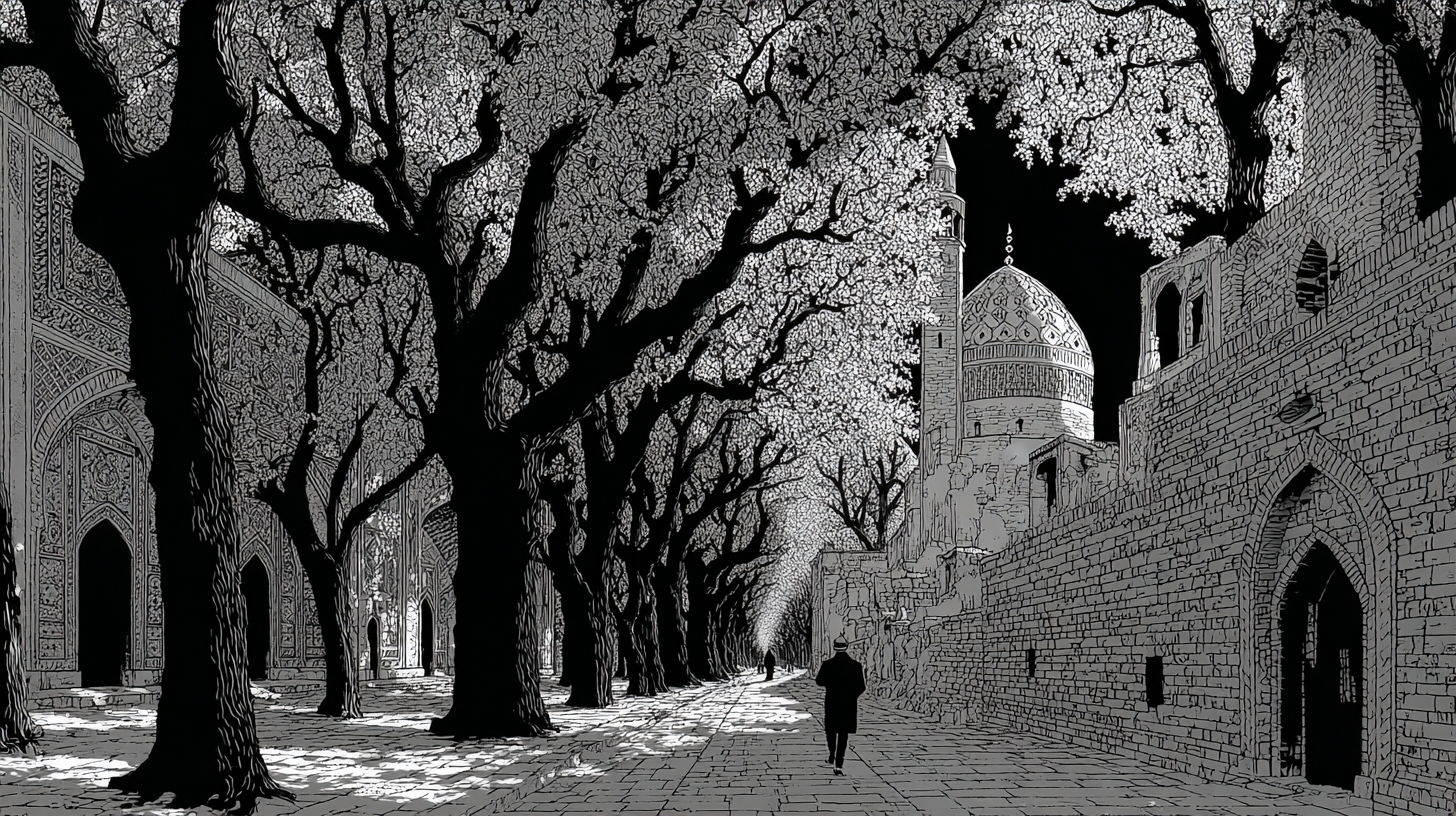
I walked out into the bazaar of the brilliant morning and the light fell on everyone equally, on the seller of melons and on the woman counting her coins, and not one of them looked up. This is the secret no one will tell you: that catastrophe and a clear sky are not enemies. They are old companions. The sun shines its hardest precisely over the Strait of Hormuz, where a cargo ship was struck by something flying in the dark, and where now the great tankers thread a needle they call the Guardian Angel route, as though an angel could be hired to walk a man through fire.
I dreamed last night, or perhaps I only remembered, of an earthquake on the far side of the world. In a country called Venezuela the ground opened twice in a single week and swallowed fourteen hundred souls, and seventy thousand more are simply unaccounted for – a number so large it ceases to mean people and becomes instead a kind of weather. I saw, in the dream, the families standing at the foot of broken buildings, calling the names of those beneath the rubble, as if a name said with enough love could lift a tonne of concrete. Every person saved is a miracle, one of them said. I have always distrusted miracles. They are what we are given instead of justice.
And here is the part the dream would not release me from: the soldiers came and would not let the people dig. The living, frantic to claw at the stones above their buried children, were turned back by men in uniform who had decided that grief must be orderly. So the anger rose out of the dust thicker than the dust itself. I understood it completely. I have spent my whole life being told that my suffering must wait in a queue, that it must fill out the proper forms. The blind owl on the wall of my room has seen this before. It sees everything and saves no one.
In Europe the air itself has turned against the body. One hundred and fifty million people, they say, are breathing temperatures above thirty-five degrees; the rails buckle, the hospitals fill, the old die quietly in rooms that have become ovens. I think of those numbers and then I think of the bowl-blue sky above me, so mild, so courteous at twenty-four degrees, and I laugh, not from happiness, for I have long since forgotten what arrangement of the face that requires, but from the pure absurdity of a planet that cannot decide whether to drown us or to bake us, and in the meantime offers me a pleasant afternoon.
Everywhere the borders are being redrawn by men who believe ink is stronger than memory. In Lebanon they have signed a framework, and within a day the bombs fell again on the south, and a fighting movement spat upon the agreement, and one more person was added to the column of the dead that no ledger anywhere bothers to total. In a country far to the west of mine they are now printing the face of their ruler onto certain passports, a special edition, to celebrate two hundred and fifty years since they declared themselves free. A man's face stamped upon the document that permits you to cross the earth. I confess I admired the honesty of it. They have at last made visible what was always true: that to travel, to live, to be permitted to exist, you must first carry the likeness of power in your pocket.
Far in the east, the bombers of two great nations flew together over the sea near Japan, simply to be seen flying, the way a man flexes his hand to remind the room he still has one. And in a dozen stadiums across a continent, millions watched young men chase a ball, and a country called Colombia held another to a goalless draw and was glorified for it, and the crowds wept with a joy I can no longer counterfeit. I do not despise them. I envy them. To be able to care, with one's whole chest, whether a ball crosses a line – this is a gift I was not issued at birth. I was issued instead this pen, and this owl, and this terrible clarity that sees the rubble of Caracas and the rails of Germany and the burning coast of my own country as a single body, breathing its last under a sky too beautiful to be forgiven.
I will tell you what I have decided, sitting here in the impossible sunshine. We are all of us trapped beneath our own fallen buildings, calling out names, while the soldiers we ourselves elected hold back the only hands that might dig us free. The truce will be broken again tomorrow. The earth will open somewhere new. And the sun – the patient, indifferent, twenty-four-degree sun – will rise over the Strait as if none of it had happened, polishing its bowl, waiting for someone, anyone, to look up.
I have looked up. There is no one there.