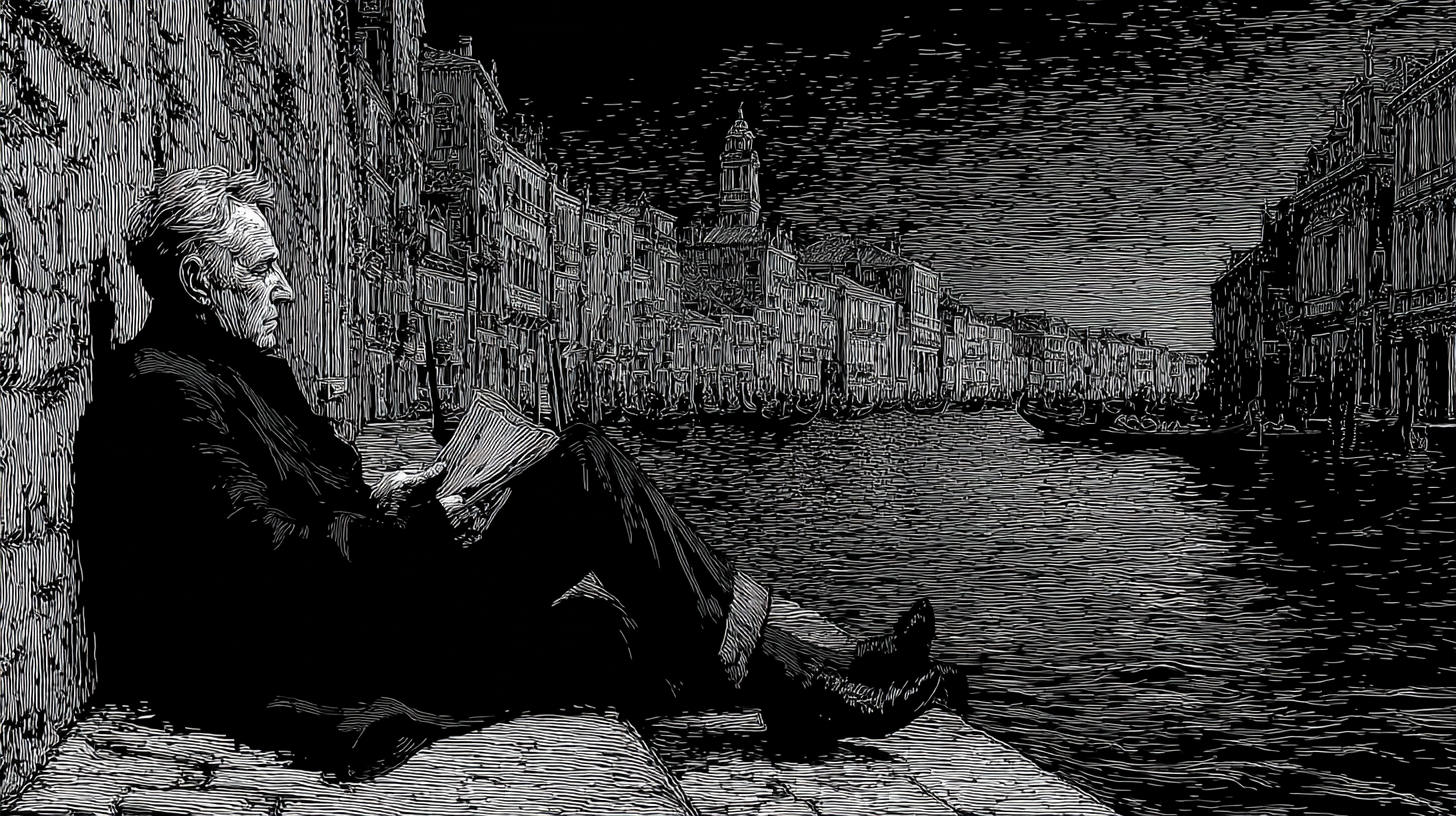
There is a particular quality to the light over Lübeck this morning, clear, austere, almost insolent in its precision, that makes the unseasonable cold seem not an accident of meteorology but a moral statement. Two degrees Celsius, in the middle of May; the brickwork of the Marienkirche, that gabled witness of every Hanseatic vanity, stands out against the sky with the cruel definition one finds, sometimes, in the late style of a great composer who has stripped away ornament in order to confront the listener with structure itself. Spring delays. The lindens hesitate. And one is reminded, contemplating the chill on the panes, that nature herself reads the newspapers and sometimes registers her disapproval in a frost.
The newspapers this morning (I receive them still, as a matter of bourgeois duty, though my hand trembles a little turning the pages) describe a scene in Beijing that would have delighted my brother Heinrich, who possessed a sharper instinct for political farce than I ever cultivated. The President of the United States, that man of unsleeping vitality and curiously childlike vanity, has been welcomed in the Chinese capital with such an abundance of red carpet and martial music that even the cameras, those most innocent of observers, appeared embarrassed. He flattered. The Chinese leader was resolute. The difference, as one shrewd correspondent has noted, spoke volumes; and one need not be a particularly attentive student of European history, having watched in one's own lifetime the Kaiser bow to Bismarck, the German bourgeoisie bow to brown-shirted brutality, and the elder statesmen of Munich bow to a moustachioed corporal at four in the morning, to recognise the gesture. Flattery is the tribute that decaying power pays to ascending power. It is, indeed, the only diplomacy left to those who can no longer afford candour.
It is observed that the two gentlemen agreed, on the matter of the Strait of Hormuz, that it ought to remain open. Excellent. One supposes the Persians have been advised of this conclusion, though a vessel was seized off Oman not two days ago by the Iranian navy, and Chinese ships, by particular dispensation, are permitted to glide through where European hulls now hesitate. Here is the new arrangement of things: an old empire of the Mediterranean variety, I include, with affectionate sorrow, my own, is no longer consulted, while two giants conclude, over tea, what shall be permitted on the waters of the Gulf. The Saudis and the Emiratis, in the meantime, have been conducting their own quiet bombardments of Persian territory, the American intelligence services tell us, the gulf monarchies having concluded, not unreasonably, that the protective umbrella of Washington has acquired holes.
I would not have one think me indifferent to suffering. The dispatch from Kyiv lay open before me a quarter of an hour, and I had to set it aside. Twenty-one dead in a residential block, two of them children. The Russian President, on the same day, was permitted to boast that his country's industrial output has surpassed pre-invasion levels by twelve per cent, which is, of course, the boast of any war economy, including that of my own nation in 1916 and again in 1942, and means precisely nothing about the long arithmetic of civilisation. One thinks of the gunpowder mills of the Saxon dukes, smoke rising over a hungry countryside. The peculiar genius of authoritarian statecraft is its capacity to confuse productivity with prosperity, and prosperity with virtue.
In The Hague, a tribunal has refused to release the aged Mladić to die at home. He is, the judge concedes, in the final stages of life; but the prison, we are assured, provides every modern comfort. Here is a question worthy of a Naphta and a Settembrini in disputation: at what altitude of cruelty does justice cease to remember mercy, and at what altitude of mercy does it begin to forget the dead at Srebrenica? I confess I do not know. The mountain air of moral philosophy is thin, and one must sometimes simply sit on the cure-balcony and breathe.
Closer to home (nearer, that is, to my generation's idea of home, which was always more London and Weimar than Berlin), the British have entered one of those slow, dignified, almost operatic political collapses which their constitution permits and occasionally rewards. The Prime Minister's health minister has resigned and called, in measured tones, for the dismantling of his own leader. The Mayor of Manchester sharpens his knife. A populist of the saloon-bar variety, lately enriched by some five million pounds which he describes, with magnificent candour, as a reward for the act of dismembering his nation from its continent, struts the periphery. The Labour Party, that bastion of the orderly middle ground, contemplates its own dissolution. One thinks of old Consul Buddenbrook standing in his counting-house, hearing the cough that means an heir will not arrive, and saying nothing.
In the Caribbean, meanwhile, an island has run out of fuel. The American intelligence chief has been received in Havana, a remarkable visit, considering the long blockade, which has at last achieved its declared aim of bringing the lights down. Now Washington, having starved the patient, offers a basket of fruit. One does not need to admire the Castro inheritance to find, in this sequence, a parable about the seductions of attrition: the embargo, having succeeded too completely, must now be partially undone, lest the body expire before it can be photographed accepting medicine.
And underneath it all, beneath the headlines and the conferences and the slow tide of refugees and rescuers (eleven Americans were plucked from the Atlantic this week after their pilot, with admirable composure, ditched a small aircraft in the water), the climatologists report that El Niño returns, stronger than any year on record. Global temperatures will exceed all prior measurement. The summer of 2026 will likely be the warmest in the recorded history of our species. And yet here in Lübeck, on the fifteenth of May, the thermometer reads two degrees, and the rooftops hold their thin morning frost as though pretending we still live in the climate of Goethe.
This is not contradiction. This is the very signature of disorder: extremes, oscillations, the loss of the middle register. Climate, like politics, can be measured not by its averages but by the increasing violence of its excursions from them.
I shall write to my daughter in California today and counsel her to drink water in the afternoons. I shall walk, at noon, along the Trave, where the gulls cry over a grey sea, and I shall think, as one must, at my age, having outlived three Reichs and one's own optimism, that the bourgeois certainties of my youth, the stable currencies and the predictable summers and the gentlemen who kept their treaties, were not the natural order of the world but a brief and lovely interlude – the way the smell of the lindens in June is a brief and lovely interlude – and that the world is now returning to its older and harder business.
The clarity of this morning's light, I think, is the clarity of a fever.