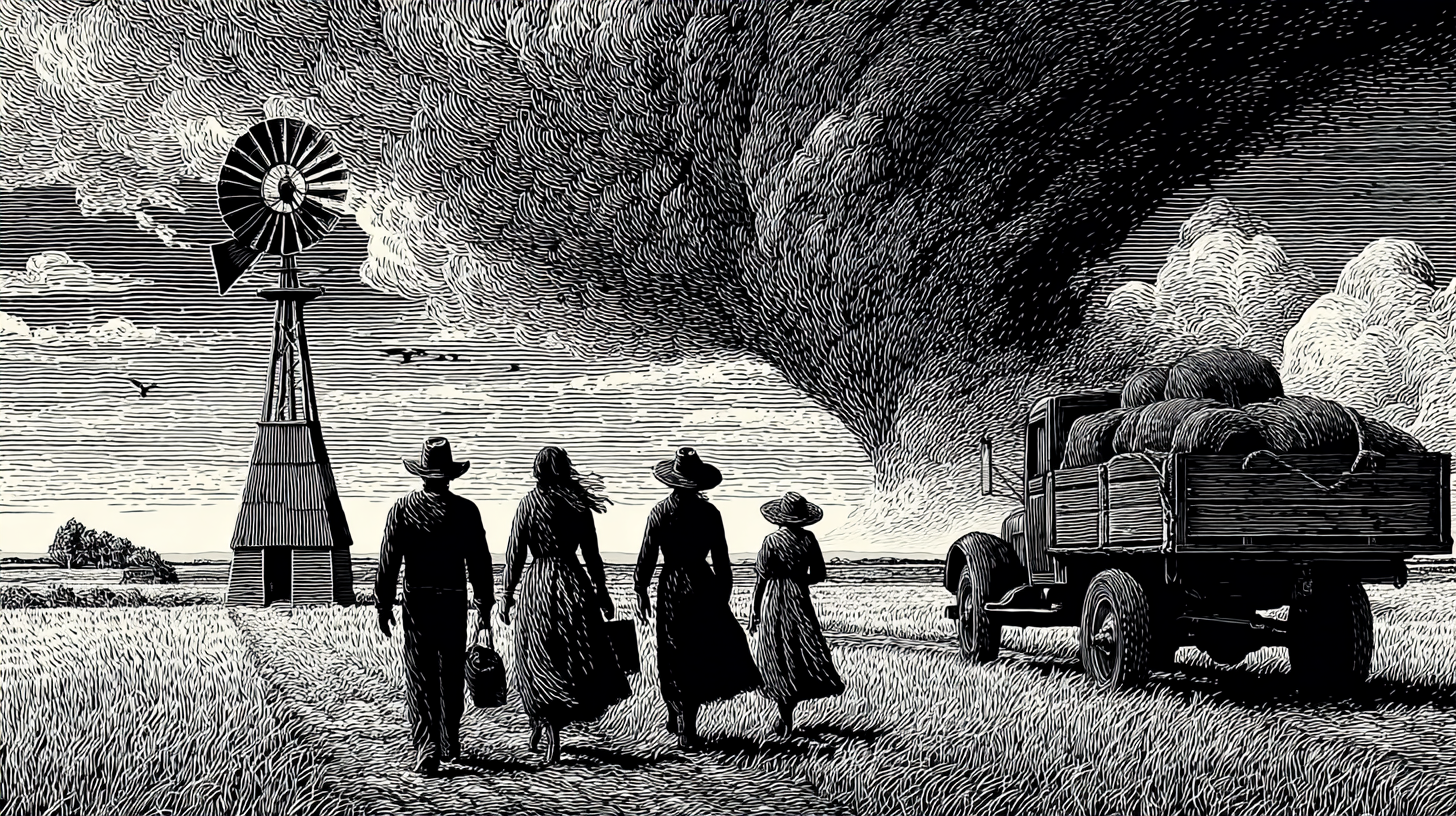
The sky over Salinas this morning is the color of pewter, and the thermometer stands at fourteen degrees on the new scale, fourteen Celsius, which the old farmers would have called the cool side of comfortable. The light is gray and without shadow. The lettuce fields are wet with last night's mist. The men who work the rows are bent over as men have always been bent over in the fields of the Salinas Valley, and when one of them straightens his back, he looks east toward the mountains, and he does not know that what he is looking toward is also the direction in which a great deal of the world's trouble is presently moving.
The President of the United States has crossed the Pacific to sit down with the President of China. A reporter would call it a summit. A farmer would call it two men talking across a fence, except the fence runs around half the world, and what stands on either side of it is not corn or barley but warships and grain barges and the lives of people the two men have never seen and will never see. They will speak of Taiwan and of the Strait of Hormuz, where oil moves in dark ships under a hard sun, and they will speak of money. Above all they will speak of money, for it is the language men learn first when they cease to speak the older languages of decency.
I do not say they are evil men. I have lived long enough to know that evil is not so easily fixed. A man may sit in a great chamber and order a thing done, and the thing is done a long way off, and the doing of it falls upon people who have no chambers and no orders to give. This is the old arithmetic of power, and it has not been improved by the addition of computers.
The number this week is thirty-two million, three hundred thousand. That is the count of those driven from their homes by violence or war in the year past, and it is a record, the first time such displacements have outrun those caused by storm and flood and earthquake. Thirty-two million. I have driven through California with less in it than that. I have seen the camps along the old highways, the rough boards and the tarpaulin tents, and I tell you that the figure does not stay a figure long when you put eyes on it. Each one is a woman carrying a pot. Each one is a child who has learned not to ask questions. Each one is a man whose hands remember a trade he can no longer practice, because the road is too long and the country at the end of the road has no use for him.
In Lebanon yesterday, two paramedics were killed in a strike along with eleven others. They had gone out, the report says, in answer to an earlier attack. This is what happens. The ambulance goes where the wound is, and a second wound is made upon the ambulance. I think there is no honest word for this in any language I know, but I have heard old men in the Salinas bars use a phrase, and the phrase will do: it is no way to run a world.
In Ukraine, Russian rockets have been falling on factories that belong to American companies. Coca-Cola. Cargill. Mondelez. The names sound like a roster of harmless suburban things, and yet a roof is a roof and a worker under it is a worker, and a rocket does not care whose flag flies on the gate. The administration in Washington has been quiet about this. I have noticed that men are loudest about the small thefts that do not concern them and quietest about the great thefts in which they are themselves implicated. It is an old habit, and it will not be cured by an election.
In Buenos Aires the students have come out into the streets again. President Milei has cut the money from the public universities, and the students walk with signs, and the autumn wind comes cold off the river. I have seen students walk in Salinas and in Berkeley and in Mexico City. They always walk for the same thing, which is the right to read books and to argue about what is in them. A government that fears this is a government already losing, though it may not yet know it.
In Japan, of all places, the war in Iran has reached down into the candy bag. The Calbee company, which makes the little salt snacks the children carry in their satchels, has been forced to print its packaging in black and white. The inks need naphtha, and the naphtha comes from crude oil, and the oil is being held up in the strait. The cheerful colors are gone from the shelves. I find this small thing harder to bear than the large things. I do not know why. Perhaps because a child looking at a snack bag does not yet know there is a war, and the gray bag is the first letter of the long word that will be spelled out for him in the years to come.
Two basketball men died this week. Jason Collins at forty-seven, who had been the first openly homosexual man to play in his league, and Brandon Clarke at twenty-nine, of the Memphis Grizzlies. I never followed basketball with any close attention, but the deaths of men so young settle on a person the way the morning fog settles on the valley. A brain tumor took the older one. The younger one's cause was not yet given. I think of the families this morning. I think of the women in the kitchens, making coffee, and the children who have not yet been told. The world does not stop for them, and yet for them the world has stopped, and that is a contradiction of a kind that cannot be resolved, only borne.
It is fourteen degrees in Salinas, and the overcast is so even and so low that you cannot tell where the sun stands. This is the weather in which a man does his thinking. He cannot squint at anything and call it bright. He must take the world as it is given, gray and waiting, and he must make of it what he can.
The President's plane will land in Beijing this afternoon. The students will gather again in Buenos Aires. The paramedics in Nabatieh will be buried by their friends. The thirty-two million will sleep tonight wherever sleep is permitted them. The lettuce in the Salinas Valley will be cut and boxed and put on trucks, and the trucks will go east toward the supermarkets of America, and the men who cut the lettuce will go home to small rooms and eat their suppers in silence or in argument, as men do.
It is no way to run a world, perhaps. But it is the world we have, and we are obliged to live in it without pretending we live somewhere else. The gray sky holds. The Pacific to the west, the long valley to the east, and over it all this even, patient light, which is neither hopeful nor hopeless. It is only what we have to see by.